
Blog
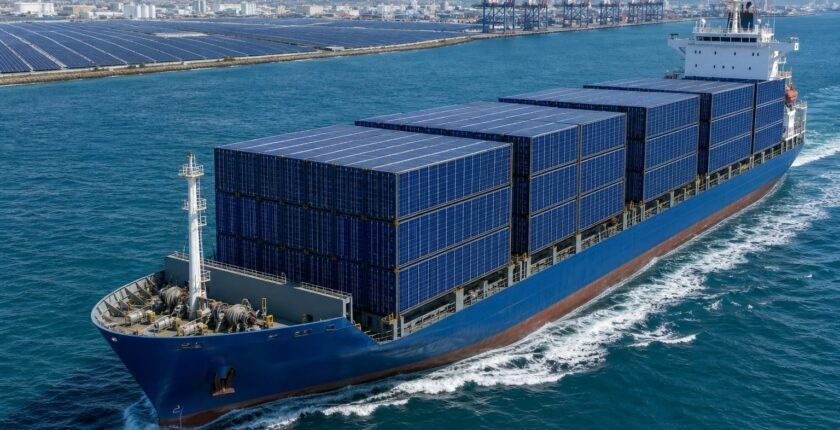
Inside China’s 20,000‑Mile Solar Trade Route
Estimated reading time: 5 minutes · Last updated: 2026-08-17
Bloomberg analysis maps a 20,000-mile trade route that routed Chinese wafers through newly built cell factories in Kenya and Nigeria, then on to assemblers on Batam island, to deliver panels to the US market while avoiding tariffs. The mechanism rests on the United States “substantial transformation” test, which treats solar cells — not final assembly — as the determinant of origin, and on the fact that solar cells make up roughly 50%-60% of a panel’s cost. Bloomberg found the route supported trade flows above $100 million per month before Washington moved to impose minimum import prices and a 15% tariff beginning Dec. 4.
"These differences between export and import statistics cannot serve as a basis for concluding that there has been any misrepresentation of the country of origin of the goods or any attempt to circumvent tariffs,"
Johni Martha, director general of international trade negotiation at Indonesia’s Ministry of Trade
Key takeaways
- Route and scale: Bloomberg traced a 20,000-mile supply chain that funneled Chinese wafers via Kenyan and Nigerian cell factories to Indonesian assemblers, supporting more than $100 million a month in US-bound trade by June.
- Customs rule at its core: Under the United States "substantial transformation" standard, US customs treats solar cells as the origin-defining component, a key legal lever used by the route.
- Cost composition: Bloomberg’s analysis notes that solar cells make up about 50%-60% of a panel’s manufacturing cost; because these components are compact yet high in value, they are practical to transport long distances.
- Policy response: The United States announced minimum import prices above market levels and a 15% tariff on polysilicon derivatives, including wafers, cells and modules, scheduled to begin Dec. 4.
Table of contents
How the route used cells to shift origin
Bloomberg’s trade analysis shows companies moved wafers from Chinese producers to new cell factories in Kenya and Nigeria, then shipped cells to Indonesian assemblers on Batam, which exported finished panels to the United States. The legal hinge was the United States "substantial transformation" test: past US customs rulings have treated the cell as the component that gives the finished panel its essential character, so panels assembled overseas with imported cells can be declared as originating where the cell was made. Solar cells make up roughly 50%-60% of a panel's cost, which makes them the high-value element in origin determinations and also cheap to ship because of low weight. That price-to-weight ratio is why firms could move the value-defining step thousands of miles and still keep logistics costs modest.
Where Bloomberg found new capacity and the footprint it left
Satellite imagery and customs records identified factories near Nairobi and Mombasa in Kenya; construction appears to have been largely finished in the period from mid 2025 to early 2026, Bloomberg reports. The analysis identifies a matching pattern in Nigeria, where a newly emerged cell supplier moved nearly $100 million of cells to Indonesian buyers in the first half of 2026. Indonesian export flows to the United States recovered after an initial dip, implying that some panels arriving in the US were declared as originating in Kenya or Nigeria rather than Indonesia or China. Bloomberg linked Chinese equipment suppliers, African cell makers and Batam assemblers through shipment manifests, corporate filings and trade statistics to build this three-continent chain, as first reported by Yahoo Finance.
Why Washington changed rules and what the measures do
US officials framed the new measures — minimum import prices above market levels plus a 15% tariff on polysilicon and its derivatives — as a response to repeated circumvention of country-specific tariffs. Bloomberg says the US move aims to stop a Whack-a-Mole pattern in which production shifts to a new country, regulators respond, and firms move again. The announced controls give firms only a few months to ship ahead of the Dec. 4 start date, and regulators warned they will scrutinize large pre‑shipment buying intended to build inventories. There are carve-outs for companies that pledge to begin construction of new US factories by the end of the current presidential term; those exceptions are conditional and must be documented with customs.
What firms and markets may do next
Bloomberg quotes Ember analyst Muyi Yang to argue that Chinese manufacturers have non‑tariff incentives to build capacity overseas: domestic overcapacity and near‑zero margins at home push firms to seek higher returns abroad and to establish long‑term market presence. Yang points out that as US price thresholds rise, some modules originally destined for the US may be redirected to markets in the Middle East, Latin America and the Asia‑Pacific. Bloomberg’s data suggests Indonesian assemblers already served as export platforms; moving those volumes elsewhere would reshape regional demand patterns and complicate enforcement. The US controls will raise the cost and legal risk of the Africa‑Indonesia route, but they do not eliminate incentives for Chinese firms to invest overseas for new markets rather than solely to avoid tariffs.
| Actor | Location | Role | Evidence | Timing |
|---|---|---|---|---|
| Chinese wafer producers | China | Supply wafers to cell plants | Trade links and equipment suppliers named in filings | Active through 2025–2026 |
| Kenyan cell factories | Kenya (near Nairobi and Mombasa) | Convert wafers into cells | Satellite imagery; customs imports/exports | Built largely between mid-2025 and early 2026 |
| Nigerian cell supplier | Nigeria | Export cells to Indonesian assemblers | Trade records showing nearly $100 million of cell shipments | First half of 2026 |
| Indonesian assemblers | Batam, Indonesia | Assemble panels and export to US | US import statistics and Indonesian export data | Recovery seen by June 2026 |
Two ways this can play out
The case for
- US customs implements the minimum price and tariff regime strictly and closes origin loopholes, sharply reducing Africa-to-Batam shipments declared as non‑Chinese.
- Companies that accept US factory‑building carve-outs convert short‑term routing into genuine US investment, bringing some module manufacturing onshore.
The case against
- Firms find new origin workarounds in other jurisdictions or reclassify trade flows, preserving substantial export volumes to the US despite higher prices.
- Chinese manufacturers continue to expand overseas capacity for real market access, which sustains global oversupply and keeps pressure on margins, moving volumes to third markets such as Latin America.
What to be careful about
- Enforcement risk: the United States may struggle to trace and prove origin for cell shipments routed across multiple jurisdictions.
- Policy arms race: other countries may respond with their own measures or incentives, accelerating relocation without resolving overcapacity in China.
- Market risk: redirected module volumes could depress prices in Latin America, Middle East and Asia‑Pacific, worsening profitability for local manufacturers.
The bottom line
Bloomberg’s reconstruction of the 20,000‑mile route shows how commercial incentives, a customs test focused on the cell, and rapid factory builds in Kenya and Nigeria combined to route value into the United States without triggering earlier country‑specific tariffs. The United States’ Dec. 4 policy change raises the legal and cost stakes for that routing, but it does not erase the commercial drivers pushing capacity overseas. Enforcement, company filings for carve‑outs and demand patterns in alternative markets will determine whether the route is a temporary workaround or a longer‑term reshaping of the global solar supply chain.
What to watch
- Watch for the Dec. 4 start of the United States’ minimum import-price regime and 15% tariff on polysilicon derivatives, the date the rules take effect was announced by US officials.
- Monitor which companies file for the construction-based exception by pledging to start US factory construction by the end of the current presidential term; no deadline for filings is specified in the reporting.
Frequently asked questions
Why do cells determine the origin of a solar panel under US rules?
US customs has in past rulings applied the "substantial transformation" standard to solar panels, treating the cell as the component that gives the finished module its essential character; that is why where the cell is made often decides origin for tariffs and duties.
How big was the route Bloomberg identified in dollar terms?
Bloomberg’s analysis shows US imports declared as originating in African suppliers approached more than $100 million per month by June before the latest US controls were announced.
When do the new US import price and tariff measures take effect?
US officials set the start of the minimum import-price controls and the accompanying 15% tariff on polysilicon derivatives to begin Dec. 4.