
Blog
GE Vernova to supply Supernode’s 780 MW battery storage
Estimated reading time: 5 minutes · Last updated:
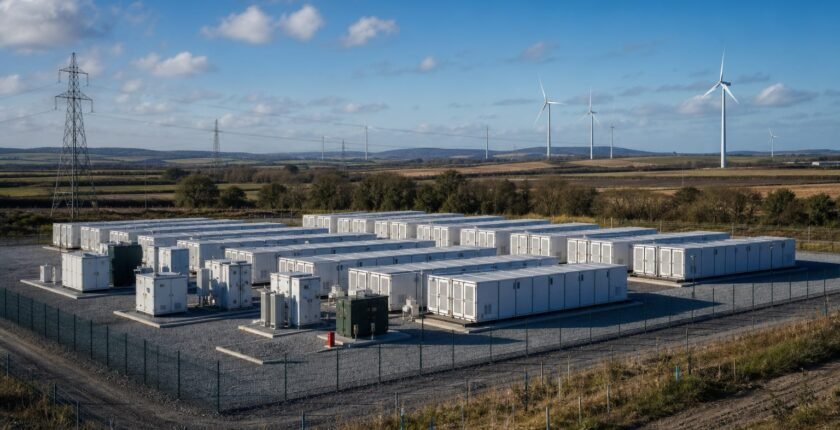
GE Vernova will provide the power conversion systems, plant controls, system integration and grid-connection support across all three development stages of the Supernode battery project in Queensland, which will total 780 MW and 3,075 MWh on a single site. Stage 3 adds 260 MW and 1,216 MWh of four-hour storage and has achieved Generator Performance Standards (GPS) acceptance, while stages 1 and 2 are already fully operational. Quinbrook is the developer and has kept GE Vernova as the sole technology provider for the entire site. This package of technical scope and a single technology stack for a multi-stage project was reported as first reported by Energies Media.
Supernode shows what is possible when storage, power conversion and intelligent controls work together at scale.
Ed Torres, Business Leader Power Conversion & Storage at GE Vernova’s Electrification segment
Key takeaways
- Technology scope: GE Vernova is the sole provider of power conversion, plant controls, system integration and grid-connection support across all three Supernode stages.
- Stage 3 addition: Stage 3 adds 260 MW and 1,216 MWh of four-hour storage and has secured GPS acceptance for grid connection.
- Total capacity: Once Stage 3 is complete the site will deliver 780 MW and 3,075 MWh of battery storage at a single location.
- Grid-forming first: Stage 3 is GE Vernova’s first grid-forming battery energy storage project in Australia.
- Expansion potential: Quinbrook says the Supernode site has capacity for a further 520 MW of expansion.
Table of contents
- Key takeaways
- Why Quinbrook kept one technology partner for the whole site
- What Stage 3 delivers and why GPS acceptance matters
- How Supernode fits Queensland’s transition to higher renewable penetration
- Capacity, expansion and the operational picture after Stage 3
- Cases for and against the single-provider approach
- What to be careful about
- Frequently asked questions
Why Quinbrook kept one technology partner for the whole site
Quinbrook chose to keep a single, integrated technology supplier across all stages to avoid the compatibility and integration risks that can come from mixing vendors across a multi-stage build. When different vendors supply power conversion and controls, site operators often face additional work to reconcile control philosophies, communications protocols and protection settings so the plant can behave as one resource.
That logic is practical rather than rhetorical: Supernode sits at a strategically important transmission node in Queensland and the site’s value depends on predictable, coordinated behaviour across every unit. A unified power-conversion and control stack reduces the chance of unexpected interactions during high-stress events, simplifies commissioning and gives a single technical interface for developers and the network operator.
What Stage 3 delivers and why GPS acceptance matters
Stage 3 contributes 260 MW and 1,216 MWh of four-hour storage to the site and has won Generator Performance Standards acceptance ahead of construction completion. GPS acceptance defines the technical performance the project must meet to connect to Australia’s National Electricity Market, which makes it a meaningful regulatory milestone for a grid-scale battery.
Stage 3 also introduces grid-forming capability at this site, meaning the battery control system can actively regulate frequency and support system strength rather than only following grid signals. Grid-forming operation changes how a storage plant participates in system security and requires coordinated plant controls and careful integration with the wider network; securing GPS acceptance before handover reduces execution risk later in commissioning and operation.
How Supernode fits Queensland’s transition to higher renewable penetration
Supernode’s operational role is to store electricity when renewable output is high and to release it when demand rises or output falls. That buffering function helps integrate more variable generation onto the grid while supporting reliability. At 780 MW and 3,075 MWh once Stage 3 is complete, Supernode is sized to provide bulk energy shifting as well as system services such as frequency and ramping support.
The addition of grid-forming capability matters for a grid losing conventional thermal plant. Batteries that can present controlled voltage and frequency support reduce reliance on traditional synchronous machines for those services. That does not mean batteries replace thermal plants entirely, but it does mean large-scale storage projects can play a significantly broader role in system stability than earlier, purely energy-shifting installations.
Capacity, expansion and the operational picture after Stage 3
Stages 1 and 2 are already operational on GE Vernova technology; Stage 3 brings the site to a combined 780 MW and 3,075 MWh at one location. Quinbrook has also identified room for a further 520 MW of expansion at the site, keeping future options open for additional battery capacity or alternative uses such as data centres.
Keeping the same technology provider through build and potential expansion streamlines future add-ons: a consistent conversion and control architecture eases integration work and can shorten future commissioning windows. The trade-off is greater concentration of technical dependence on a single vendor for maintenance, spares and future upgrades, which remains a procurement and operational consideration for the owner.
| Stage | Capacity (MW) | Energy (MWh) | Status | Technology provider |
|---|---|---|---|---|
| Stages 1–2 (combined) | ≈ 520 MW | ≈ 1,859 MWh | Fully operational | GE Vernova |
| Stage 3 | 260 MW | 1,216 MWh | GPS accepted / under development | GE Vernova |
| Full site (post-Stage 3) | 780 MW | 3,075 MWh | Operational once Stage 3 completes | GE Vernova |
Cases for and against the single-provider approach
The case for
- A single vendor across all stages reduces compatibility risk and simplifies commissioning, which is especially valuable at a strategically connected transmission node.
- GPS acceptance for Stage 3 before construction completes lowers the regulatory risk of the grid-connection phase and signals the project meets agreed performance standards.
- Grid-forming capability allows the site to supply frequency and system-strength services in addition to bulk energy, increasing its utility as thermal plants retire.
The case against
- Concentrating power-conversion and control on one supplier creates vendor dependence for spare parts, software updates and long-term maintenance.
- Grid-forming operation raises integration complexity and may require detailed operational procedures and testing with the network operator to manage dynamic interactions.
- Further expansion of up to 520 MW will still require planning, connection and possible additional regulatory approvals before capacity can be realised.
What to be careful about
- Operational dependence on a single technology supplier for conversion and controls increases exposure if that supplier’s equipment or software needs major updates or experiences faults.
- Grid-forming systems introduce more complex dynamic control interactions with the surrounding network, which can require extended testing and coordination during commissioning.
- The quoted 520 MW expansion potential is a site capability statement; realising it will require separate commercial decisions, permits and any required network approvals.
The bottom line
The Supernode project now has a single technology stack across all stages, with Stage 3 adding 260 MW and 1,216 MWh and securing GPS acceptance ahead of completion. That approach reduces integration work and helps deliver grid-forming capability at scale, which can supply frequency and system-strength services as well as energy shifting. The site’s total 780 MW and 3,075 MWh capacity and stated 520 MW of expansion potential make Supernode a substantial piece of Queensland’s storage capacity. The trade-offs are concentration of vendor dependence and the extra testing and operational coordination grid-forming systems require.
What to watch
- Watch for Quinbrook or GE Vernova to publish a Stage 3 construction completion and commissioning date; no date has been set.
- Watch for a formal commissioning and declared commercial operation date for the full 780 MW site; no date has been set.
- Watch for any announcements converting the site’s 520 MW expansion potential into a concrete project plan; no date has been set.
Frequently asked questions
What capacity will Supernode have when Stage 3 is complete?
Once Stage 3 is complete the site will total 780 MW of power and 3,075 MWh of energy storage on a single site.
How much did Stage 3 add to the project and what is new technically?
Stage 3 adds 260 MW and 1,216 MWh of four-hour storage, has secured GPS acceptance for grid connection, and is GE Vernova’s first grid-forming BESS project in Australia.
Who supplies the technology and what are they providing?
GE Vernova is the technology provider across all three stages, supplying power conversion systems, plant controls, system integration and grid-connection support.
Related reading