
Blog
Lexington solar zoning balances farms and energy
Estimated reading time: 5 minutes · Last updated: 2026-08-15
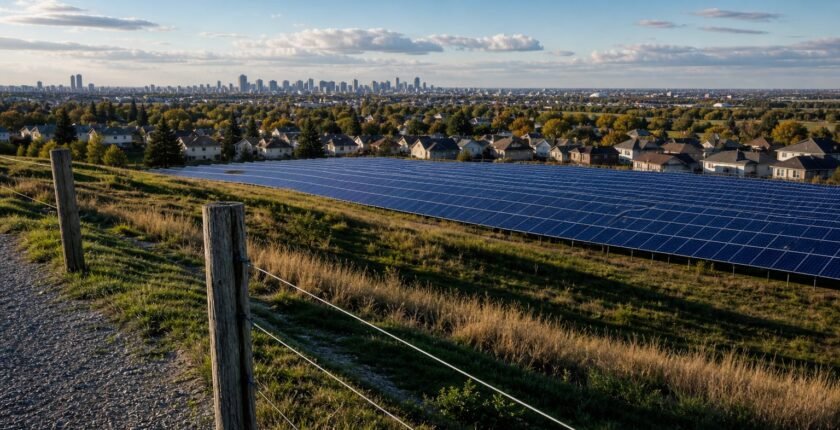
Henry Jackson, a retired LFUCG strategic planning manager and member of the Bluegrass Climate Action Team, urges the Lexington‑Fayette Urban County Government to adopt a draft eight‑page ordinance that would permit up to 1% of county land to host larger ground‑mounted solar systems. Jackson says the draft requires agrivoltaics, expert‑approved land and soil conservation plans and conditional use permits with public hearings to guide siting, construction and decommissioning. The proposal, Jackson argues, is intended to expand local control over utility‑scale sites that he says are otherwise exempt when subject only to the State Public Service Commission and to help the city meet its carbon‑neutral by 2050 goal.
Key takeaways
- Scale limit: Henry Jackson supports a draft LFUCG ordinance that would allow up to 1% of county land for larger ground‑mounted solar systems.
- Ordinance length and rules: Jackson describes the measure as an eight‑page ordinance requiring agrivoltaics, expert‑approved land/soil conservation plans and decommissioning controls.
- Permitting process: The draft would require conditional use permits and public hearings for intermediate and large arrays, Jackson says.
- Local control vs. state oversight: Jackson argues the zoning would return local control over sites that publicly‑owned utilities otherwise leave to the State Public Service Commission.
Table of contents
- Key takeaways
- What the draft ordinance would allow and require
- Agrivoltaics, soil plans and decommissioning in the draft
- Local zoning authority versus State Public Service Commission oversight
- Trade‑offs: farmland preservation, climate goals and community control
- Momentum and obstacles to adoption
- What to be careful about
- Frequently asked questions
What the draft ordinance would allow and require
Henry Jackson frames the LFUCG draft as a targeted change: the ordinance would permit larger ground‑mounted solar on no more than up to 1% of county land and impose strict development controls. Jackson describes the package as an eight‑page ordinance that sets out panel locations, lot coverage limits, height caps, conditional use requirements and a decommissioning framework intended to return sites to suitable agricultural use.
Jackson says the draft also builds in a public process: intermediate and large arrays would need a conditional use permit and a public hearing where the developer must demonstrate compliance with the ordinance. As first reported by the Lexington Herald Leader, the Council Committee considered the solar ordinance on March 10, and Jackson urges the full LFUCG to adopt the committee version as a first step toward the city’s carbon goal.
Agrivoltaics, soil plans and decommissioning in the draft
A central element Jackson highlights is the ordinance’s requirement for agrivoltaics and an expert‑approved land/soil conservation plan. Jackson says the code would obligate developers of larger systems to integrate agricultural use—examples in his column include managed sheep grazing—and to follow a scheduled implementation of soil conservation measures.
Jackson attributes agronomic benefits to the approach, arguing it can improve soil quality after a few years of grazing while providing a dependable supplemental farm income. He also stresses the ordinance’s decommissioning language: bond or financial assurance requirements would force developers to restore sites at end of life, though Jackson’s opinion does not include the ordinance’s full financial assurance formulas or thresholds.
Local zoning authority versus State Public Service Commission oversight
Jackson draws a legal and practical contrast between locally governed parcels and publicly‑owned utility sites. He argues that the proposed zoning would give LFUCG significantly greater local control over siting and decommissioning than currently applies to publicly‑owned utilities, which Jackson says are regulated under the State Public Service Commission and thus exempt from local land use rules.
That distinction is the core policy tension: if a site is owned or directly controlled by a public utility, Jackson contends local zoning cannot impose the same conditions. The draft attempts to bridge that gap for privately developed larger systems by attaching permitting, agrivoltaics and decommissioning obligations at the local level.
Trade‑offs: farmland preservation, climate goals and community control
Jackson frames the 1% cap as a cautious compromise between preserving Fayette County’s agricultural landscape and advancing clean energy to address an accelerating weather crisis. He links adoption of the ordinance to the city’s plan to be carbon‑neutral by 2050, arguing that limited, regulated solar deployment can serve both aims.
At the same time, Jackson acknowledges political and technical trade‑offs: local hearings and conservation plans add complexity and potential delay to projects, while utility exemptions and the specifics of decommissioning assurances will determine how effectively farmland returns to agriculture after projects end. Those implementation details will shape whether the ordinance succeeds at the balance Jackson seeks.
| Site type | Permit required | Agricultural requirement | Decommissioning oversight |
|---|---|---|---|
| Private larger arrays | Conditional use permit | Required agrivoltaics and soil plan | Local financial assurance and decommissioning plan |
| Intermediate arrays | Conditional use permit | Site‑specific conservation plan | Local decommissioning controls |
| Publicly‑owned utility sites | Regulated by State Public Service Commission | Subject to PSC rules (not local zoning) | PSC oversight; local return to agriculture not guaranteed |
Momentum and obstacles to adoption
The case for
- If LFUCG adopts the draft, Jackson argues it would channel larger deployments into sites with agrivoltaics and enforce decommissioning through local permits and bonds, preserving farmland while adding renewables.
- The ordinance’s conditional use and public hearing requirements could give neighbors and preservation groups concrete leverage to shape project siting and mitigation, which Jackson says enhances community control.
The case against
- Jackson notes that publicly‑owned utilities remain under State Public Service Commission jurisdiction, which could leave significant sites outside local control and blunt the ordinance’s reach.
- Implementation depends on financial assurance details and clear definitions of 'intermediate' and 'large‑scale' arrays; Jackson’s opinion does not publish those thresholds, leaving uncertainty about enforcement and scope.
What to be careful about
- The opinion references an eight‑page ordinance but does not publish the full text; the precise thresholds that define 'intermediate' and 'large‑scale' arrays and the exact decommissioning financial assurances are not specified in Jackson’s column.
- Jackson asserts publicly‑owned utilities are subject to State Public Service Commission regulation and thus exempt from local zoning; whether that exemption applies in all cases to sites sited within LFUCG needs legal confirmation.
- Claims that agrivoltaics 'improve soil quality after a few years of grazing' are presented without citation in the opinion and require empirical verification for Lexington’s soils and management regimes.
The bottom line
Henry Jackson’s opinion frames the LFUCG draft as a narrowly targeted zoning change that tries to reconcile farmland protection with climate action by allowing larger ground‑mounted solar on up to 1% of county land, while adding agrivoltaics, soil plans and decommissioning rules. The proposal raises two practical questions: whether the draft’s financial assurances and size thresholds are sufficiently detailed to guarantee site restoration, and whether state oversight of publicly‑owned utilities will leave major sites outside local control. Those answers require the ordinance text and legal review before the Council’s final action turns Jackson’s sketch into enforceable rules.
What to watch
- Final LFUCG Council vote on the solar zoning ordinance; date to be set by the Council.
- Submission of the ordinance’s full eight‑page text and its decommissioning financial assurance schedules to the public record.
Frequently asked questions
What does 'up to 1% of county land' mean in practice?
Henry Jackson says the draft ordinance would cap larger ground‑mounted solar at up to 1% of Fayette County’s land area; the opinion does not publish the county acreage or how the percentage will be calculated parcel‑by‑parcel, so the ordinance text must be checked to see whether the 1% is a rolling cap or a fixed aggregate.
What is agrivoltaics and why does the draft require it?
Jackson defines agrivoltaics as the combination of solar panels and agricultural use—his column cites sheep grazing as an example—and the draft would require this along with an expert‑approved land/soil conservation plan to protect and, Jackson argues, improve soil quality over time.
Will public utilities be subject to the same local rules?
Jackson argues they will not; he says publicly‑owned utilities are regulated under the State Public Service Commission and thus exempt from local land use rules, meaning the draft’s local controls would primarily affect privately developed larger arrays unless legal changes occur.
Related reading