
Blog
Solar over canal proves viable but twice as costly
Estimated reading time: 7 minutes · Last updated: 2026-08-15
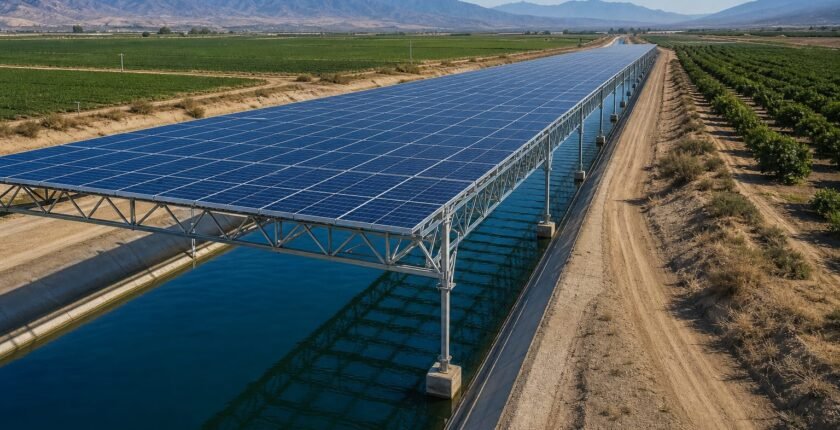
The Gila River Indian Community’s Casa Blanca array put the United States’ first utility-scale solar installation over an irrigation canal into operation on October 3, 2024. The 2,556 panels span 2,782 linear feet and carry a 1.31 megawatt nameplate capacity; Reclamation expects at least 2.26 million kilowatt-hours a year from the array. The project used $5.65 million from the Inflation Reduction Act and sits on land south of Phoenix. The installation proves a truss-mounted, no-contact design can clear moving water and feed the local grid, but David H. DeJong and Ben Lepley both stress the cost premium: capital runs roughly twice the per-megawatt price of a ground-mounted farm in the same district.
It was scheduled to be the first in the Western Hemisphere, but our Phase 2 Casa Blanca Solar over Canal project actually was completed first.
David H. DeJong, director of the Pima-Maricopa Irrigation Project
Key takeaways
- Panels and size: The Casa Blanca array uses 2,556 panels across 2,782 linear feet of the canal and has a 1.31 megawatt nameplate capacity.
- Expected output: The Bureau of Reclamation expects at least 2.26 million kilowatt-hours per year from Casa Blanca.
- Cost and funding: Casa Blanca received $5.65 million from the Inflation Reduction Act and works out to about $4.31 million per megawatt versus $6.7 million per megawatt for the Corps-run phase.
- Water savings: David H. DeJong estimates the array saves roughly 8 to 12 acre-feet of water per year, where one acre-foot equals 325,851 gallons.
- Program scale and IRA pot: The IRA set aside $25 million for solar over water conveyance; Casa Blanca used $5.65 million and Interior built a five-year monitoring period into the grant.
Table of contents
- Key takeaways
- How Casa Blanca finished first despite not being first to sign
- The engineering that keeps steel out of the water
- Costs, per-megawatt math and the paperwork premium
- Water savings, monitoring and what scale would look like
- How the case for and against scale-up stacks up
- What to be careful about
- Frequently asked questions
How Casa Blanca finished first despite not being first to sign
The Pima-Maricopa Irrigation Project divided its pilot into two phases with different federal partners and funding. The Gila River Indian Community signed with the U.S. Army Corps of Engineers in November 2023 for the I-10 Level Top Phase I — about 1,000 feet and an estimated 1,000 kilowatts — that the Corps says was the first to start construction. Separately, Reclamation funded the Casa Blanca Phase II with $5.65 million from the Inflation Reduction Act; Phase II produced first power on October 3, 2024 and completed fourteen months ahead of the Corps-run job, which held its ribbon cutting on December 11, 2025.
David H. DeJong, director of the Pima-Maricopa Irrigation Project, told the Army Corps in a written statement that the Casa Blanca project “was scheduled to be the first in the Western Hemisphere, but our Phase 2 Casa Blanca Solar over Canal project actually was completed first.” DeJong also described the Corps as “very methodical,” a factor project managers say explains part of the Corps job’s later completion date and higher per-megawatt cost.
The difference in contracting paths — Reclamation administering IRA funding versus a Corps Tribal Partnership Program award — drove distinct schedules and conditions. Robert Savage, the Corps project manager, said the Los Angeles District deliberately chose a tribally owned contractor, Numunu (a Comanche Nation-owned company), to meet program goals; that choice increased administrative time without being described as a technical failure.
The engineering that keeps steel out of the water
Tucson firm Tectonicus designed a prefabricated modular truss that spans the canal without placing foundations in the water, a point Ben Lepley has emphasized in interviews. The truss ties the array into the local distribution grid about every 1,000 feet, which the project team says equates to roughly one megawatt per grid tie. That modular approach explains why Phase I was defined as a 1,000-foot, 1 megawatt block and why Casa Blanca’s 2,782 feet contains multiple grid interconnection points.
Avoiding in-water supports preserves flow and maintenance access but raises materials and foundation complexity: the steel and anchoring needed to hold panels over moving water increase capital costs compared with ground mounts. Lepley told Canary Media that the team built a repeatable module they regard as a deployable playbook for future arrays, even if the upfront steel and foundation bill is high.
Costs, per-megawatt math and the paperwork premium
Project budgets show two different per-megawatt numbers inside the same canal network. Casa Blanca’s $5.65 million budget divided by its 1.31 megawatts equals about $4.31 million per megawatt, while the I-10 Level Top Phase I carried an estimated $6.7 million budget for 1.0 megawatt. The article’s worked comparison reproduces those published budgets and nameplate figures.
Lepley has been blunt: capital cost for canal-mounted solar runs roughly twice the price of ground-mounted farms in equivalent terrain because steel, foundations and nonstandard anchoring are needed when you cannot put a post in the ground. The Corps project also carried programmatic aims — it was the first under the Los Angeles District’s Tribal Partnership Program to reach active construction and used a tribally owned contractor — and Robert Savage said those aims slowed delivery in ways that raised cost per megawatt without changing the underlying engineering.
The premium is visible elsewhere: the piece cites an unrelated 52-megawatt landfill array in Houston that relies on concrete ballast rather than driven piles to survive 140-mph Gulf winds, an example of how unusual site conditions push structural costs up even when panel counts scale.
Water savings, monitoring and what scale would look like
Water conservation from canal shading is real but small at the pilot scale. DeJong estimates the Casa Blanca stretch keeps in the range of 8 to 12 acre-feet of water in the system each year; one acre-foot is 325,851 gallons. By comparison, the irrigation district burns 27 million kilowatt-hours annually to pump, move and store water, at a cost DeJong put at about $3 million a year; Casa Blanca covers roughly eight percent of that electrical load.
Reclamation expected at least 2.26 million kilowatt-hours a year from Casa Blanca, but season-long, verified evaporation reductions are not yet published because Interior built a five-year monitoring period into the grant when it announced the money in December 2023. The monitoring clock started with Casa Blanca’s first power on October 3, 2024, so a defensible final number should appear near the end of that five-year window.
The community has larger ambitions: Interior’s grant documents describe plans for 18.5 miles of coverage, and DeJong has said 16 miles of Casa Blanca alone would save about 360 acre-feet a year and carry roughly 26 megawatts. Those are planning targets, not completed works; the Casa Blanca half mile is a proof of concept rather than the program’s endpoint.
| Project | Panels | Length | Nameplate MW | Funding / Budget | Cost per MW |
|---|---|---|---|---|---|
| Casa Blanca / Phase II | 2,556 | 2,782 ft | 1.31 MW | $5.65M from the Inflation Reduction Act via Reclamation | $4.31M per MW |
| I-10 Level Top / Phase I | — | ≈1,000 ft | 1.0 MW | Estimated $6.7M via the U.S. Army Corps of Engineers | $6.7M per MW |
How the case for and against scale-up stacks up
The case for
- The engineering proof is complete: the Tectonicus truss design spans moving water without in-channel supports and can be replicated module-by-module.
- Federal seed money exists: the Inflation Reduction Act set aside $25 million for solar over water conveyance and Casa Blanca used $5.65 million, showing grants can get pilots built.
- A tribal utility can build without state REST incentives, and the Gila River Indian Community has already budgeted or planned additional self-funded arrays according to DeJong.
The case against
- Capital cost is a material barrier: canal arrays run roughly twice the capital cost per megawatt of ground mounts because of steel and foundations.
- Measured water savings remain unverified until the five-year monitoring completes, so projected acre-foot reductions are preliminary.
- There is no standing federal program beyond the IRA pot, so scaling past pilot miles depends on local budgets or new appropriation decisions.
What to be careful about
- Capital-intensity risk: steel and nonstandard foundations materially raise upfront cost per megawatt compared with ground-mounted arrays.
- Measurement risk: the five-year monitoring period that Interior required means verified season-long evaporation reductions will not be available until near the end of that window.
- Program risk: IRA funding for solar over water conveyance is a one-off $25 million pot and is not a guaranteed ongoing subsidy for expansion.
The bottom line
Casa Blanca proves the technical case: a prefabricated truss can carry solar panels over moving irrigation water without in-channel supports, feed the local grid and produce measurable energy. But the economics are the limiting story. Project budgets and statements from Tectonicus’ Ben Lepley and Pima-Maricopa director David H. DeJong show canal arrays carry a substantial capital premium — roughly double ground-mounted costs in the district — and the quantified water savings at pilot scale are in the single- to low-double-digit acre-feet per year. The next decisive inputs will be the five-year monitoring results and whether communities can fund miles of coverage without recurring federal grants.
What to watch
- Final five-year monitoring report from Interior and Reclamation due about October 3, 2029 (five years after Casa Blanca first power on October 3, 2024).
- Progress or public confirmation of the Gila River Indian Community’s planned expansion to 16 miles and roughly 26 megawatts, including permitting and interconnection milestones (no firm date provided).
- Any new federal program or appropriation after the $25 million IRA pot that would replace or extend the one-off funding for canal solar projects (no firm date provided).
Frequently asked questions
How much electricity does the Casa Blanca array produce?
The array has a 1.31 megawatt nameplate capacity and the Bureau of Reclamation expects at least 2.26 million kilowatt-hours per year from it.
How much water does shading the canal save?
David H. DeJong estimates Casa Blanca saves roughly 8 to 12 acre-feet annually; one acre-foot equals 325,851 gallons, so the pilot conserves the water needed to irrigate a couple of acres rather than river-scale volumes.
Why does solar over canal cost more than ground-mounted solar?
Ben Lepley and project budgets point to steel trusses, larger foundations and nonstandard anchoring when you cannot place posts in the water; those structural costs push capital per megawatt to about $4.31M for Casa Blanca and, in the Corps job, about $6.7M per megawatt.
When will we know measured evaporation reductions?
Interior required a five-year monitoring period when it announced the IRA grant in December 2023; the clock started with Casa Blanca’s first power on October 3, 2024, so a defensible final measurement should emerge around October 3, 2029.
Related reading