
Blog
DeBary Plant Burns 100% Green Hydrogen for Peaking Power
Estimated reading time: 5 minutes · Last updated:
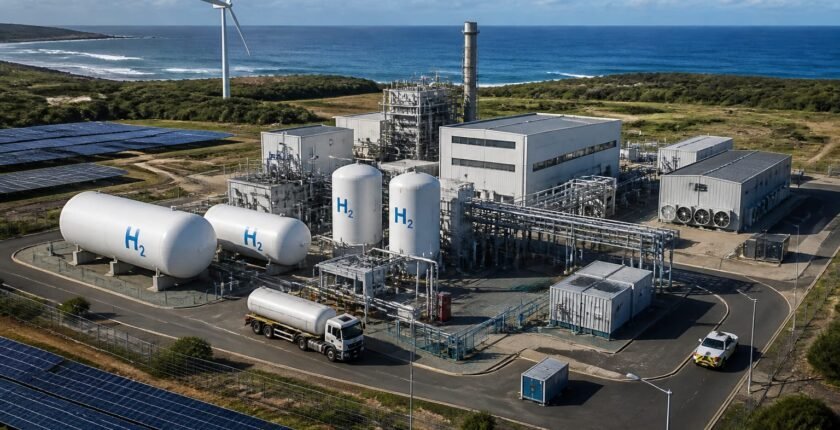
Duke Energy Florida and GE Vernova have placed the DeBary Hydrogen Production Storage System into commercial operation in Volusia County as a working demonstration of green hydrogen for grid reliability, as first reported by POWER Magazine. The co-located complex produces, stores and combusts 100% green hydrogen for commercial peaking power alongside a 692-MW natural gas plant and a 74.5-MW solar farm. The system uses onsite solar to feed two 1-MW electrolyzer units; hydrogen is stored on site and can be burned in a retrofitted GE Vernova 7E gas turbine that was commissioned to run on hydrogen in 2025.
Key takeaways
- First-in-U.S. system: The DeBary Hydrogen Production Storage System is described by its operators as the first U.S. end-to-end facility producing, storing and combusting 100% green hydrogen for commercial peaking power.
- Site capacities: The DeBary complex includes a 692-MW natural gas–fired plant, a 74.5-MW solar farm and two 1-MW hydrogen electrolyzer units.
- Turbine milestone: A GE Vernova 7E gas turbine at DeBary was commissioned for hydrogen operation in 2025 and achieved an 80-MW run on 100% hydrogen in June 2026.
- Commercial start: The hydrogen production facility began commercial operation in January of this year.
Table of contents
- Key takeaways
- How DeBary turns solar into dispatchable green hydrogen
- Turbine retrofit and testing that enabled full hydrogen firing
- Operational results, recognition and local impacts
- What DeBary means for scaling hydrogen in the power sector
- Paths forward and headwinds for hydrogen-fired peaking power
- What to be careful about
- Frequently asked questions
How DeBary turns solar into dispatchable green hydrogen
DeBary demonstrates a closed-loop approach: daytime solar generation is routed to onsite electrolyzers that split water into hydrogen and oxygen. The project uses two 1-MW electrolyzer units sited alongside the plant’s 74.5-MW solar field; oxygen is released and hydrogen is stored in reinforced containers for later use.
Stored hydrogen serves as a fuel that can be dispatched during peak demand periods, so the facility turns intermittent renewable output into on-demand, carbon-free capacity. Duke Energy framed this arrangement as a way to address renewable intermittency while preserving the dispatchability of existing assets.
By producing hydrogen on site from renewable electricity, the system reduces reliance on external fuel markets for peaking capacity and creates a reserve that can be drawn down when solar output falls. The DeBary setup therefore ties three functions—generation, electrolysis and storage—into a single operational chain.
Turbine retrofit and testing that enabled full hydrogen firing
Rather than building a new hydrogen plant, the project upgraded an existing GE Vernova 7E gas turbine so it can run on hydrogen blends and on pure hydrogen. The conversion work began after planning in mid-2022 and construction started late in 2023, leading to commissioning for hydrogen operation in 2025.
GE Vernova reported that the turbine passed hot-load tests and safety verification before entering service, and it recorded an 80-MW run on 100% hydrogen in June 2026. GE Vernova framed that outcome as a technical milestone showing that current turbine fleets can be adapted to hydrogen firing.
The retrofit model at DeBary therefore serves as a proof of concept for converting existing peaking units: it retains operational flexibility across natural gas, blends and pure hydrogen while providing a pathway to lower operational carbon intensity without replacing the plant footprint.
Operational results, recognition and local impacts
Operators report the system moved from pilot to commercial operation in January of this year and has since demonstrated hydrogen firing at utility scale. The integrated facility won POWER’s 2026 Hydrogen Award in recognition of its technical and operational achievements.
Project leaders highlight secondary benefits: workforce and STEM development in the region, potential customer savings from lower fuel costs over time, and improved local fuel security by creating an on‑site hydrogen reserve. Duke Energy described the scheme as consistent with its wider net-zero-by-2050 ambition and as an example for future fleet evaluations.
The complex occupies a site the groups compare to almost 200 football fields; that scale—paired with a 692-MW natural gas plant and a 74.5-MW solar array—underlines this project’s emphasis on integrating hydrogen into an existing generation footprint rather than pursuing remote, standalone hydrogen facilities.
What DeBary means for scaling hydrogen in the power sector
Both Duke Energy and GE Vernova present DeBary as a replicable model: the project shows one route to firm intermittent renewables by producing hydrogen locally and retrofitting turbines to burn it. GE Vernova described the technical concept as applicable beyond a single plant and emphasised retrofit potential across its fleet.
At the same time, both companies acknowledge hydrogen remains an emerging area that requires further scaling, cost reduction and wider operational experience before it becomes a mainstream alternative for peaking capacity. Duke Energy said it will evaluate additional turbine conversions and longer-term deployment as part of that learning process.
In short, DeBary supplies operational proof that green hydrogen can serve today’s peak demand needs while indicating the next steps are demonstration at multiple sites and economic validation over longer operating windows.
| Component | Capacity / Role | Status |
|---|---|---|
| Natural gas plant | 692-MW | Existing, co-located |
| Solar farm | 74.5-MW | Onsite, supplies electrolyzers |
| Electrolyzers | Two 1-MW units (2 MW total) | Commercial operation since January of this year |
| Gas turbine | GE Vernova 7E, hydrogen-capable | Retrofitted; commissioned for hydrogen in 2025; 80-MW 100% hydrogen run June 2026 |
Paths forward and headwinds for hydrogen-fired peaking power
The case for
- DeBary demonstrates retrofitability of existing turbines, creating a lower-barrier pathway to decarbonize dispatchable assets as described by GE Vernova and Duke Energy.
- Onsite production and storage allow renewables to be firmed without entirely new dispatchable builds, which could expand renewable penetration while preserving system reliability.
The case against
- Both companies concede hydrogen is still emerging; broader deployment will require cost reductions, supply-chain scale-up and regulatory clarity before it can be widely adopted.
- Economic competitiveness versus other long-duration storage options depends on future capital and operating costs that are not yet settled at scale.
What to be careful about
- Scaling retrofits requires capital investment and project-by-project verification beyond a single demonstration site.
- Green hydrogen supply at scale depends on abundant low-cost renewable electricity and additional electrolyzer capacity.
- Economic competitiveness versus alternatives (batteries, other long-duration storage) remains uncertain until lifecycle costs and operating profiles are reported across multiple projects.
The bottom line
DeBary provides an operational template for integrating onsite renewable generation, electrolysis and storage with an upgraded turbine to deliver dispatchable, zero‑carbon peaking power. The project preserves existing generation assets while demonstrating that full-hydrogen firing is technically feasible at utility scale. That combination of retrofitability and onsite production is the practical advance operators emphasise, but broader deployment hinges on cost reductions, larger electrolyzer deployments and consistent performance data from additional sites. For now, DeBary moves green hydrogen from pilot status toward an option utilities can test on real grids.
What to watch
- Duke Energy’s decision on whether to evaluate or approve additional turbine conversions; no date has been set.
- publication of multi-site operational data or fleet studies showing levelized cost or operating hours for hydrogen-fired peaking units; no date has been set.
- updates from GE Vernova on retrofit programs or product roadmaps expanding hydrogen-capable turbines; no date has been set.
Frequently asked questions
How much hydrogen production capacity is installed at DeBary?
DeBary uses two 1-MW electrolyzer units—about 2 MW of electrolysis capacity in total—sited with a 74.5-MW solar farm to produce green hydrogen for storage and later combustion.
Can existing gas turbines be converted to burn hydrogen?
Yes; at DeBary a GE Vernova 7E gas turbine was retrofitted and commissioned for hydrogen operation in 2025 and ran at an 80-MW output on 100% hydrogen during testing in June 2026.
Is hydrogen at DeBary fully carbon-free?
Duke Energy and GE Vernova describe the hydrogen produced on site as green because it is made from onsite solar electricity; when burned as hydrogen the turbine emits no CO2 from the fuel itself.
Related reading