
Blog
Massachusetts Startup Floats a New Solar Boat
Estimated reading time: 6 minutes · Last updated:
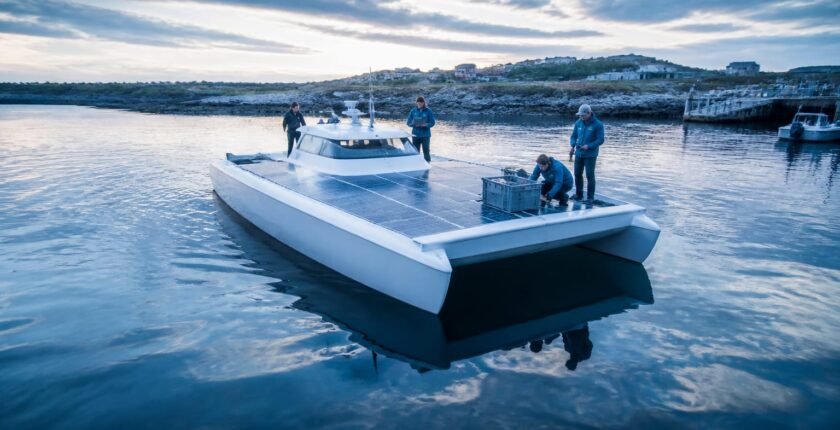
Worden Marine, a Massachusetts startup led by James Worden, is testing the TruSolar20, a 20-foot solar boat that runs on a canopy of six 425-watt solar panels and an onboard battery. On a mostly cloudy August run the prototype cruised at about five miles per hour on panel power alone, reaches eight miles per hour in sunnier weather and can approach 14 miles per hour when it draws on battery energy. The company’s next model, the TruSolar40, is being designed as a larger, enclosed ferry variant that carries more panels. This account, as first reported by Canary Media, is based on an August trial and interviews with Worden.
We are sure that when people experience this, they’ll be really excited about it.
James Worden, Worden Marine founder
Key takeaways
- The TruSolar20 uses a canopy of six 425-watt solar panels and cruised at about five miles per hour on a mostly cloudy day.
- In full sun the boat reaches eight miles per hour on solar power alone and can reach close to 14 miles per hour when using battery power.
- The TruSolar40 will be twice as long as the TruSolar20, topped with 12 solar panels and, when fully fitted, will weigh just 9,000 pounds.
- Worden Marine has not closed sales yet; the prototype Anita first hit the water in 2024 and the company is talking with several possible customers.
Table of contents
- Key takeaways
- How the TruSolar20 runs on sunlight and stored energy
- The TruSolar40: a larger, configurable ferry and tour platform
- James Worden’s background and the business case
- Market context and practical limits for solar passenger boats
- Prospects and headwinds for Worden Marine
- What to be careful about
- Frequently asked questions
How the TruSolar20 runs on sunlight and stored energy
The TruSolar20 pairs a lightweight hull with a large rooftop array to let sunlight power continuous low‑speed cruising. Its canopy comprises six 425-watt solar panels that supplied all the energy the prototype needed to cruise at about five miles per hour during a mostly cloudy afternoon trial. In brighter conditions the panels push the boat to about eight miles per hour on solar alone and the system can switch to battery power for higher speeds; Worden said tapping the battery can bring the vessel close to 14 miles per hour.
That mix of direct solar drive and battery backup is the core design choice: the canopy keeps the boat moving on good solar days and the battery both raises top speed and maintains motion after sunset. Worden describes a full battery as capable of keeping the vessel moving through the night at a reduced pace. The design emphasises simple, commercially available components — the solar modules used cost about 20 cents per watt of capacity — and a hull engineered in carbon fiber and Kevlar to cut weight while keeping strength high.
The TruSolar40: a larger, configurable ferry and tour platform
Worden Marine’s second model, the TruSolar40, scales the same basic system for commercial use. Worden says the larger boat is twice as long as the TruSolar20, half again as wide and will be fitted with 12 solar panels. That model will be enclosed, its ends more streamlined than the boxy prototype, and buyers will be able to configure seating and amenities to suit ferry routes, river tours or water‑taxi work.
The company plans layouts that can include room for a bar or a small bathroom, and seats can be arranged for ferry service; Worden says seating can be configured to carry as many as 16 people on ferry runs. Worden also plans optional navigation gear such as radar for misty conditions, and add‑ons like a swim deck or small grill. With the fully fitted TruSolar40 weighing just 9,000 pounds, Worden says the boat remains light enough to be trailered, which he cited as a design objective when shopping for transport equipment.
James Worden’s background and the business case
James Worden has worked on solar vehicles since the mid-1980s, when he built a solar go-kart that won a state science fair, and later helped start MIT’s Solar Electric Vehicle Team. He and his late wife Anita co-founded the solar EV company Solectria; they spun out Solectria Renewables, a photovoltaic inverter business that was acquired in 2014, and Worden remained co-CEO until 2017. He says he began planning the TruSolar line in earnest about four years ago and launched the Anita prototype — named for his wife, who died in 2023 — which first hit the water in 2024.
For Worden the technical demonstration must become a sustainable business. He emphasises keeping costs down by using off-the-shelf solar modules priced at about 20 cents per watt and a lightweight, durable hull built from carbon fiber and Kevlar. Worden Marine is headquartered in a renovated, net-positive, geothermally heated barn in North Andover, Massachusetts. The company has not yet closed any sales but is talking with several potential customers and is designing the TruSolar40 with commercial certification and operator requirements in mind.
Market context and practical limits for solar passenger boats
Commercial solar passenger vessels remain uncommon. The piece notes a Coast Guard–approved sun‑powered passenger boat began carrying passengers on the Hudson River in 2018, illustrating that approval and deployment are possible but rare. Worden has engaged with a retired U.S. Coast Guard captain early in the design process to familiarise himself with certification standards and to help the boats meet commercial requirements.
Adoption depends on more than technology. Materials such as carbon fiber and Kevlar, customisation for passenger layouts and regulatory compliance all affect price and time to market. Operational limits are also material: the TruSolar20’s top solar‑only speed falls to about five miles per hour in mostly cloudy conditions and relies on battery energy for higher speeds and overnight movement. Those performance characteristics suit short ferry runs and tour operations where low emissions and a quiet ride are priorities, but they set constraints on routes that require higher cruising speeds or long, overnight transits.
| Model | Length | Solar panels | Top sun speed | Top battery speed | Passengers |
|---|---|---|---|---|---|
| TruSolar20 | 20-foot | six 425-watt panels | up to 8 mph (sun) | close to 14 mph (battery) | configurable seating |
| TruSolar40 | twice as long as TruSolar20 (about 40 feet) | 12 panels | not stated | not stated | configurable; seats can be arranged for up to 16 passengers |
Prospects and headwinds for Worden Marine
The case for
- A simple architecture of canopy-mounted panels and battery backup suits short ferry and tour routes where low speed and quiet operation are advantages.
- Early engagement with Coast Guard certification standards and a retired captain’s guidance reduces the technical risk of commercial approvals.
The case against
- Affordability depends on material and fit-out costs (carbon fiber, Kevlar, custom interiors) and while panels are low-cost per watt, total boat cost and manufacturing scale remain unknown.
- Operational limits — slower speeds in cloudy conditions and reliance on batteries for higher speeds or overnight movement — constrain route choices and commercial appeal.
What to be careful about
- Regulatory and certification risk: commercial passenger operations require Coast Guard–compliant design and approvals, and the certification timeline and conditions are not specified.
- Market risk: Worden Marine has not closed sales yet and must convert interest into orders to sustain production.
- Cost and supply risk: lightweight composite hulls and custom interiors could raise unit costs despite low per-watt solar module prices.
- Operational risk: lower solar-only speeds in cloudy weather and dependence on battery charge limit suitable routes and operating windows.
The bottom line
Worden Marine’s TruSolar line tests a straightforward way to move passengers with near-zero emissions: a large rooftop solar array coupled with battery backup and a lightweight hull. The TruSolar20 demonstrates the concept in small, low‑speed service, while the TruSolar40 aims to translate that architecture into a configurable ferry for short routes and tours. The technical approach appears practical for the niche it targets, but commercial success will hinge on converting interest into orders, meeting Coast Guard commercial standards and keeping unit costs down despite composite hulls and custom fit-outs. Those are the milestones to watch as the company moves from prototype to customers.
What to watch
- Watch for Worden Marine to announce its first commercial sale; no date has been set.
- Watch for formal Coast Guard certification milestones for a TruSolar model; no date has been set.
- Watch for the company's timetable to begin production of the TruSolar40; no date has been set.
Frequently asked questions
How fast does the TruSolar20 go on solar power?
On a mostly cloudy day the TruSolar20 cruised at about five miles per hour on its six 425-watt panels; in sunnier conditions the boat reaches eight miles per hour on solar alone and can approach 14 miles per hour when using battery power.
How do the TruSolar20 and TruSolar40 differ?
The TruSolar40 is described as twice as long as the TruSolar20 and topped with 12 solar panels; the TruSolar40 will be enclosed and, when fully fitted, will weigh about 9,000 pounds, while the TruSolar20 is a 20-foot open‑canopy prototype.
Has Worden Marine sold any boats yet?
No — Worden Marine has not closed any sales yet; the prototype Anita first hit the water in 2024 and the company is talking with several possible customers.
Related reading