
Blog
Walvis Bay green hydrogen facility goes online
Estimated reading time: 4 minutes · Last updated:
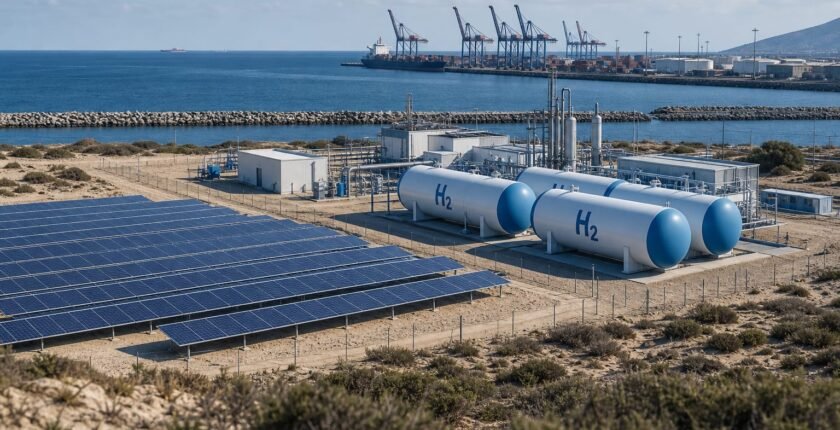
CMB.TECH has commissioned an integrated clean‑energy facility at Walvis Bay, Namibia, that pairs a 5 megawatt‑peak (MWp) solar park with a 5 MW Proton Exchange Membrane (PEM) electrolyser and a 5.9 megawatt‑hour battery system to produce green hydrogen for on‑site industrial use. The plant occupies about 6.5 hectares and currently operates with 7,000 solar panels. As first reported by The Kenyan Wall Street on 27 August 2026, CMB.TECH is already using the hydrogen in its industrial operations and plans future expansion with targets of 250 MW and eventually 500 MW of capacity.
Key takeaways
- Installed equipment: The facility includes a 5 MWp solar park, a 5 MW PEM electrolyser and a 5.9 MWh battery storage system.
- Site footprint: The initial plant covers about 6.5 hectares and is fitted with roughly 7,000 solar panels.
- Immediate use: CMB.TECH will use the hydrogen on site for dual‑fuel trucks, generators and Namibia’s first hydrogen‑powered freight locomotive.
- Scale ambitions: CMB.TECH says it aims to expand capacity to 250 MW and later to 500 MW to support exports and port refuelling with ammonia.
Table of contents
How the Walvis Bay plant produces and stores hydrogen
The facility pairs solar generation with on‑site electrolysis so electricity directly powers hydrogen production rather than exporting power to a grid. The installed 5 MWp solar park feeds a 5 MW Proton Exchange Membrane (PEM) electrolyser that splits water into hydrogen and oxygen using electricity. A 5.9 MWh battery system smooths variations in supply so the electrolyser can operate more steadily despite solar intermittency.
Electrolysis using a PEM stack is a standard route to low‑carbon hydrogen where the electricity input is renewable; the process produces hydrogen and oxygen at the stack and requires water treatment and balance‑of‑plant systems. At Walvis Bay the hydrogen is being routed into local industrial uses at first — trucks, standby generators and a freight locomotive — and can be converted into ammonia for storage and marine refuelling by combining hydrogen with nitrogen.
Why the project matters for industry and shipping
The Walvis Bay installation demonstrates an integrated, site‑scale approach: generation, storage, electrolysis and initial offtake are co‑located so the operator can match production to near‑term demand without immediately needing long export chains. For CMB.TECH that reduces the commercial risk that many early hydrogen projects have faced when they build production capacity before securing buyers.
Converting hydrogen to ammonia gives an easier route to marine refuelling because ammonia can be liquefied and handled with existing port logistics more readily than gaseous hydrogen. CMB.TECH says future links to port infrastructure could allow ships to take ammonia made from green hydrogen, reducing fuel emissions in shipping sectors that are hard to electrify directly.
Scale‑up plans, technical limits and open questions
CMB.TECH has stated ambitions to scale the Walvis Bay facility from the current 5 MW class to 250 MW and ultimately to 500 MW. Moving from a site fitted with 7,000 panels and 6.5 hectares to a multi‑hundred‑megawatt hub implies major land, grid‑connection and desalination or water‑supply investments for electrolysis feedstock.
There are practical constraints to that expansion: electrolyser procurement at the 100s of megawatts scale, large‑format battery or alternative firming solutions, ammonia synthesis capacity and port permit and safety approvals. The company also needs offtake agreements and logistics to export energy or supply vessels, and scaling to “millions” of panels — a figure CMB.TECH mentioned as possible in future phases — would change the local footprint and permitting requirements substantially.
Prospects for Walvis Bay as a domestic hub and export node
The case for
- Local offtake cuts early commercial risk: using hydrogen on site for trucks, generators and a locomotive creates immediate demand while export logistics are developed.
- Ammonia conversion provides a practical maritime fuel pathway that leverages existing liquid‑fuel handling infrastructure in ports.
The case against
- Scaling to 250–500 MW will require major capital, water supply and industrial permits and may face delays in procuring electrolysers and synthesis plants.
- Without firm long‑term buyers or port refuelling contracts, a rapid build‑out risks producing capacity that cannot be absorbed by the market.
What to be careful about
- Insufficient offtake: the plant’s commercial case depends on buyers for hydrogen or ammonia beyond CMB.TECH’s internal needs.
- Infrastructure and permitting delays for port integration and large‑scale ammonia handling could push back export plans.
- Supply chain constraints for electrolysers, catalysts and balance‑of‑plant equipment at the 100s of MW scale.
- Water availability and treatment for large‑scale electrolysis as capacity increases.
The bottom line
Walvis Bay is a practical example of staged green‑hydrogen development: a small, integrated plant that produces hydrogen for immediate industrial use while the operator tests technical and commercial assumptions. The 5 MWp/5 MW/5.9 MWh configuration keeps complexity local and reduces early‑stage market risk, but CMB.TECH’s stated jump to 250–500 MW will require new land, large‑scale electrolysers, water resources and port‑side ammonia handling. Whether Walvis Bay becomes an export hub depends on securing buyers and overcoming supply‑chain and permitting hurdles during any rapid expansion.
What to watch
- Watch for CMB.TECH’s next public update on its planned expansion to 250 MW; no date has been set.
- Watch for announcements about port integration or an ammonia bunkering pilot at Walvis Bay; no date has been set.
- Watch for the commissioning date of Namibia’s first hydrogen‑powered freight locomotive; no date has been set.
Frequently asked questions
What is the current production capacity at the Walvis Bay facility?
The plant combines a 5 MWp solar park with a 5 MW PEM electrolyser and a 5.9 MWh battery, operating initially to supply local industrial demand including CMB.TECH’s fleet and a hydrogen freight locomotive.
How much land does the project occupy and how many panels are installed?
The initial site covers about 6.5 hectares and is equipped with roughly 7,000 solar panels as installed for the project's opening phase.
What are CMB.TECH’s expansion targets?
CMB.TECH has stated plans to scale the facility to 250 MW and ultimately to 500 MW to support larger exports and port refuelling with ammonia.
Related reading