
Blog
How Himalayan hydropower amplifies disaster damage
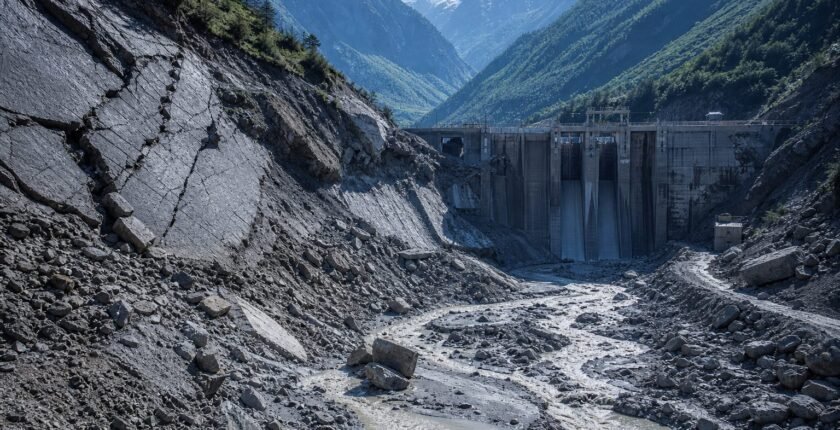
Estimated reading time: 5 minutes · Last updated:
Himalayan hydropower projects concentrate infrastructure where steep river drops make generation attractive but where landscapes and communities are fragile. As first reported by Hankyoreh, Himanshu Thakkar, coordinator of the India-based South Asia Network on Dams, Rivers & People (SANDRP), says years of construction activity — dams, tunnels, blasting and access roads — raises the odds of avoidable floods and downstream inundation. Thakkar points to 11 projects damaged across Rasuwa and Nuwakot, and to recent disasters in July 2025 and September 2024, as evidence that projects without credible studies, early warning systems and accountable governance multiply harm rather than reduce it.
Each of these tends to increase the disaster vulnerability of the landscape,
Himanshu Thakkar, SANDRP coordinator
Key takeaways
- SANDRP has worked on dam and river issues for 28 years and is led by coordinator Himanshu Thakkar.
- Eleven hydropower projects across Rasuwa and Nuwakot, including Upper Trishuli-1, were reported damaged in recent floods and landslides.
- Thakkar says construction elements — dams, tunnels, blasting, deforestation, muck dumping and access roads — increase landscape disaster vulnerability.
- Thakkar calls for independent reviews, cumulative impact and climate assessments, and bilateral climate-monitoring agreements among Nepal, India and China.
Table of contents
- Key takeaways
- Why mountain rivers attract hydropower — and where that goes wrong
- Construction as a hazard multiplier
- Climate change, glacial melt and recent incidents in the region
- SANDRP’s prescriptions: independent reviews, cumulative assessment and cross‑border monitoring
- Cases for and against stricter review and limits
- What to be careful about
- Frequently asked questions
Why mountain rivers attract hydropower — and where that goes wrong
Steep gradients and concentrated river flows make mountain sites commercially attractive for hydropower, but that advantage depends on asking different questions than lowland projects require. Developers and funders often treat elevation drop as the single technical input and skip landscape-scale studies that assess geology, meteorology and climate-driven changes to glaciers and runoff.
Himanshu Thakkar says that when those studies are omitted or carried out without independent oversight, projects are too often approved on an incomplete record. The combination of blasting, tunnelling and large civil works in unstable terrain changes local drainage, removes slope-supporting vegetation and creates new pathways for debris and water to reach populated valleys.
Construction as a hazard multiplier
Construction activities bring a long list of physical changes that raise disaster risk: permanent and temporary reservoirs, spoil and muck dumps, quarrying for materials, access roads cut into slopes, and tunnels that alter subsurface water routes. Each activity can increase landslide probability, reduce natural drainage, or concentrate flood energy where communities live below a project.
Thakkar lists the common features that recur across projects and that, in his view, add to vulnerability: dams, tunnels, blasting, deforestation, displacement, submergence, drying of downstream reaches, muck dumping, and expanded road and settlement strips. Without properly implemented early warning systems and disaster-management planning, these construction impacts can turn routine high flows into catastrophic downstream flooding.
Climate change, glacial melt and recent incidents in the region
Warming temperatures that accelerate glacial melt change seasonal runoff patterns and can weaken the ground in high basins. Thakkar points to recent episodes in September 2024 and July 2025 as illustrations of how the Himalayan region has suffered repeated infrastructure damage, arguing that climate-driven hazards and prior construction effects combine to raise overall danger.
Those incidents, and the reported damage to 11 projects in Rasuwa and Nuwakot including Upper Trishuli-1, underscore the need to treat past failures as lessons rather than exceptions. Thakkar says the pattern of repeating accidents without meaningful institutional learning indicates weak accountability among planners, funders and regulators.
SANDRP’s prescriptions: independent reviews, cumulative assessment and cross‑border monitoring
SANDRP calls for independent reviews of under‑construction and operating projects and for cumulative impact assessments that consider multiple projects across a watershed. Thakkar emphasises that reviews must be done by experts free of conflicts of interest and that climate vulnerability assessments specific to the affected region are essential.
He also urges bilateral climate‑monitoring arrangements and data‑sharing protocols between Nepal and China and between India and Nepal, plus a re-examination of international funding involvement including bilateral contributions named by projects' supporters. Thakkar recommends adherence to the World Commission on Dams guidelines when deciding whether to proceed with future projects.
| Project | Location | Status reported | Source |
|---|---|---|---|
| Upper Trishuli-1 | Rasuwa/Nuwakot | Damaged | Hankyoreh interview with Himanshu Thakkar |
| Other identified projects | Rasuwa and Nuwakot | Multiple damaged (total 11 projects reported) | Hankyoreh interview with Himanshu Thakkar |
Cases for and against stricter review and limits
The case for
- Independent reviews and cumulative impact assessments would identify systemic weaknesses and could be designed to require remediation or halt high‑risk projects.
- Bilateral monitoring and shared protocols between Nepal, India and China would improve forecasting for glacial lake outburst floods and coordinate downstream warnings.
The case against
- Political and commercial incentives for rapid project approval make implementation of independent, conflict‑free review teams difficult without legal or regulatory change.
- Funders who treat projects as routine investments, Thakkar says, may resist stricter assessments because they raise costs and cause delays.
What to be careful about
- Ongoing construction and operation in steep terrain increase landslide and downstream flooding exposure for communities below project sites.
- Lack of independent oversight and conflict‑of‑interest reviews can allow deficient studies and mitigation plans to pass approval.
- Insufficient early warning systems and disaster management plans make avoidable floods more likely to become disasters.
- Cross‑border data gaps among Nepal, India and China hinder timely response to glacial or upstream hazards.
The bottom line
The interview with Himanshu Thakkar frames Himalayan hydropower not as a purely technical choice but as a governance and planning problem where landscape change, climate trends and weak oversight combine. The record cited — damage to 11 projects, repeated incidents in September 2024 and July 2025 — supports SANDRP’s call for independent reviews, watershed‑level cumulative assessments and cross‑border monitoring. Whether funders and regulators adopt those steps will determine if future projects reduce risk or continue to act as amplifiers of disaster.
What to watch
- Watch for any independent review panel convened to assess under‑construction and operating Himalayan hydropower projects; no date has been set.
- Watch for announcements of bilateral monitoring or data‑sharing agreements between Nepal and India or Nepal and China; no date has been set.
- Watch for public statements or funding reviews by the International Finance Corporation or other international funders about project safeguards; no date has been set.
Frequently asked questions
What does SANDRP identify as the main construction risks for Himalayan projects?
SANDRP lists dams, tunnels, blasting, deforestation, displacement, submergence, drying of downstream reaches, muck dumping, material mining and approach roads as recurring construction elements that increase disaster vulnerability; the organisation has worked on these issues for 28 years under coordinator Himanshu Thakkar.
How many projects were reported damaged in the recent Nepal floods?
The interview reports that 11 hydropower projects across Rasuwa and Nuwakot, including Upper Trishuli-1, suffered damage in recent floods and landslides.
What specific reforms does SANDRP propose?
Thakkar calls for independent, conflict‑free reviews of under‑construction and operating projects, credible cumulative impact assessments, climate change assessments for the specific region, and bilateral climate‑monitoring and data‑sharing agreements among Nepal, India and China.
Related reading