
Blog
Geothermal Cooling for New York Subways
Estimated reading time: 6 minutes · Last updated:
New York City has opened a study to test geothermal cooling for its subway system by installing a Thermal Energy Network (TEN) as part of upgrades at the Brooklyn Bridge 4/5/6 and Chambers Street J/Z complex. The move targets platforms that regularly reach 96 °F (35 °C) in summer by circulating fluid into boreholes drilled hundreds of feet into bedrock that stays near 55 °F (12 °C). The study will determine whether a TEN can shift waste heat into the ground for summer cooling and recover that stored heat for municipal use in winter.
Key takeaways
- Scope: The city and state will study a Thermal Energy Network (TEN) at the Brooklyn Bridge 4/5/6 and Chambers Street J/Z upgrade package.
- Heat target: Brooklyn Bridge 4/5/6 platforms regularly hit 96 °F (35 °C) in summer, driving the need for a cooling solution.
- How it works: TENs use pipes and fluid circulated into boreholes drilled hundreds of feet deep to transfer station heat into bedrock near 55 °F (12 °C).
- Precedent: A 2019 condo in Coney Island uses 153 geothermal wells for comfort; Europe and Canada also operate similar systems.
Table of contents
Why subway heat is a hard problem to fix
Subway heat is systemic rather than local. Trains shed heat from motors and brakes, platform crowds add body heat, and air-conditioned cars exhaust warm air into the tunnel network. Those combined inputs raise platform temperatures across miles of open tunnel, so a single rooftop HVAC unit or a few local fans will have only limited effect.
New York’s situation is acute: Brooklyn Bridge 4/5/6 regularly records platform highs of 96 °F (35 °C). That number anchors why the city and state have elected to test a Thermal Energy Network rather than pursue broad air conditioning; the fluid-in-borehole approach tackles heat at source and removes it to cool a confined volume rather than trying to keep miles of tunnel cold.
Because the problem affects the entire network, earlier experiments are relevant. The transit authority cites a groundwater cooling trial from 1906 and modern applications in other cities; those precedents indicate the concept can work at small scale, but the technical challenge is scaling it to serve millions of commuters and an interconnected tunnel system.
What a Thermal Energy Network does and why bedrock helps
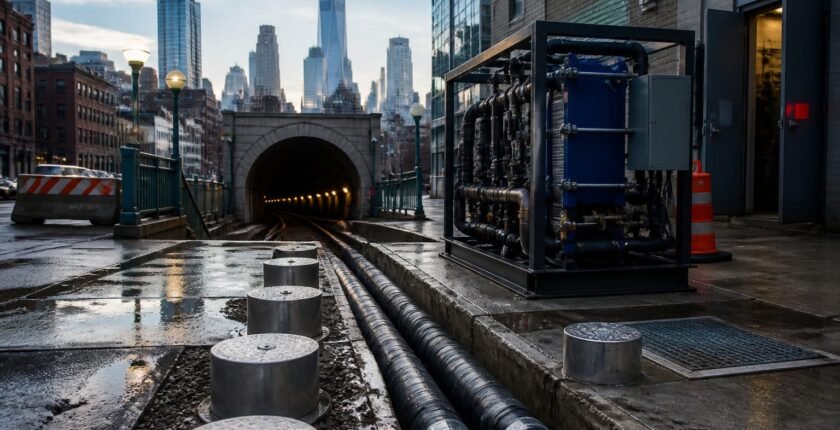
A Thermal Energy Network moves heat from where it is unwanted to where it can be stored or reused. In the subway application, fluid circulated through platform piping absorbs heat, carries it down pipes into boreholes drilled hundreds of feet into bedrock, and returns cooler fluid to the station. Bedrock temperatures cited for this purpose are about 55 °F (12 °C), a steady baseline that makes the ground an effective heat sink.
Because bedrock warms and cools slowly, a TEN can act as a seasonal thermal battery: excess summer heat is pushed into the ground and later reclaimed for municipal heating in winter. The idea is not novel—examples in Europe, Canada and a 2019 Coney Island project using 153 wells show the technique can deliver comfort and heat reuse at building scale—but the subway application requires larger flows and integration with transit infrastructure.
Engineering and operational hurdles the study must test
Scaling a TEN to a busy underground station raises several engineering questions the study must quantify. Drilling hundreds of feet near subway tunnels and utilities requires geotechnical surveys, alignment with existing shafts and strict vibration and settlement limits to protect tracks and signal equipment. The system also needs enough thermal capacity and flow rate to lower platform air effectively rather than merely cooling a small pocket.
Operationally, subways are porous environments: vents, stairways and open trackways let cooled air escape into adjoining tunnel volumes. Any TEN must be paired with targeted air distribution or platform-edge containment to make reduced fluid temperatures translate into a meaningful change in commuter comfort rather than a negligible local effect.
Cost and programme timing are central practical constraints. The study is being done as part of station upgrades at Brooklyn Bridge and Chambers Street; integrating drilling, piping and heat-exchange hardware into an active upgrade schedule will determine the feasibility of wider roll-out across the system.
Precedents, public reaction and political momentum
Precedent helps explain why the transit authority selected a TEN rather than a speculative, untested technology. The authority's filing notes geothermal boreholes have been used for cooling across Europe and Canada and points to a Coney Island installation of 153 wells serving a 2019 condo. Those examples show municipal-scale drilling and reuse are possible, but they are not identical to a subway retrofit.
Public reaction in the sourced comments ranges from scepticism about cost to practical suggestions such as platform doors and larger ventilation fans. One commenter claimed roughly 100 track fires per day as a current system problem; that remark is an anecdote in the comments and not an official statistic, but it does reflect a level of public concern about legacy infrastructure that will shape political decisions.
Politically, the project has backing: Mayor Mamdani, Governor Hochul and the MTA are named in the announcement of the study. That alignment gives the effort weight, but it also places expectations on the study to deliver clear, implementable results to justify broader investment.
| Site | Scale | Known numbers | Status |
|---|---|---|---|
| Brooklyn Bridge 4/5/6 | Underground station | Platforms reach 96 °F (35 °C) | Study to test TEN during station upgrades |
| Chambers Street J/Z | Adjacent station complex | Part of the same upgrade package | Included in the TEN study |
| Coney Island condo | Residential development | 153 geothermal wells; built 2019 | Operational example of wells for comfort |
| London Underground | Network-wide problem example | No numerical values given in the source | Used as international comparison for heat issues |
Case for and against wider roll-out
The case for
- A successful TEN pilot could reduce peak platform temperatures and provide winter heat to municipal buildings by reusing stored energy from bedrock.
- Existing installations—European, Canadian systems and the Coney Island 153-well project—demonstrate the core drilling and heat-exchange technology at scale for buildings, reducing technical novelty risk.
The case against
- Large-scale deployment requires drilling near active tunnels and signals, which raises engineering, safety and permitting hurdles that could slow or balloon costs.
- Open tunnel geometry and ventilation paths mean a TEN alone may not deliver noticeable comfort gains without complementary measures such as platform containment or targeted air distribution.
What to be careful about
- Drilling hundreds of feet near subway infrastructure could cause settlement, require costly mitigation and complicate station upgrades.
- Ground thermal recharge from repeated summer loads could raise local bedrock temperatures over time, reducing cooling efficiency and altering long-term performance.
- Integration with MTA upgrade schedules risks delays or cost overruns if TEN work conflicts with signal, track or passenger access programs.
The bottom line
The planned study will test whether a Thermal Energy Network can convert a subway’s waste heat into a usable municipal asset and, crucially, whether that conversion delivers perceptible comfort for commuters. Benchmarks already in the source—96 °F platform peaks and bedrock near 55 °F, plus the 153-well Coney Island precedent—give the study measurable targets. Success would open a route to station-scale cooling and seasonal heat reuse; failure will most likely trace to drilling constraints, ventilation losses or integration costs revealed during the engineering phase.
What to watch
- Watch for the published findings of the Thermal Energy Network study for Brooklyn Bridge/Chambers Street; no public date has been set.
- Watch for MTA permitting and geotechnical reports that clear drilling hundreds of feet beneath or adjacent to the station; no public date has been set.
- Watch for any pilot installation that pairs TEN piping with platform-edge containment or dooring; no public date has been set.
Frequently asked questions
What temperature problem is this study trying to solve?
The study targets platforms such as Brooklyn Bridge 4/5/6 that regularly reach 96 °F (35 °C) in summer and seeks to lower that peak using a Thermal Energy Network tied to bedrock temperatures near 55 °F (12 °C).
Has this geothermal approach been used before in New York?
At building scale, yes: the source cites a Coney Island project that uses 153 geothermal wells to provide comfort for a condo completed in 2019; the subway pilot would be larger and must prove the concept in tunnels.
What engineering risks could stop a rollout?
Drilling hundreds of feet near active tunnels poses settlement, vibration and permitting risks; the study must resolve geotechnical constraints and integration with MTA upgrades before any wider deployment.
Related reading