
Blog
Space Lasers Head for First In-Orbit Power Test
Estimated reading time: 6 minutes · Last updated:
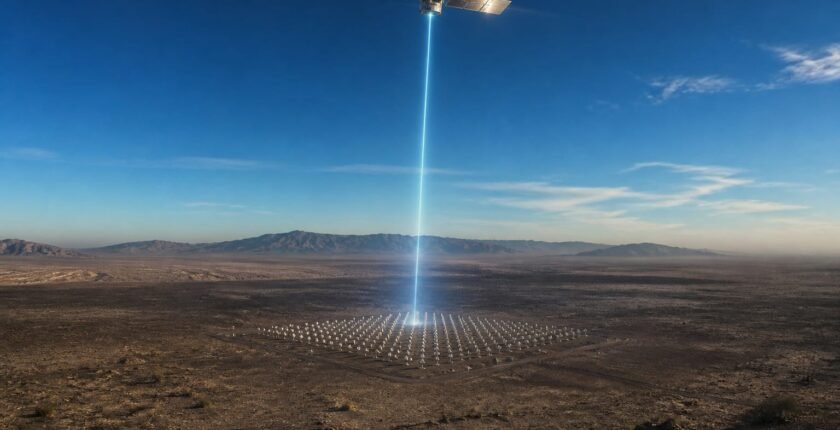
Star Catcher is preparing to launch Protostar, a prototype that will test converting concentrated sunlight into a laser beam and directing it at another satellite to deliver power in orbit. The company will measure how much energy a cubesat receives as it moves away from Protostar and compare those measurements to its models. WIRED first reported that the demonstration will be the startup's first in-space trial of beamed power between two untethered objects, following a ground test that delivered more than 1 kilowatt to off-the-shelf solar panels. The primary test will determine whether Star Catcher's space-laser approach to topping up satellites works outside the lab.
Key takeaways
- Prototype launch: Protostar, Star Catcher’s prototype, will fly on a SpaceX mission to test beamed power between untethered satellites.
- Funding and awards: Star Catcher announced a $65 million funding round and won a $30 million award from the US Space Force.
- Commercial interest: The company reports 40 letters of intent and 10 power purchase agreements from prospective buyers.
- Prior test results: A ground test delivered more than 1 kilowatt to solar panels; a 2023 Naval Research Laboratory experiment ran 100 days at 11 percent efficiency with a beam shorter than 5 feet.
Table of contents
How Star Catcher’s system is meant to work
Star Catcher calls its satellites power nodes because each one combines generation and transmission. The devices concentrate sunlight with a set of lenses, then refine that light into wavelengths the company says provide up to ten times more usable power than diffuse sunlight, and finally emit a focused laser beam that can be pointed at satellites that need electricity.
In practice that beam acts like a transmission cable in space. A receiving satellite — in this demonstration, an untethered cubesat — converts the laser illumination back to electricity with its solar panels. The company’s stated goal for the orbital programme is to reduce reliance on heavy batteries and allow operators to trade battery mass for instruments such as additional processors or communications gear.
Star Catcher frames the offering as infrastructure: a distributed set of nodes that supply power to spacecraft on demand. The prototype test will collect measurements of received power as the cubesat moves away, data the firm will use to validate its tracking algorithms and propagation models.
What the in-orbit demo will prove — and what it won’t
The mission’s immediate aim is narrow: show that a laser can be tracked onto an untethered target and transfer measurable power in orbit. Chief executive officer and cofounder Andrew Rush says the test will check how much power the cubesat receives as it moves away from Protostar and compare those readings to Star Catcher’s models. Success would validate the company’s tracking and beam-steering systems at orbital distances.
The demonstration will not, by itself, deliver telecom-grade power or show a full commercial system. Star Catcher’s ground record test delivered more than 1 kilowatt to off-the-shelf panels, which the company compares to enough juice to run a microwave. That is an important step but far smaller than the continuous megawatts a space data center would need.
The firm is explicit about stages: Rush says Star Catcher is still in a “crawl” phase, aiming to move to walking and running as tests accumulate. The Protostar flight is therefore a technology validation, not an immediate market rollout.
Commercial signals: contracts, funding and partners
Investors and customers are already placing bets. Star Catcher announced a $65 million financing round earlier this year and a separate $30 million award from the US Space Force. The company says it has 40 letters of intent from prospective buyers and 10 signed power purchase agreements, which are long-term contracts that signal some commercial commitment.
Those agreements matter because launch mass is expensive: reducing batteries in favor of beamed power could free payload capacity for revenue-generating instruments. The SpaceX mission manifest shows Google's first attempt at a space-based data center is riding the same flight as Protostar, underscoring interest in on-orbit power if reliable beaming can be demonstrated.
Even with that demand signal, the path to wide commercial adoption will require scaling the demonstrator into higher-power nodes and proving long-term reliability in orbit before operators shift fleet design around remote power delivery.
Technical hurdles left to solve
Hanieh Fattahi of the Max Planck Institute for the Science of Light singles out efficiency as a constraint: a Naval Research Laboratory space-laser test in 2023 ran at about 11 percent efficiency. Low end-to-end efficiency increases the energy the emitter must produce for any given delivery to a receiver, raising power, heat and mass requirements.
Tracking is also critical. Beaming to an untethered, moving target requires high-precision pointing and closed-loop tracking to keep the laser locked onto a receiving array. Star Catcher has also warned that thermal management and ensuring optics and electronics survive years in the cold vacuum of space present additional engineering challenges.
Finally, alternatives such as microwave transmission exist: a team at Caltech has tested transmitting power to Earth with microwaves; that method can transfer larger amounts of energy but requires a massive receiver, while lasers can strike much smaller targets. Each method therefore carries trade-offs between receiver size, beam area and practical application.
| Method | Recent test cited | Transmission footprint | Receiver size |
|---|---|---|---|
| Lasers | Star Catcher ground test: more than 1 kW to panels; NRL 2023: 100 days, 11% efficiency | Small, highly focused beam aimed at a compact target | Small receiver arrays can be used on satellites |
| Microwaves | Caltech successful Earth-directed tests | Broader beam that can transmit more energy over distance | Requires a massive receiver to capture energy on Earth |
Outlook — the case for and against rapid adoption
The case for
- Falling launch costs make placing generation and infrastructure in orbit more economically plausible, a point noted by Max Planck researcher Hanieh Fattahi.
- Star Catcher’s $65 million funding round, $30 million US Space Force award, 40 letters of intent and 10 power purchase agreements provide a concrete early commercial signal.
The case against
- Low measured efficiencies in past space-laser work (about 11 percent in a 2023 Naval Research Laboratory experiment) mean emitters must be larger or run hotter for the same delivered power.
- Long-term reliability, thermal control and millimeter-scale pointing for untethered targets are unresolved engineering risks that could slow scaling.
What to be careful about
- End-to-end conversion efficiency remains low in space tests (NRL reported roughly 11 percent), limiting usable delivered power.
- Precision tracking failures would prevent consistent power transfer to untethered receivers and could render commercial operations unreliable.
- Thermal management and component lifetime in vacuum conditions are unproven at scale for continuous beaming nodes.
- Economic viability depends on further reductions in launch costs and on scaling from kilowatt-range tests to the megawatt-class loads data centers would require.
The bottom line
The Protostar demonstration is a narrowly focused but necessary next step: it will show whether precise tracking and beamed delivery can produce measurable power on an untethered receiver in orbit. Star Catcher has financial backing and early commercial commitments, but ground-level kilowatt tests and prior 11 percent-efficiency space experiments make clear that significant engineering and scaling work remains. If Protostar validates the firm’s models, the next challenges will be improving end-to-end efficiency, proving long-term reliability, and scaling nodes to the higher continuous outputs that larger spacecraft or orbital data centers would require.
What to watch
- Watch for Protostar’s demonstration results and the company’s published comparison of received power versus models; no date has been set.
- Watch for the outcome of the SpaceX mission carrying Protostar and Google’s first space-based data center experiment; no date has been set.
- Watch for any public timeline updates from Star Catcher on when it expects to offer “meaningful commercial power provisioning services in orbit before the end of the decade”; no firm dates have been set.
Frequently asked questions
What will Protostar test in orbit?
Protostar will test tracking, beam steering and power delivery by beaming concentrated sunlight converted to a laser at an untethered cubesat and measuring how much power the cubesat receives as it moves away, data the company will compare against its models.
How much power has Star Catcher demonstrated so far?
On the ground, Star Catcher reports delivering more than 1 kilowatt to off-the-shelf solar panels; the in-orbit test is intended to measure how that performance scales in space.
What did past space-laser tests show about efficiency?
A 2023 Naval Research Laboratory experiment ran for 100 days but operated at about 11 percent efficiency and transmitted a beam shorter than 5 feet, highlighting the efficiency and range challenges for beamed power in space.
Related reading