
Blog
Pennsylvania Gas Well Geothermal Pilot Targets 1 Megawatt
Estimated reading time: 7 minutes · Last updated:
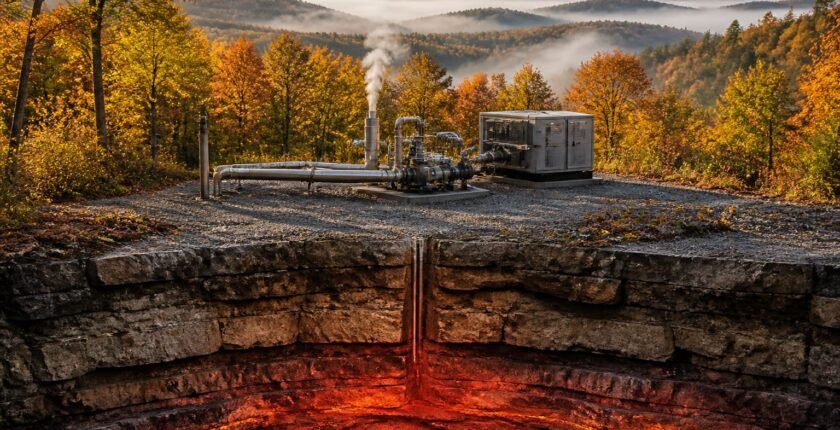
A Pennsylvania gas well geothermal pilot will try to produce one megawatt of electricity from an Indiana County gas well in the Marcellus Shale that has been underperforming. The Pennsylvania Department of Environmental Protection leads the project. It is budgeted at about $14 million and funded by the U.S. Department of Energy. Water would be sent down the well, warmed by rock at depth, and brought back up to feed the local grid and to heat nearby homes and businesses. Lehigh University said it has received $1.6 million to join the effort, formally the Commonwealth of Pennsylvania EGS Pilot Demonstration. CNX Green Ventures operates the well. No date for first power has been announced.
This project asks whether we can give that infrastructure a second life as a clean, renewable energy source.
Frank Pazzaglia, professor of Earth and environmental sciences, Lehigh University
Key takeaways
- Target output: The DEP-led pilot aims to generate one megawatt of electricity from an underperforming Marcellus Shale gas well in Indiana County, Pennsylvania.
- Budget and funding: The U.S. Department of Energy funds the project, budgeted at about $14 million, and Lehigh University's $1.6 million share is about 11 percent of that total.
- Two products from one well: Heated water drawn from the well is meant to supply both electricity for the local grid and direct-use heat for homes and businesses nearby.
- Partners: CNX Green Ventures, Idaho National Laboratory, Gradient Geothermal Inc., Teverra Inc., Seequent and the Pennsylvania Geological Survey work alongside DEP and Lehigh.
- Eastern test case: Lehigh principal investigator Frank Pazzaglia frames the pilot as a test of whether old oil and gas infrastructure can be reused for clean energy in the eastern US.
Table of contents
- Key takeaways
- How a Shale Gas Well Becomes a Geothermal Heat Source
- Who Pays for the $14 Million Pilot and Who Runs It
- Why Reuse Old Wells, and Where the Argument Stretches
- What One Megawatt Can and Cannot Prove for the East
- What could make or break the pilot
- What to be careful about
- Frequently asked questions
How a Shale Gas Well Becomes a Geothermal Heat Source
EGS stands for enhanced geothermal system. Here that means circulating water through hot rock deep underground so its heat can be carried to the surface. The pilot does not start with a fresh borehole. It starts with a deep unconventional gas well in Indiana County, picked because the geology there suits geothermal extraction, Lehigh said.
The heat resource is described as low-enthalpy, meaning its temperature is modest compared with the steam fields behind conventional geothermal plants. That limit shapes the plan. The team wants two outputs from the warmed water instead of one: electricity sent into the local grid, and direct-use heat delivered to homes and businesses nearby. Lehigh has also pointed to farms as possible beneficiaries of the state's underground heat.
CNX Green Ventures, an Appalachian oil and gas producer, operates the well. One megawatt is a small amount of power. The real test is whether an existing bore can be converted without the cost of drilling a new one.
Who Pays for the $14 Million Pilot and Who Runs It
The U.S. Department of Energy funds the project, and the Pennsylvania Department of Environmental Protection leads it in coordination with the Pennsylvania Geological Survey. The outside partners are Idaho National Laboratory, Seequent, Teverra Inc., Gradient Geothermal Inc. and CNX Green Ventures, plus Lehigh University.
Lehigh's $1.6 million is about 11 percent of the roughly $14 million budget. The university said the money supports five researchers and students drawn from two units. Its staffing breakdown, however, lists a postdoc, a graduate student and three principal investigators in the Department of Earth and Environmental Sciences, and two principal investigators plus one graduate student at the Energy Research Center. Lehigh has not explained the difference between the two counts.
The named faculty are Frank Pazzaglia, professor of Earth and environmental sciences and principal investigator; Steve Peters, associate professor in the same department; Anne Meltzer, also a professor there; Carlos Romero, professor of mechanical engineering and mechanics and director of the Energy Research Center; and Muhannad Suleiman, professor of civil and environmental engineering. Robert Flowers, the Herbert J. and Ann L. Siegel Dean of the College of Arts and Sciences, presented the work as a pairing of earth scientists with engineers from the P.C. Rossin College of Engineering and Applied Science.
Why Reuse Old Wells, and Where the Argument Stretches
Pazzaglia's case begins with what Pennsylvania already has. He said conventional drilling and then the shale boom left the state with a vast network of wells and supporting equipment. He presents the pilot as a test of whether that network can be turned to renewable use.
Romero went further. He called the reuse of abandoned hydrocarbon wells for low-enthalpy geothermal "an economic and environmental opportunity," one that turns a methane-leaking liability into a dependable local energy source. That is the strongest version of the pitch, and the Indiana County pilot does not test it directly. The chosen well is neither abandoned nor described as leaking. It is an underperforming well that CNX Green Ventures still operates. Success there would show that a weak producer can be converted. It would not show that the state's orphaned and leaking wells can be.
Lehigh's project leaders also argue that former oil, gas and coal workers could find jobs in the work, because their experience below ground carries over to geothermal. No hiring figures or training plans have been published to back that claim.
What One Megawatt Can and Cannot Prove for the East
The broader aim is regional. Geothermal resources in the eastern US are scarcer than in the West, and the team wants to show that its method can travel to other sites. By keeping existing wells useful for longer, the pilot is meant to encourage geothermal development in places that have so far had little of it. Pazzaglia said it is a chance to show geothermal can work where many people would not expect it, and to train young scientists and engineers along the way.
Bigger claims have been attached to the project. David E. Hess, who served as DEP secretary from 2001 to 2003 and republished Lehigh's announcement on his PA Environment Digest blog, paired it with studies indicating that geothermal could meet 100 percent of Pennsylvania's electricity and heating needs and most of its industrial demand. Those studies were not named. Nothing in a one-megawatt pilot measures that proposition. The test is narrower: whether heat can be drawn reliably from one converted well and sold as power and as heat.
| Organisation | Role |
|---|---|
| U.S. Department of Energy | Funder |
| Pennsylvania DEP | Project lead |
| Pennsylvania Geological Survey | Coordinates with DEP |
| CNX Green Ventures | Operates the Indiana County well; partner |
| Lehigh University | Research partner, $1.6 million |
| Idaho National Laboratory, Seequent, Teverra Inc., Gradient Geothermal Inc. | Partners |
What could make or break the pilot
The case for
- The well already exists, so the project avoids the cost of drilling a new deep bore.
- Selling both electricity and direct-use heat gives a low-enthalpy resource two sources of value.
- A partner list that includes Idaho National Laboratory and the well's operator puts geological, engineering and site knowledge in one team.
The case against
- A low-enthalpy resource limits how much electricity the well can produce.
- The test well is an operating, underperforming well, so the results may not carry over to abandoned or leaking wells.
- No start date or performance data has been published, so the one-megawatt goal is still only a target.
What to be careful about
- The pilot could fall short of its one-megawatt target if the heat at depth proves weaker than expected.
- Results from a single Indiana County well may not transfer to other eastern sites with different geology.
- Lehigh's staffing figures conflict, which leaves the size of its research effort unclear.
The bottom line
The Indiana County pilot is a modest, well-defined test. It asks whether an operating but underperforming shale gas well can supply one megawatt of power and useful heat. Its backers are making a much wider case. Pazzaglia wants to give Pennsylvania's drilling infrastructure a second life. Romero talks of turning methane-leaking wells into clean energy. Hess has pointed to studies, not named, that put geothermal at 100 percent of the state's electricity and heating. The $14 million project can support the first of those claims if it works. The other two depend on evidence it is not designed to produce. Measured output will be the first evidence that matters.
What to watch
- Watch for first electricity and heat delivery from the Indiana County well; no date has been set.
- Watch for DEP or the Pennsylvania Geological Survey to publish measured output against the one-megawatt goal; no reporting schedule has been announced.
- Watch for the partners to name a second well or site to test whether the method transfers, the portability the project says it wants to show; no timetable has been given.
Frequently asked questions
What is an enhanced geothermal system?
An enhanced geothermal system circulates water through hot rock underground and brings the heat back to the surface. In the Pennsylvania pilot, water will be circulated through an existing Marcellus Shale gas well in Indiana County rather than a newly drilled bore.
How much is the Pennsylvania geothermal pilot costing?
The total budget is about $14 million, funded by the U.S. Department of Energy. Lehigh University said it received $1.6 million of that to take part.
Who owns the gas well used in the geothermal test?
The well is operated by CNX Green Ventures, an Appalachian oil and gas producer, which is also one of the project partners. The well is described as underperforming, not abandoned.
Can geothermal power all of Pennsylvania?
Former DEP secretary David E. Hess cited studies suggesting geothermal could meet 100 percent of the state's electricity and heating needs, but those studies were not named. The Indiana County pilot aims for one megawatt and does not test that statewide claim.
Related reading