
Blog
Pronghorn Sped Past Wyoming Wind Turbines in USGS Study
Estimated reading time: 6 minutes · Last updated:
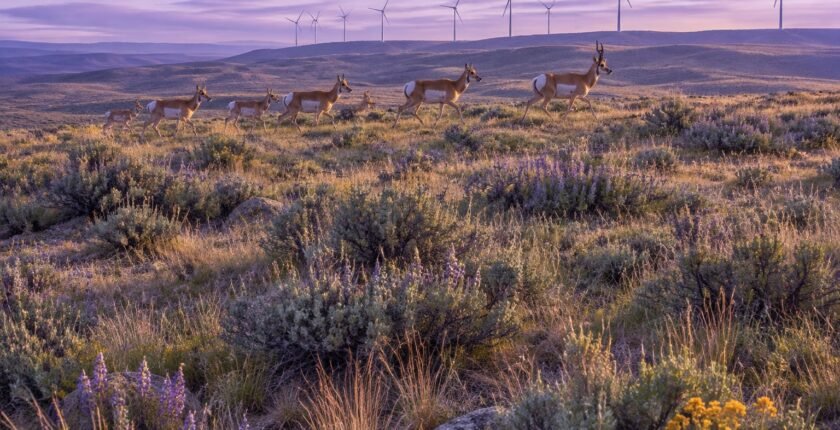
Wyoming pronghorn fitted with GPS collars by the U.S. Geological Survey (USGS) kept using their traditional migration corridors near Medicine Bow, but they behaved differently once wind turbines were close by. Researchers followed 117 adult animals across two windows, 2010 to 2012 and 2018 to 2020. In spring the herds moved faster past turbines. In winter they stopped less often nearby and stuck less closely to their usual routes. The findings matter now because Wyoming has about 3,700 megawatts of large-scale wind online and roughly eight gigawatts more proposed or being built. Ranchers, landowners and municipal leaders already oppose projects that cross game migration paths. The open question is no longer whether pronghorn can pass wind farms. It is where the turbines should go.
Key takeaways
- The study: The U.S. Geological Survey fitted 117 adult pronghorn near Medicine Bow, Wyoming, with high-resolution GPS collars during 2010 to 2012 and 2018 to 2020.
- Spring behaviour: Pronghorn crossing their traditional corridors in spring travelled faster when their route took them near operating wind turbines.
- Winter behaviour: Close to the turbines, the tracked pronghorn held to their established routes less consistently and made fewer winter stopovers, which USGS researchers read as localized avoidance.
- The buildout: Wyoming runs about 3,700 megawatts of large-scale wind on around 1,500 turbines, and roughly eight gigawatts of further projects would more than double that capacity.
- The grid backdrop: Coal supplies more than 70% of Wyoming's electricity, and the state's yearly carbon dioxide output works out to roughly 68.55 metric tons for each resident.
Table of contents
- Key takeaways
- What 117 GPS Collars Revealed About Pronghorn Near Turbines
- Why Faster Spring Travel and Fewer Winter Stops Matter
- Wyoming's Coal-Heavy Grid Is Driving the Wind Buildout
- Eight Gigawatts of Projects Meet Local Resistance
- Can Wyoming add wind without breaking migration routes?
- What to be careful about
- Frequently asked questions
What 117 GPS Collars Revealed About Pronghorn Near Turbines
USGS researchers ran the work in south-central Wyoming, near the town of Medicine Bow, where large wind farms sit across open sagebrush country. They collared 117 adult pronghorn in two separate periods, 2010 to 2012 and 2018 to 2020. Telemetry is the remote recording of an animal's position, and these collars logged location at a fine enough scale to measure speed and route choice close to individual sites.
The team set those tracks against the distance to each turbine, as well as maps of roads and fences and a set of environmental variables. That let the analysis separate the effect of wind infrastructure from other barriers a pronghorn meets on the steppe. The outputs covered three things: how fast the animals moved, which habitat they chose, and the overall shape of their movement.
The headline result is mixed. The herds did not abandon their historical corridors. They still crossed the same country. But the turbines changed how they moved through it, and that change showed up in both spring and winter.
Why Faster Spring Travel and Fewer Winter Stops Matter
In spring, pronghorn picked up their pace when a migration leg brought them near wind infrastructure. In winter, animals close to operating turbines made fewer stopovers and showed less route fidelity, meaning they were less likely to repeat the paths they had used before. USGS researchers interpreted the pattern as localized avoidance: the animals kept moving rather than lingering near the machines.
A stopover is where a migrating animal pauses to rest and feed. Anke Maree, a staff writer who covered the study, argued that losing those stops cut deeply into winter foraging time. That is a reasonable reading of fewer stopovers, but the published description of the findings gives no measured figure for lost feeding time, speed increase or distance at which the effect began.
Without those numbers, the size of the impact remains unclear. The direction is consistent across seasons. Whether it affects body condition, survival or herd size is a separate question that tracking speed and stops alone cannot settle.
Wyoming's Coal-Heavy Grid Is Driving the Wind Buildout
Wyoming leans on coal for more than 70% of its electricity output. Because of that dependence, the state's annual carbon dioxide output averages about 68.55 metric tons for every resident. It also ships far more energy than it uses, exporting about 12 times its own consumption to markets including Colorado and California.
A Renewable Portfolio Standard is a state law requiring utilities to source a set share of power from renewables. Wyoming has none. The pressure comes from its customers instead, because the states buying its power have their own clean energy procurement rules. To keep selling into those grids as demand rises, Wyoming needs more low-carbon generation.
Wind is the obvious candidate. The state's high plains carry strong, steady wind, and new turbines let Wyoming stay a major energy exporter while easing its coal dependence. That commercial logic is why the pronghorn findings carry weight: the projects are coming regardless, so the debate is about placement.
Eight Gigawatts of Projects Meet Local Resistance
Wyoming currently operates about 3,700 megawatts of large-scale wind, spread across roughly 1,500 turbines. Around eight gigawatts of proposed and under-construction projects would more than double that installed base. Wyoming does not rank among the top five wind-producing states, but its pipeline is growing quickly.
Opposition has grown alongside it. Municipal leaders, ranchers and landowners object to effects on property values, land access and views, and to ecological damage. The sharpest resistance concerns habitat fragmentation along historical game corridors, with local groups arguing that sprawling wind farms threaten seasonal movement across the sagebrush. The USGS study began as a response to those concerns.
Maree argued that developers should adopt micro-siting adjustments, mandatory buffer zones around corridors and seasonal slowdowns of turbine operation. Those are proposals rather than tested remedies. The USGS findings describe changed behaviour, but the published description of the work does not show whether any of these measures would reverse it.
| Behaviour | Observed near turbines | Season |
|---|---|---|
| Use of traditional corridors | Continued | Year-round |
| Travel speed | Faster | Spring migration |
| Route fidelity | Reduced | Winter |
| Stopovers | Fewer | Winter |
Can Wyoming add wind without breaking migration routes?
The case for
- Pronghorn kept crossing their historical corridors, so the turbines did not sever the routes outright.
- Fine-scale GPS data linked to turbine distance gives developers a basis for siting new projects away from the most-used paths.
- Proposed measures such as corridor buffers and seasonal slowdowns could be written into the roughly eight gigawatts of projects before they are built.
The case against
- Fewer winter stopovers near turbines point to less time spent resting and feeding in the hardest season.
- Doubling installed capacity would put more turbines along the same open steppe the herds rely on.
- Local opposition over migration corridors could slow or block projects that Wyoming's export customers need.
What to be careful about
- The tracking covered one area near Medicine Bow, so the results may not apply to other Wyoming herds or terrain.
- No magnitudes for speed change, lost foraging time or avoidance distance are available, which makes it hard to size buffers.
- The most recent data end in 2020 and predate much of the eight gigawatts now planned.
- Suggested mitigations such as seasonal turbine slowdowns have not been shown to reverse the observed behaviour.
The bottom line
The USGS work near Medicine Bow gives Wyoming something it lacked: tracking data instead of competing assumptions. Pronghorn did not stop crossing their corridors when turbines went up, which undercuts claims that wind farms simply cut migration routes. But the animals hurried through in spring and paused less in winter, and that is a real cost in a season when feeding time is scarce. What the findings cannot yet say is how large that cost is, or whether buffers and seasonal slowdowns would reduce it. With roughly eight gigawatts in the pipeline and coal still dominant, Wyoming will build more wind. The study's practical value is in deciding where those turbines go.
What to watch
- Watch whether developers behind Wyoming's roughly eight gigawatts of proposed and under-construction wind projects adopt corridor buffers or seasonal operating limits; no timetable has been set.
- Watch for further USGS analysis showing how large the speed and stopover effects were and whether they affect pronghorn condition or survival; no release date has been announced.
- Watch whether opposition from ranchers, landowners and municipal leaders over migration corridors delays any of the planned projects; no decision dates have been given.
Frequently asked questions
Do wind turbines stop pronghorn from migrating?
Not in the USGS tracking near Medicine Bow, Wyoming. The 117 collared pronghorn still used their historical corridors. They changed speed, route loyalty and stopover habits near turbines rather than abandoning the routes.
Why does Wyoming need more wind power if it already exports energy?
Wyoming gets more than 70% of its electricity from coal and exports about 12 times the energy it consumes to states such as Colorado and California. Those buyers have clean power procurement requirements, so Wyoming needs low-carbon supply to keep serving them.
How much wind capacity is planned in Wyoming?
The state has about 3,700 megawatts of large-scale wind online across roughly 1,500 turbines. Around eight gigawatts of proposed and under-construction projects would more than double that.
Related reading