
Blog
Envision Energy’s global push in wind power
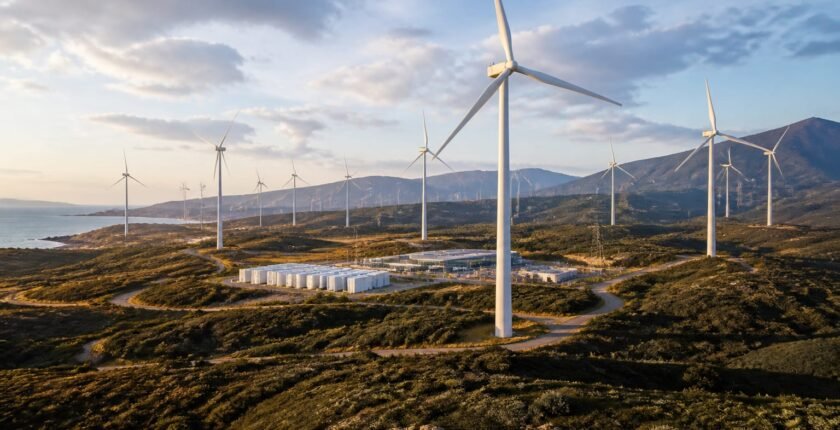
Estimated reading time: 5 minutes · Last updated:
Envision Energy, founded in 2007 and headquartered in Shanghai, is exporting Chinese wind-turbine technology and integrated storage systems to Europe, Latin America, Australia and beyond. The company reports 103 gigawatts of wind installations and more than 50 gigawatt-hours of battery capacity, and it is combining turbines, grid-scale batteries and AI control to steady supply for large electricity users. That engineering approach underpins Mission Gobi, announced in June 2026, which targets five gigawatts of renewables-based capacity for data centers by 2030 and whose first large site — the Galaxy Campus in Ulanqab, Inner Mongolia — has been commissioned and will reach two gigawatts when complete.
Key takeaways
- Scale: Envision Energy reports 103 gigawatts of installed wind power and more than 50 gigawatt-hours of battery energy storage systems.
- Data‑center plan: Mission Gobi, announced in June 2026, aims to assemble five gigawatts of renewable capacity for AI data centers by 2030.
- First renewable‑powered data center: Envision says it directly powered a data center entirely with renewable energy at a facility that opened in Chifeng, China.
- Exports and projects: The company is delivering projects in Germany, Brazil and Australia and will start a 200-megawatt nearshore project in Vietnam in the first half of 2027.
Table of contents
- Key takeaways
- A Chinese manufacturer scaled to global reach
- Project footprint: Germany to Brazil to Australia
- Powering AI facilities with wind, batteries and prediction
- Operational and market challenges for an integrated model
- Where Envision could gain — and where it may stall
- What to be careful about
- Frequently asked questions
A Chinese manufacturer scaled to global reach
Envision Energy began in 2007 and now reports a global fleet of 103 gigawatts of wind turbines and over 50 gigawatt-hours of battery systems. Those raw figures place the company among the largest renewable engineering firms by capacity, and the firm has developed hardware and software to run fleets rather than sell standalone turbines. Its smart turbines adjust operating parameters to current wind conditions, and the company has trialed two-blade designs that it says may cut costs versus conventional three-blade models after long-duration testing.
Scaling from domestic deployment to international contracts requires different capabilities. Envision is marketing integrated systems—turbine hardware, onsite batteries and AI models that forecast wind and match supply to demand—so projects overseas are framed as complete energy platforms. That package changes procurement and operation: buyers evaluate software accuracy, battery sizing and the local supply chain as much as rotor diameter and tower design.
Project footprint: Germany to Brazil to Australia
The company is active on several continents. In Germany it is building battery energy storage systems intended to support grid flexibility. In Brazil it continues plans for a net-zero industrial park first announced in May 2025 that would run on wind and produce sustainable aviation fuel, hydrogen and ammonia. In Australia Envision has installed 17 turbines and is deploying turbine-control systems to optimise output.
One named installation the company cites is Narrogin Wind Farm in Australia; Envision plans smart turbines there that the company says will help power nearly 100,000 homes. Overseas projects include nearshore and onshore sites; the firm is scheduled to begin delivery on a 200-megawatt Vietnam project in the first half of 2027, which the material identifies as its largest nearshore overseas assignment to date. Each market brings permitting, environmental review and local-partnership challenges that the company must manage while transferring operations skills across jurisdictions.
Powering AI facilities with wind, batteries and prediction
Envision is positioning wind plus storage as a direct supply option for energy‑intensive AI data centers. The company says it was the first to directly power a data center entirely with renewable energy at a facility that opened in Chifeng, China, and it has commissioned the Galaxy Campus in Ulanqab, Inner Mongolia, which the company says will reach two gigawatts when fully built.
Mission Gobi, announced in June 2026, sets a target of five gigawatts of renewables capacity for desert and arid-region data centers by 2030. The plan pairs turbines and batteries with predictive models that balance generation, storage and demand in real time. Cooling on these sites avoids water by relying on alternative coolants and dry coolers, according to the company; the result is an integrated design that seeks redundancy through storage and forecasting rather than continuous grid supply.
Operational and market challenges for an integrated model
Engineering alone does not guarantee project delivery. The material stresses that manufacturers must also work with local developers, clear planning and environmental hurdles, and engage communities. Building an integrated energy system means setting up local operations teams, training partners and ensuring spare‑parts logistics for turbines and batteries in remote regions.
For AI data centers the core technical difficulty remains steady, guaranteed power. The firm argues its predictive models reduce mismatch between variable generation and computing demand, but projects still require redundancy and transmission arrangements to guarantee uptime. On the market side, competition for cross-border projects comes from established multinational turbine suppliers and from local project developers that control land and grid interconnection rights.
| Project / Initiative | Location | Capacity | Status |
|---|---|---|---|
| Envision global fleet | Worldwide | 103 gigawatts | Operating |
| Battery systems (cumulative) | Worldwide | >50 gigawatt-hours | Operating |
| Galaxy Campus | Ulanqab, Inner Mongolia | 2 gigawatts (when fully built) | Commissioned |
| Vietnam nearshore project | Vietnam | 200 megawatts | Delivery due H1 2027 |
| Mission Gobi | Arid regions worldwide | 5 gigawatts (target) | Announced June 2026 |
Where Envision could gain — and where it may stall
The case for
- Integrated hardware-plus-software offerings lower operating costs for large customers if forecasting and storage reduce need for backup grid power.
- Demand growth for electricity, cited in the material at 3.5%–4% per year globally, increases the market for utility-scale renewables and onsite data‑center supply.
The case against
- Local permitting, environmental reviews and community pushback could delay or add cost to overseas projects, especially in regions without established wind supply chains.
- AI data centers require high availability; if forecasting and battery buffers fail to provide required redundancy, customers may prefer grid-tied backup or fossil-fuel peakers instead of renewables-driven designs.
What to be careful about
- Delays in grid connection or permitting for overseas projects that rely on local partners and approvals.
- Underperformance of predictive models in extreme or rapidly changing weather, increasing need for backup generation.
- Supply-chain or logistics problems scaling spare‑parts and maintenance for remote, integrated sites.
- Policy shifts or local content rules that favour domestic suppliers over foreign turbine manufacturers.
The bottom line
Envision Energy is translating domestic scale into international projects by selling integrated renewable systems rather than components: turbines, batteries and AI-driven control. The company’s reported 103 gigawatts of wind capacity and its Mission Gobi target of five gigawatts by 2030 frame a clear commercial strategy to serve large, steady consumers such as AI data centers. Execution will hinge on local partnerships, permitting and the real‑world performance of forecasting and storage; the Vietnam delivery slated for the first half of 2027 and the Galaxy Campus expansion are immediate tests of whether Envision’s integrated model can be exported reliably.
What to watch
- Watch for the start of delivery on Envision’s 200-megawatt nearshore project in Vietnam in the first half of 2027.
- Watch whether Mission Gobi reaches five gigawatts of renewables capacity for data centers by 2030.
- Watch progress at the Galaxy Campus in Ulanqab; no final completion date has been set.
Frequently asked questions
How large is Envision Energy’s installed base?
Envision reports 103 gigawatts of wind power installations worldwide and more than 50 gigawatt-hours of battery energy storage systems.
What is Mission Gobi and what does it target?
Mission Gobi, announced in June 2026, is Envision’s plan to develop five gigawatts of renewable‑generated capacity by 2030 to power data centers in deserts and arid regions.
When will Envision start delivering its Vietnam project?
The material states Envision is scheduled to begin delivery of a 200-megawatt wind project in Vietnam in the first half of 2027.
Related reading