
Blog
GICON Wind Turbine Jacked to 984-Foot Hub in Schipkau
Estimated reading time: 7 minutes · Last updated:
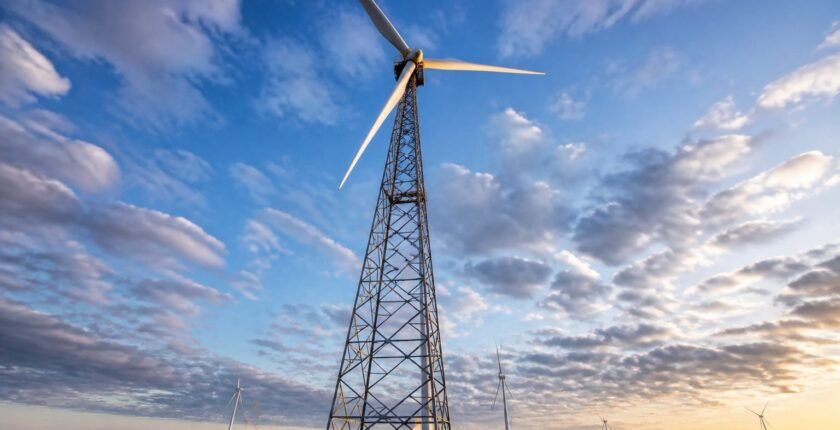
GICON, an engineering group from Dresden, has raised a complete 3.8-megawatt wind turbine to a hub height of 984 feet in Schipkau, eastern Germany, without using a crane for the final stretch. Hydraulic strand jacks pushed an 827-ton load, the turbine plus the inner tower carrying it, up through a lattice outer tower at about 30 feet an hour. The climb finished on 28 September with the blade tips at 1,198 feet. Gusts cancelled the planned 20 September start and kept halting progress for a week. The GICON wind turbine stands in an existing wind farm about 71 miles south of Berlin. The company expects a grid connection by the end of October and an official switch-on in November.
Key takeaways
- Record height: The GICON turbine in Schipkau reached a 984-foot hub height on 28 September, and its blade tips now sit at 1,198 feet.
- No crane at the top: Hydraulic strand jacks moved an 827-ton load at about 30 feet an hour, sliding an inner tower up through an outer lattice just under 525 feet tall.
- Unproven yield: GICON says a year of readings from a 984-foot mast show about 40 percent more wind energy at that height, but Ingenieur.de notes no independent data backs this yet.
- Costly pilot: Christoph Winkler of the Jülich research center told Cleanthinking the pilot costs nearly four times as much per unit of capacity as a normal new turbine.
- Next steps: GICON expects grid connection by the end of October and an official switch-on in November, with a German Sustainability Award ceremony on 3 December in Düsseldorf.
Table of contents
Why a Crane Cannot Set a Hub at 984 Feet
A conventional onshore turbine goes up with a large mobile crane. The crane stacks the tubular tower sections, then lifts the nacelle and blades onto the top. That method has a ceiling, because the tallest conventional onshore machines stop at around 820 feet in total, and nobody builds a crane that can place a nacelle at 984 feet.
GICON's workaround is a tower nested inside another. The outer structure is a broad steel lattice just under 525 feet tall, shaped much like a power pylon. A narrower inner tower sits within it. Crews mounted the turbine on that inner tower at about 490 feet, still within crane reach. The inner tower then slid upward through the outer one, like a telescope extending, and locked at full height. That left the last 400 feet or so to be climbed without any crane.
The lifting gear was the hydraulic strand jack, a tool heavy-lift contractors use to raise bridge decks. A strand jack is a cylinder that clamps a bundle of steel cables and climbs them a few inches with each stroke, repeating the cycle for hours. Once the inner tower is counted, the moving load came to 827 tons, rising at roughly 30 feet an hour.
How a Planned 24-Hour Climb Stretched Into a Week
GICON had booked the lift for Sunday 20 September, and Schipkau held its community festival that day regardless. Strong gusts called off the start. All week the company kept saying that safety had to come ahead of speed. That was a sensible line with 827 tons hanging on cables hundreds of feet up.
By the following Sunday the inner tower had climbed to about 820 feet and the whole structure measured 1,033 feet. Those figures come from dpa reports relayed by Cleanthinking, a German clean-energy outlet. The last stretch ran on Monday 28 September, and GICON announced full height that evening. Jochen Großmann, founder and chairman of GICON, described reaching 1,198 feet as overwhelming for the whole team.
How long the jacks actually ran is unclear, because GICON has published no log of the stop-start week. Ingenieur.de, the trade outlet of the German engineering association, said the lift was scheduled to take roughly 24 hours, with the inner tower climbing some 30 feet each hour. Luis Reyes worked out from the published heights that the inner tower travelled roughly 430 to 460 feet.
Why GICON Wants Turbines 984 Feet Up
Trees, buildings and terrain break up the wind close to the ground. A few hundred feet higher it usually blows harder and more evenly. In steadier air, a turbine spends more hours of the year at full output and less time idling through lulls.
GICON did not rely on models alone. It put up a 984-foot measurement mast at the site and logged wind for a year before committing to the tower. GICON says the air at that height carries about 40 percent more energy. It calculates that this means roughly double the electricity from the same rotor. Ingenieur.de notes that no independent data supports those figures yet.
Vensys supplied the turbine, which is rated at 3.8 megawatts and turns a rotor measuring 413 feet across. GICON rates it for at least about 18 gigawatt-hours a year, enough, the company says, for up to 7,500 homes. The tower stands inside an existing wind farm because GICON pitches the idea as a second tier of generation above land that already produces power. For series production, the plan is to fit a turbine rated above 7 megawatts. GICON says the design could be repeated up to 4,000 times across Germany.
What the Pilot Costs and Who Is Paying
SPRIND, the German federal innovation agency, has funded the project since 2020, more recently through a subsidiary named beventum. German press has put the budget at $23 million to $35 million.
Christoph Winkler of the Jülich research center told Cleanthinking that the pilot costs nearly four times as much per unit of capacity as a normal new turbine. He said a production run with a larger turbine could cut tower cost per kilowatt by a third or more. Even with that cut, the tower would not match the cost of a normal turbine. Series production would have to prove the economics.
The structure holds more than 2,200 tons of steel in about 22,000 parts, fastened with around 80,000 high-strength bolts. According to the German news site t-online, a QR code is attached to each bolt field, and installers scan it before tightening the bolts to the specified torque. GICON says the build ran into trouble. It broke ground two Septembers before the lift, then lost the winter when its own quality control found faulty steel parts from a subcontractor. Work resumed on 2 March, and the steel shell was finished in mid-July.
| Measure | Height | Reported by |
|---|---|---|
| Turbine mounting point on inner tower | About 490 ft | GICON |
| Outer lattice tower | Just under 525 ft | GICON |
| Tallest conventional onshore turbines (total) | Around 820 ft | Industry comparison |
| Inner tower, Sunday before completion | About 820 ft | dpa via Cleanthinking |
| Whole structure, Sunday before completion | 1,033 ft | dpa via Cleanthinking |
| Final hub height | 984 ft | GICON |
| Final blade-tip height | 1,198 ft | GICON |
Can the high-altitude tower pay its way?
The case for
- GICON's year of mast readings indicates about 40 percent more wind energy at 984 feet, which it says means roughly double the electricity from the same rotor.
- The tower sits within an existing wind farm, so the concept adds a second layer of output over land already in use.
- Winkler says a production run with a larger turbine could cut tower cost per kilowatt by a third or more.
- GICON says the design could be repeated up to 4,000 times across Germany with turbines of more than 7 megawatts.
The case against
- No independent data yet supports the 40 percent energy gain, as Ingenieur.de points out.
- Winkler puts the pilot's cost per unit of capacity at nearly four times that of a normal new turbine.
- Faulty subcontractor steel cost the project a winter, and wind stretched a planned 24-hour climb into a week.
What to be careful about
- The yield case rests on GICON's own measurements; if output falls short of the projected gain, the economics weaken further.
- At nearly four times the capacity cost of a standard turbine, the concept depends on series production that does not yet exist.
- Weather sensitivity during the lift, which cost a week, could repeat during maintenance or blade replacement at this height.
- Construction quality has already been an issue, with faulty steel parts from a subcontractor flagged by GICON's own checks.
The bottom line
The height record is set, but the result that matters is still pending. GICON's case rests on its own year of wind readings showing about 40 percent more energy at 984 feet, and the turbine now has to show that in grid output. Großmann says a connection by the end of October is possible, with the official switch-on planned for November. GICON announced on 16 October that the German Sustainability Award for 2027 had gone to the tower, which was honoured in the products category. Luis Reyes calls it the second-tallest structure in Germany, standing on the spoil heap of a former coal strip mine. Winkler's cost figures show how far it still is from a commercial product.
What to watch
- Watch for GICON to confirm the grid connection, which Jochen Großmann says is possible by the end of October.
- The official switch-on is planned for November, and its first output figures will test the claimed 40 percent energy gain.
- The German Sustainability Award for 2027 will be presented at a ceremony on 3 December in Düsseldorf.
Frequently asked questions
Who is paying for the Schipkau high-altitude wind tower?
SPRIND, the German federal innovation agency, has funded the project since 2020, more recently through its subsidiary beventum. German press has put the budget at $23 million to $35 million.
Has anyone independently checked GICON's wind measurements at 984 feet?
Not yet. GICON logged wind with a 984-foot mast for a year and reports about 40 percent more energy at that height, but Ingenieur.de notes no independent data backs the figure. Output after the November switch-on will be the first real test.
How much electricity will the GICON turbine produce?
GICON rates the 3.8-megawatt Vensys unit for at least about 18 gigawatt-hours a year. The company says that is enough for up to 7,500 homes.
How tall is the GICON tower compared with Germany's tallest structure?
With blade tips at 1,198 feet, the Schipkau tower is about 10 feet shorter than the Berlin TV Tower, which Luis Reyes of Autonocion identifies as the tallest structure in Germany. He describes the turbine as the second-tallest structure in the country.
Related reading