
Blog
Hydrogen City Project Picks Samcheok and Donghae
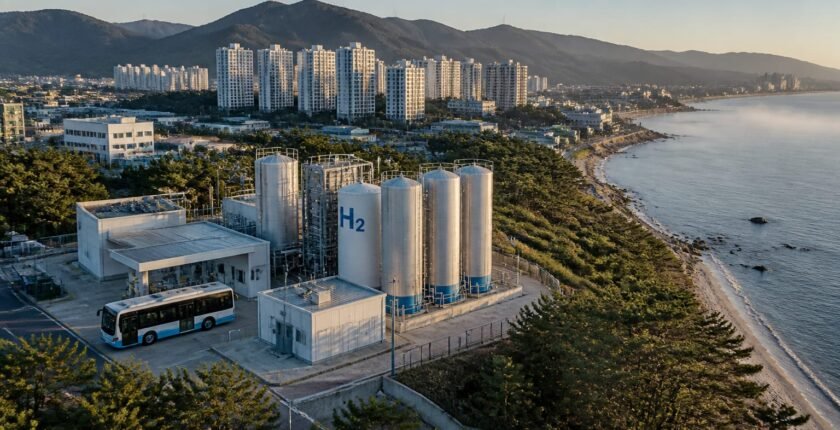
Estimated reading time: 4 minutes · Last updated:
Samcheok and Donghae, two cities in Gangwon State, have been chosen for the hydrogen city project and will receive 20 billion won in national funding. The plan joins production and storage sites the cities built separately with a 2.5-kilometer pipeline, so hydrogen can reach industrial complexes, senior centers and swimming pools. Together the pair will form Gangwon State's first hydrogen city, as first reported by Financial News. Gangwon State's plan adds a reforming plant able to make 1.3 tons of hydrogen per day. It also draws on green hydrogen from a solar-powered electrolysis facility now being built in Donghae. No completion date has been published.
Key takeaways
- Selection and funding: Samcheok and Donghae won a place in the hydrogen city project, backed by 20 billion won of national money.
- New production: Gangwon State's plan adds a reforming-based hydrogen unit rated at 1.3 tons per day.
- Green supply: A solar-powered water electrolysis plant under construction in Donghae will also feed the network.
- Delivery network: A 2.5-kilometer pipeline plus one-ton-class storage and loading will serve industrial complexes, senior centers and swimming pools.
Table of contents
How a Pipeline Ties Two Cities' Hydrogen Together
The core idea is connection. Samcheok and Donghae have each built hydrogen facilities on their own, and the project links them physically. A 2.5-kilometer pipeline will move hydrogen between sites, backed by a storage and loading facility in the one-ton class.
Gangwon State's plan names three kinds of user: industrial complexes, senior centers and swimming pools. Two of the three are facilities that residents use directly, so the project reaches beyond industry.
The plan, provided by Gangwon State, does not state how much hydrogen each user group will take.
Where Will the Hydrogen Come From?
Supply rests on two sources. The first is a new reforming-based production facility rated at 1.3 tons per day. Reforming is a chemical process that releases hydrogen from another fuel. Gangwon State's plan does not say which feedstock the new unit will use.
The second is green hydrogen from Donghae, where a water electrolysis facility running on solar power is under construction. Electrolysis splits water into hydrogen and oxygen using electricity, which is why solar-fed output counts as green. No capacity figure for the Donghae plant appears in the plan.
What 20 Billion Won Buys, and What Is Still Missing
The 20 billion won is national funding, and it arrives with the selection. The plan does not give a total project cost or any city or provincial share, nor does it name the body that ran the selection.
Samcheok also appears in an AI-generated rendering, published with the announcement, of a liquid hydrogen receiving terminal at commercial scale. How that terminal relates to the city pipeline is not explained in the plan.
| Component | Role | Size | Status |
|---|---|---|---|
| Reforming-based production facility | Production | 1.3 tons per day | To be added |
| Solar-powered water electrolysis facility, Donghae | Green hydrogen production | Not stated | Under construction |
| Pipeline | Delivery between sites and users | 2.5 kilometers | Planned |
| Storage and loading facility | Storage and dispatch | One-ton class | Planned |
What could help or hold back the hydrogen city
The case for
- The project reuses production and storage assets Samcheok and Donghae have already built, rather than starting from nothing.
- National funding of 20 billion won gives the plan committed public backing.
- Solar-powered electrolysis in Donghae adds a green hydrogen source alongside reforming.
The case against
- The Donghae electrolysis facility is still under construction and has no published capacity.
- The reforming unit's feedstock is not specified, so the share of low-carbon supply cannot be judged.
- No total budget or timetable has been made public.
What to be careful about
- Green supply depends on the Donghae electrolysis plant being completed, and no completion date is given.
- With production at 1.3 tons per day from reforming and one-ton-class storage, a shortfall at either site could interrupt supply to public facilities such as pools and senior centers.
- The national grant of 20 billion won may not cover the full cost, and other funding shares are undisclosed.
The bottom line
The Samcheok-Donghae plan is small and specific: one 1.3-ton-per-day reforming unit, one solar electrolysis plant still being built, a 2.5-kilometer pipeline, plus loading and storage gear in the one-ton class. Its value lies in joining assets the two cities developed apart and pointing them at daily users as well as industry. The 20 billion won in national funding gives the project backing. What it still lacks is a timetable, a total budget and an output figure for the Donghae electrolyser. Those numbers will show whether Gangwon's hydrogen city becomes a working network.
What to watch
- Watch for completion of the solar-powered electrolysis facility in Donghae; no date has been set.
- Watch for Gangwon State to publish a construction schedule for the 2.5-kilometer pipeline and the 1.3-ton-per-day reforming unit; no date has been announced.
- Watch for disclosure of the total project budget beyond the 20 billion won in national funding; no date has been given.
Frequently asked questions
Who will use hydrogen from the Samcheok-Donghae hydrogen city?
Gangwon State's plan lists industrial complexes, senior centers and swimming pools as users. Hydrogen will reach them through a 2.5-kilometer pipeline.
How much funding did Samcheok and Donghae receive?
The two cities secured 20 billion won in national funding through their selection. A total project cost has not been made public.
Is the hydrogen in the Samcheok-Donghae project green?
Part of it is: in Donghae, a plant is being built that will use solar power to split water by electrolysis, and that plant will supply green hydrogen. The rest comes from a new reforming unit rated at 1.3 tons per day, whose feedstock is not specified.
Related reading