
Blog
NC school rooftop solar could power nearly 150,000 homes
Estimated reading time: 5 minutes · Last updated: 2026-08-20
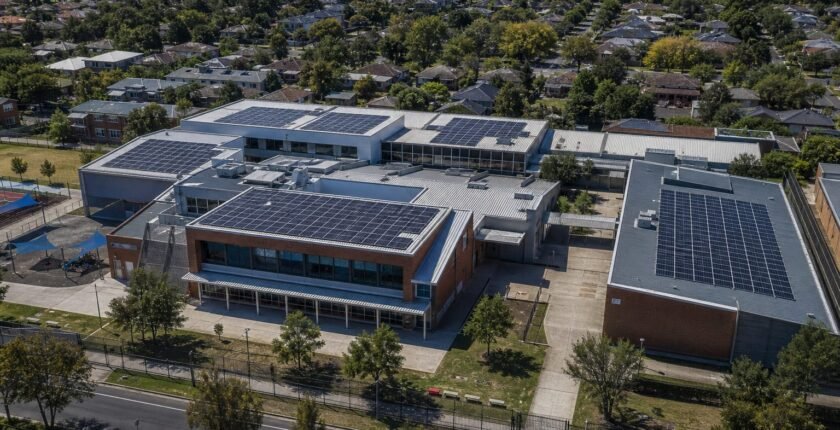
A new analysis from Environment North Carolina Research & Policy Center and Frontier Group finds North Carolina public school rooftops could host roughly 900 megawatts of solar capacity and produce about 1.6 terawatt-hours in the first year — roughly the annual electricity use of nearly 150,000 homes. Wake County alone accounts for an estimated 75 megawatts from 204 public and charter schools, producing the equivalent of about 12,200 typical U.S. households. These findings are drawn from the groups’ statewide screening-level analysis, as first reported by WRAL.
Key takeaways
- Statewide potential: The analysis finds more than 900 megawatts of rooftop solar capacity across North Carolina public schools, producing about 1.6 terawatt-hours in year one.
- Wake County lead: Wake County could support about 75 megawatts from 204 schools, estimated to match the annual electricity use of about 12,200 homes.
- School stock and suitability: Researchers report roughly 2,400 public schools — about 90% of those analyzed — have at least some rooftop area suitable for panels based on a 100-school random sample and adjustments for obstructions and roof condition.
- Policy barriers: The report recommends a solar schools grant program, allowing third-party power purchase agreements, and funding for roof and electrical upgrades to unlock installations.
- Emissions impact: If fully developed, the rooftop solar scenario could avoid about 1.3 million tons of CO2 emissions from power plants each year, according to the analysis using an EPA model.
Table of contents
- Key takeaways
- How large is the school rooftop resource in North Carolina?
- Why installing panels won’t produce identical savings at every district
- Policy barriers the report says block wider adoption — and the fixes proposed
- Carbon, local resilience and the role of batteries
- Outlook: what could speed or stall school solar
- What to be careful about
- Frequently asked questions
How large is the school rooftop resource in North Carolina?
The analysis converts school building footprints, satellite imagery and solar modeling into a statewide screening estimate. Aggregated across districts, the study finds the rooftop surfaces analyzed could host more than 900 megawatts of solar capacity and generate about 1.6 terawatt-hours in the first year. The authors explain this output equals roughly 1.2% of the electricity the state currently uses each year.
At county level, Wake County ranks first with about 75 megawatts of potential from an estimated 204 public and charter schools. Mecklenburg follows with about 71 megawatts, Guilford about 41 megawatts, Durham about 24 megawatts and Johnston about 21 megawatts. The report also expresses total rooftop area as the equivalent of over 1,300 football fields to give a sense of scale.
The groups describe the statewide numbers as a screening-level estimate: individual school suitability varies and would require site-specific engineering and financial review before any installation could proceed.
Why installing panels won’t produce identical savings at every district
Schools are attractive solar sites because they have large flat roofs and daytime electricity use, but that does not guarantee uniform savings. The report notes schools face commercial billing features such as demand charges based on peak use; solar only lowers those costs when generation coincides with a district’s peak demand.
Summer production can be high while building demand is low, which reduces the overlap that creates the biggest utility bill savings. The analysis also points to necessary preconditions that raise initial costs: many schools will need roof repairs, electrical upgrades or other building work before panels can be safely fitted.
The report cites federal data showing average commercial electricity prices in North Carolina rose 24% from 2021 to 2024, a trend that could make solar more attractive over time but is not a short-term guarantee of payback at every site.
Policy barriers the report says block wider adoption — and the fixes proposed
A central policy barrier flagged is North Carolina’s prohibition on third-party power purchase agreements (PPAs). The report notes PPAs and leases are the dominant financing models for K–12 solar elsewhere because a private developer covers upfront installation costs and sells electricity under a long-term contract. Without that option, districts face heavier capital requirements.
To address the financing and condition gaps, the report recommends three state actions: establish a targeted solar schools grant program, allow third-party PPAs, and provide funds for roof and electrical upgrades needed to host systems. The authors also call for a review of utility interconnection practices and rate structures that affect project economics.
Implementing those recommendations would require legislative or regulatory change. The report treats its recommendations as policy options rather than imminent measures; it does not assume any specific bills or rulemakings are already scheduled.
Carbon, local resilience and the role of batteries
Using a U.S. Environmental Protection Agency emissions model, the analysis estimates full deployment of the identified rooftop potential would avoid about 1.3 million tons of CO2 from power plants annually. The study also reports reductions in nitrogen oxides and fine particulate emissions as fossil generation displacement rises.
The authors highlight a secondary community benefit when solar is paired with battery storage: schools often serve as emergency shelters during hurricanes, and combined solar-plus-storage systems can provide limited power during outages depending on system size and design. The report cites existing programs such as NC GreenPower’s Solar+ Schools grants as examples of smaller installations used for education and resilience.
Those community benefits are offered as additional rationale for targeted funding and policy changes, not as quantified outputs in the statewide production estimate.
| County | Estimated potential (MW) | Equivalent homes (where stated) |
|---|---|---|
| Wake County | 75 | 12,200 |
| Mecklenburg County | 71 | — |
| Guilford County | 41 | — |
| Durham County | 24 | — |
| Johnston County | 21 | — |
Outlook: what could speed or stall school solar
The case for
- Rising commercial electricity prices (federal data show a 24% increase in North Carolina from 2021 to 2024) would improve project economics over time by raising avoided costs.
- State grants for roof repair and targeted programs such as a solar schools grant could unlock projects that are technically feasible but capital-constrained.
The case against
- North Carolina’s ban on third-party PPAs limits common low-capex financing routes used by most K–12 installations nationally.
- Widespread need for roof and electrical upgrades increases upfront costs and delays projects, especially in districts with older facilities.
What to be careful about
- Site-level viability: the statewide estimate is screening-level; many rooftops will prove technically unsuitable or require costly upgrades.
- Financing gap: prohibition of third-party PPAs in North Carolina constrains low-upfront-cost models commonly used for school solar elsewhere.
- Mismatch of production and demand: solar output timing, notably high summer generation, may not align with peak demand that drives commercial bills.
- Policy and interconnection constraints at the utility level could lengthen project timelines or raise costs.
The bottom line
The screening-level analysis assembled by Environment North Carolina Research & Policy Center and Frontier Group shows a substantial untapped rooftop solar resource across North Carolina’s public schools — roughly 900 megawatts and 1.6 terawatt-hours in the first year under full deployment. Turning that theoretical potential into working projects will require targeted funding for roof and electrical upgrades, changes to financing rules such as allowing third-party PPAs, and utility practices that improve project economics. For districts considering installations, the priority steps are site-level engineering assessments and a careful review of billing structures that determine whether and when installations pay back.
What to watch
- Watch whether state lawmakers introduce a dedicated solar schools grant program; no date has been set.
- Watch for any bill or regulatory petition to allow third-party power purchase agreements in North Carolina; no date has been set.
Frequently asked questions
How much electricity could Wake County schools generate?
The analysis estimates Wake County could support about 75 megawatts of rooftop solar from an estimated 204 public and charter schools, producing the equivalent annual electricity used by roughly 12,200 typical U.S. homes.
How many North Carolina schools have suitable rooftop area?
Researchers report roughly 2,400 public schools — about 90% of those analyzed — have at least some rooftop area that could host panels, based on a random 100-school sample adjusted for obstructions and roof condition.
Would installing solar always save a school district money?
Not necessarily: the report explains savings depend on factors such as demand charges, timing of solar generation versus peak use, and upfront costs; it also notes North Carolina currently does not allow third-party PPAs, a common low-capex financing model used by many K–12 projects.
Related reading