
Blog
Plug-in solar vs rooftop: what the new UK rules mean
Estimated reading time: 6 minutes · Last updated:
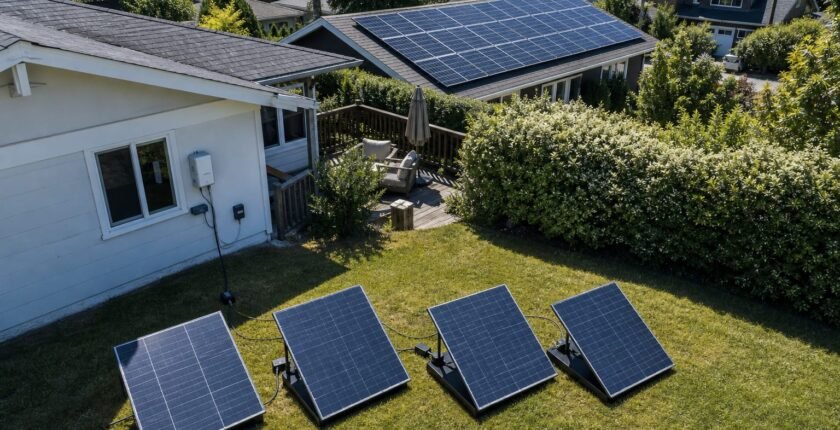
From 27 August 2026, UK rules permit compliant plug-in solar kits to connect to a household socket and supply up to 800VA to a home. The change lets households buy an 800W AC-capable kit that government analysis prices at about £400–£600, rather than commissioning a multi-kilowatt rooftop array that typically costs around £6,500–£8,000. Plug-in kits are much smaller in scale: government modelling shows a well‑positioned 800W system could produce roughly 690 kWh a year, versus representative conventional 4–5 kW rooftop systems modelled at about 4,200 kWh a year. This note explains the technical limits, likely use cases and the trade-offs between the two options.
Key takeaways
- Regulations and limits: From 27 August 2026 compliant plug-in solar devices may supply a maximum of 800VA to a home's electrical installation, with current limited to 3.5A.
- Upfront cost comparison: Government modelling places an 800W plug-in kit at about £400–£600, compared with around £6,500–£8,000 for a typical three-bedroom home's rooftop system.
- Annual generation examples: DESNZ modelling estimates an 800W south-facing, 30°-tilt kit at about 690 kWh/year and a vertical east/west kit at about 378 kWh/year; a 4–5 kW rooftop example is given at about 4,200 kWh/year.
- Practical restrictions: The product rules cover plug-in systems without batteries, permit one device per suitable household final circuit and note G98 network limits currently restrict multiple devices per household.
Table of contents
- Key takeaways
- What the rules allow and their technical limits
- How much electricity an 800W kit will actually deliver
- Costs, value and real-world trade-offs
- Who benefits from plug-in kits and when rooftop remains the better choice
- Outlook: what could expand or constrain uptake
- What to be careful about
- Frequently asked questions
What the rules allow and their technical limits
The new amendments to The Plugs and Sockets etc. (Safety) Regulations 1994 and the Electricity Safety, Quality and Continuity Regulations 2002 take effect on 27 August 2026 and will permit compliant plug-in solar devices to be connected through a standard UK mains plug. Under the government's final interim product specification, the power delivered to the home's electrical installation is capped at 800 VA and the current is limited to 3.5 A.
Manufacturers may fit panels with a combined rated DC capacity of up to 2,000 W, but the government's specification requires them to advise customers whose panels total more than 960 W to seek a professional electrical assessment before use. The specification also excludes systems that incorporate batteries: plug-in battery systems and integrated battery devices fall outside the initial framework.
The specification permits one plug-in device on each suitable household final circuit, but it points to existing network rules — Engineering Recommendation G98 — that presently restrict households from fitting several independent devices. Consumers should therefore follow manufacturer instructions and be cautious about assuming they can scale multiple 800W kits in a single home.
How much electricity an 800W kit will actually deliver
An 800W AC rating is a peak output figure, not a guaranteed annual generation. Actual production depends on siting, tilt, orientation and shading. The Department for Energy Security and Net Zero modelled two occupation and placement examples using average UK irradiance and no battery: a south-facing kit at 30° tilt at about 690 kWh/year, and a vertical east- or west-facing set-up at about 378 kWh/year.
Those estimates also assume partial self-consumption: DESNZ calculated the south-facing example would see roughly 62% of its generation used in the home, and the vertical example about 72%, which reduces the value captured without storage. Anker Solix EU's Kelvin Cao provides a slightly higher example, saying two 500W panels well positioned could deliver around 850 kWh/year, but he stresses timing matters — midday generation often occurs when occupancy and demand are low.
By contrast, the government's guidance lists a typical conventional rooftop output of about 4,200 kWh per year for a 4–5 kW system, highlighting how annual generation from a plug-in kit compares to that from a correctly sized roof-mounted array.
Costs, value and real-world trade-offs
Upfront price is the clearest economic distinction. Government analysis uses a range of £400–£600 for a typical 800W plug-in kit; a professional rooftop installation for a three-bedroom home is cited at about £6,500–£8,000. That makes plug-in kits an accessible entry point for households without the budget or suitable roof space for a full array.
But purchase price is only one variable. A rooftop system's larger annual generation means it can cover a substantially greater share of annual electricity use and therefore deliver larger lifetime bill reductions. The DESNZ examples also exclude any value for exported electricity, so households considering payback should examine local export tariffs and how much generation they can use when it is produced.
Other practical factors affect value: plug-in kits avoid scaffolding and professional installation and are potentially portable for renters, while rooftop arrays support batteries and can be sized to match higher loads such as EV charging or heat pumps.
Who benefits from plug-in kits and when rooftop remains the better choice
Plug-in solar is aimed at households the traditional rooftop market has struggled to reach: flats, renters and properties without suitable roofs. The government's response to its consultation describes the technology as intended to be simpler and lower cost and suggests it could enable people who cannot install conventional panels to generate some of their own electricity.
Industry contributors in the government's consultation materials make a similar point. Phil Steele of Octopus Energy calls plug-in solar "very much a gateway" into generation for those households, while Kelvin Cao at Anker Solix EU highlights portability and simple installation for balconies or garden sheds.
Homeowners with suitable roofs who want rooftop solar to supply a substantial share of their annual electricity—or who intend to add a battery, EV charger or heat pump—will find that a professionally designed roof-mounted system remains the more capable option, because it can be scaled and integrated to serve higher loads.
| Feature | Plug-in solar | Rooftop solar |
|---|---|---|
| System size | Up to 800VA/800W AC output under the new framework; panels up to 2,000W DC rated | Typically several kilowatts; common domestic systems 4–5 kW or larger |
| Typical upfront cost | Government modelling: about £400–£600 for an 800W kit | Around £6,500–£8,000 for a three-bedroom home's installation |
| Annual generation (example) | DESNZ examples: about 690 kWh/year (south 30°) or 378 kWh/year (vertical E/W) | Representative 4–5 kW example: about 4,200 kWh/year |
| Installation | Customer-installed where suitable; manufacturer-supplied plug required | Professionally surveyed, designed and installed with certification |
| Battery pairing | Excluded from the initial product specification | Readily paired with home batteries |
| Portability | Potentially movable with the occupier | Permanent to the property |
Outlook: what could expand or constrain uptake
The case for
- Lower upfront cost and plug-and-play installation should broaden access for renters and flat dwellers.
- Regulatory clarity from 27 August 2026 makes compliant products marketable and easier for consumers to buy with confidence.
- Portability and absence of scaffolding reduce non-financial barriers to entry.
The case against
- The 800VA/3.5A supply limit and current G98 rules mean households cannot easily scale multiple kits, limiting aggregate generation.
- Exclusion of battery-equipped plug-in units from the initial specification reduces the ability to store and capture midday production.
- Timing mismatch between midday generation and occupancy limits bill savings for many households without storage.
What to be careful about
- Households may assume they can aggregate several 800W kits; G98 network limits and the one-device-per-final-circuit note in the specification currently prevent this.
- Because batteries are excluded from the initial framework, a plug-in kit may generate electricity that cannot be consumed and so delivers lower realised savings.
- Some installations will require landlord, freeholder or building-manager permission, which may block use in multi-occupancy buildings.
The bottom line
The regulatory change from 27 August 2026 opens a defined, low-cost route for households to buy compliant 800W plug-in solar kits and connect them to a standard socket. The value proposition is clear for people without roof access, renters and those seeking a low-commitment entry into self-generation: lower upfront cost (about £400–£600) and simple installation. But the limits on supply (800VA/3.5A), the exclusion of batteries from the initial framework and current G98 network rules mean plug-in kits are complementary to, not a substitute for, a properly sized rooftop system that can deliver several times the annual energy and be integrated with storage and higher-demand loads.
What to watch
- 27 August 2026: the amended safety and electricity regulations enabling compliant plug-in solar kits take effect in the UK.
- Watch for any amendment to Engineering Recommendation G98; no date has been set for changes that would permit multiple plug-in devices per household.
Frequently asked questions
What exactly can a plug-in solar kit supply to my home under the new rules?
Under the final interim product specification a compliant device may supply up to 800VA to the home's electrical installation with current limited to 3.5A, and panels may have combined rated DC capacity up to 2,000W.
How much energy might an 800W plug-in kit generate each year?
DESNZ modelling gives two examples: about 690 kWh/year for a south-facing kit at 30° tilt and about 378 kWh/year for a vertical east- or west-facing installation; actual results will depend on site conditions.
Can I buy several 800W kits and run them all in one house?
The product specification permits one device per suitable household final circuit, but DESNZ notes Engineering Recommendation G98 currently restricts multiple devices per household until any network rule change; consumers should follow manufacturers' connection guidance.
Related reading