
Blog
rPlus Energies Secures $450M Credit Line Backed by Solar
Estimated reading time: 7 minutes · Last updated:
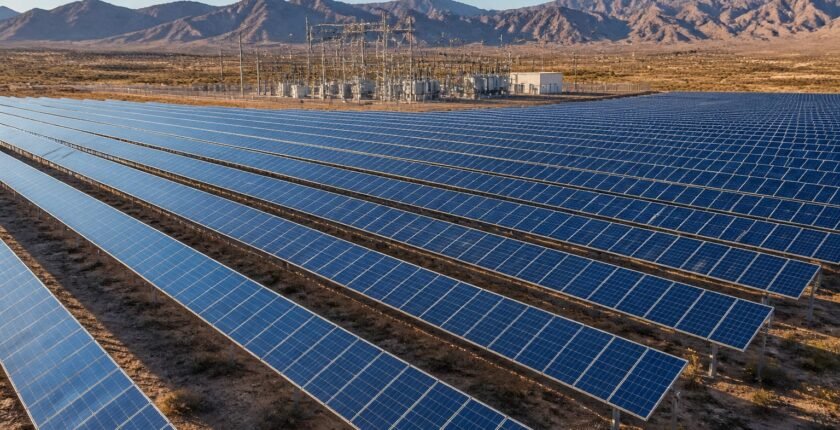
rPlus Energies has closed a revolving credit facility of up to $450 million. It runs for three years and is secured by cash flows from nearly 1GW of the company's operating plants, with the Green River Energy Center in Utah and Pleasant Valley Solar 2 in Idaho named first. rPlus can draw cash or have letters of credit issued under it, and plans to use the money to push its next solar and storage projects in the American West through development and construction. The speed is the notable part. Plants that entered full commercial operation on 21 July were backing a company-level loan by early November 2026, a gap of a little over three months.
Key takeaways
- The deal: rPlus Energies closed a three-year revolving credit facility of up to $450 million, covering cash draws and letters of credit, secured by nearly 1GW of operating assets.
- The collateral: The Green River Energy Center in Utah, with 400MW of solar and a 400MW/1,600MWh battery, and Pleasant Valley Solar 2 in Idaho are the first-named plants backing the loan.
- The lenders: CIBC's New York Branch arranged the facility and syndicated it to six banks, including Zions Capital Markets and National Bank of Canada, with Kirkland & Ellis advising rPlus and Milbank the lenders.
- The scale: Green River alone needed more than $1 billion of construction debt in 2024, so the $450 million revolver cannot fund a build of that size by itself.
Table of contents
- Key takeaways
- How Two New Plants Became Collateral Within Months
- Who Lent Against rPlus's Operating Plants
- Where rPlus Wants the Money to Go Next
- How Meta Bought Idaho Solar Through Its Utility
- Why $450 Million Will Not Build Another Green River
- What could help or limit the facility
- What to be careful about
- Frequently asked questions
How Two New Plants Became Collateral Within Months
Green River pairs 400MW of solar with a 400MW/1,600MWh battery, which can discharge at full power for four hours. rPlus raised more than $1 billion in construction debt for the project in 2024, in a round led by Wells Fargo Securities, Truist Securities, MUFG Bank, KeyBanc Capital Markets and Crédit Agricole Corporate and Investment Bank. PacifiCorp takes the output under a power purchase agreement signed in October 2022. A power purchase agreement is a long-term contract in which a buyer commits to take a plant's electricity on agreed terms.
Pleasant Valley Solar 2 was financed on its own, with a $179 million construction loan in December 2024. Work started at both sites in April 2025, and during 2026 each reached commercial operation and moved onto term financing.
That order of events explains the new facility. A construction loan is tied to one plant and absorbs the risk that it runs late or over budget. Once the plant generates and its debt shifts to long-term terms, lenders can watch real revenue come in. For rPlus, that visible cash was enough to support borrowing at the company level within months of the plants switching on.
Who Lent Against rPlus's Operating Plants
CIBC's New York Branch acted as lead left arranger and administrative agent. It then syndicated the facility to six banks: Zions Capital Markets, MUFG, Wells Fargo, KeyBank, Truist Bank and National Bank of Canada. Kirkland & Ellis represented rPlus, and Milbank represented the lenders.
Banking groups carrying the MUFG, Wells Fargo and Truist names appear both here and in the 2024 Green River construction round. Institutions that financed the plant's build are now lending against what it earns, which points to comfort with how it has performed since start-up. Seven banks in all signed on.
Natalie Jackson, rPlus's chief financial officer, described the facility as proof of her team's progress and of lenders' confidence in the company's long-term plans. That is a company's own reading of its financing. The lender roster, and the speed with which it formed after the plants came online, is the more independent signal.
Where rPlus Wants the Money to Go Next
rPlus is an independent power producer backed by Sandbrook Capital. It develops projects and keeps ownership once they run, which is what lets finished plants be recycled into collateral. Its portfolio of more than 12GW of solar and storage is focused on Utah and Idaho.
In Idaho, rPlus acquired the Blacks Creek and Bluebird solar projects from Qcells and Mission Clean Energy, taking its solar and storage pipeline in the state beyond 1GW. It is also developing three pumped hydro projects, one each in Wyoming, Nevada and Utah. Pumped hydro stores energy by moving water uphill and releasing it through turbines when power is needed.
Company president Luigi Resta has said rPlus aims at rural areas that have seen little clean energy investment and long relied on coal and gas, as first reported by Energy-Storage.news. Discussing the pumped hydro pipeline in September 2024, Resta stressed its ability to supply grid inertia as coal plants retire, and said rPlus intends to contract project output to utilities through tolling agreements.
How Meta Bought Idaho Solar Through Its Utility
The Pleasant Valley contracting route is the part large power buyers should study. In May 2023, the 200MW Pleasant Valley Solar project signed a long-term power purchase agreement with Idaho Power. Meta arranged it through an Energy Services Agreement with the utility, so it could draw renewable power from the grid feeding its new data center in Kuna, Idaho. rPlus said at the time that no larger solar project had been contracted to Idaho Power's system.
The structure puts the utility in the middle. Meta negotiated with Idaho Power, Idaho Power held the contract with rPlus, and the plant connects to the network serving the Kuna site. A data center operator in a regulated territory does not have to sign with a developer directly to secure new local supply.
The chain now runs one link further. A buyer-brokered utility contract helped get a plant built. That running plant is now collateral, and the collateral is funding the developer's next projects in the same region.
Why $450 Million Will Not Build Another Green River
The ceiling needs to be kept in proportion. Green River alone took more than $1 billion of construction debt, over twice the revolver's maximum, so this facility cannot pay for a plant of that scale on its own. Given the three-year term and letter-of-credit capacity, the likelier uses are development spending, credit support and early construction costs, with large builds still raising their own project loans. rPlus has not said how the money will be split, so that remains an inference.
A single-project loan works differently. In October 2026 the European Bank for Reconstruction and Development (EBRD) announced US$265 million in lending for a 1.2GW solar plant in Minya, Egypt, paired with a 600MWh battery system. The EBRD is providing US$160 million, Bank of Jordan US$75 million and the Climate Investment Fund up to US$30 million on concessional terms. The borrower is one special purpose vehicle, Nefer Menya for Renewable Energy, and the Egyptian Electricity Transmission Company will buy the power under a 25-year PPA.
That loan rests on one plant and one buyer. The rPlus revolver rests on a group of running plants and the pipeline behind them.
| Financing | Amount | Tied to | Arranged or led by | Timing |
|---|---|---|---|---|
| rPlus revolving credit facility | Up to $450M | Nearly 1GW of operating assets | CIBC New York Branch | Early November 2026, three-year term |
| Green River construction debt | More than $1B | One Utah plant | Wells Fargo Securities and four others | 2024 |
| Pleasant Valley Solar 2 construction loan | $179M | One Idaho plant | Not stated | December 2024 |
| Minya, Egypt project lending | US$265M | 1.2GW solar plus 600MWh battery | EBRD | October 2026 |
What could help or limit the facility
The case for
- Cash flow from nearly 1GW of operating plants gives lenders revenue they can already observe, rather than projections.
- Letter-of-credit capacity lets rPlus post security for new contracts without tying up cash.
- A pipeline of more than 12GW, including over 1GW in Idaho, gives the revolver projects to fund.
The case against
- A $450 million ceiling is less than half the construction debt Green River alone required, so major builds still need separate loans.
- The three-year term may end before longer supply contracts or pumped hydro schedules run their course.
- rPlus has not disclosed how the money will be allocated across projects.
What to be careful about
- Buyers relying on letters of credit from the revolver face a facility that runs for only three years.
- The loan depends on continued performance of the Green River and Pleasant Valley Solar 2 plants backing it.
- Pumped hydro projects in Wyoming, Nevada and Utah have no announced tolling contracts yet.
The bottom line
For utilities and data center buyers in Utah and Idaho, the facility offers a practical diligence question. Being able to borrow against plants that already earn puts a developer in a stronger position than one whose first project is still being built. Buyers can reasonably ask whether a counterparty has a company-level facility, which operating assets secure it, and whether a letter of credit offered as security comes from that facility or from a single-project loan. The term matters as well. The rPlus facility lasts three years, so it could expire before a longer supply contract does. The clearest evidence of what the revolver is really for will be which projects it moves first, Blacks Creek and Bluebird or a pumped hydro scheme.
What to watch
- Watch whether Blacks Creek and Bluebird in Idaho move into construction while the revolver is open, which would show what the operating plants are funding; no date has been set.
- Watch for a utility tolling agreement on any of the three pumped hydro projects in Wyoming, Nevada or Utah; rPlus has given no timetable.
- The facility's three-year term points to expiry around November 2029, three years after the early November 2026 close, when rPlus will need to extend or replace it.
Frequently asked questions
What is a revolving credit facility and how does rPlus use it?
A revolving credit facility lets a company borrow, repay and borrow again up to a set limit during its term. rPlus can draw up to $450 million in cash or letters of credit over three years. It will put the money toward near-term solar and storage projects in the American West.
When does the rPlus Energies credit facility end?
The facility runs for three years from its close in early November 2026, which points to expiry around November 2029. Any supply contract that relies on security from it and runs longer could outlast it.
Who owns rPlus Energies?
rPlus is backed by Sandbrook Capital and operates as an independent power producer that keeps the projects it builds. Its president is Luigi Resta and its chief financial officer is Natalie Jackson.
Which banks lent to rPlus Energies?
CIBC's New York Branch led the deal as lead left arranger and administrative agent. Zions Capital Markets, MUFG, Wells Fargo, KeyBank, Truist Bank and National Bank of Canada joined the syndicate.
Related reading