
Blog
Solar ambulance proves it can power a mobile clinic
Estimated reading time: 6 minutes · Last updated:
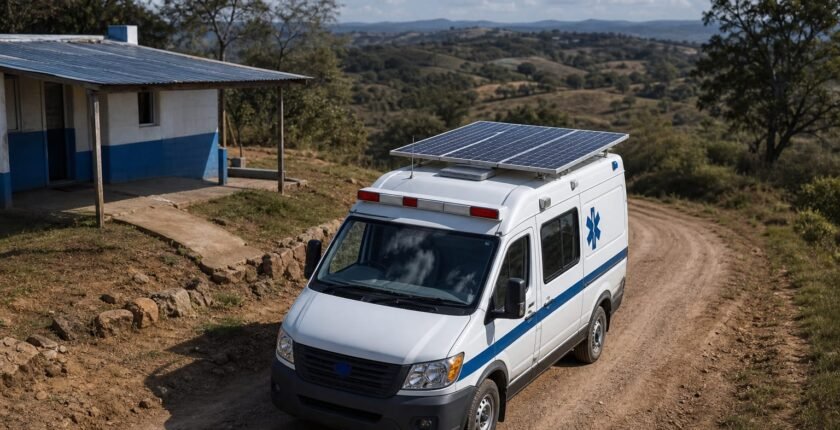
Solar ambulance Stella Juva demonstrated in Kenya that a vehicle equipped with rooftop and extendable panels can carry medical equipment and the energy to run it without relying on grid hookups. Built by Solar Team Eindhoven — a 23‑member student group based at Eindhoven University of Technology alongside students from two collaborating institutions — the vehicle completed more than 800 kilometers (about 500 miles) of travel during the test and, while parked, produced more energy than it consumed powering an X‑ray, ultrasound and vaccine fridge. The trial was run in partnership with Amref Health Africa, as first reported by CNN, and the team says the vehicle could have enabled treatment for approximately 200 people over two days.
The solar ambulance would be quite useful in these locations.
John Kutna, a program manager for Amref Health Africa
Key takeaways
- Who built Stella Juva: Solar Team Eindhoven is a 23‑member student group based at Eindhoven University of Technology with participants from two collaborating institutions.
- How far it ran in Kenya: The team drove Stella Juva more than 800 kilometers (about 500 miles) around Kenya, including to clinics without electricity.
- Onboard power balance: During the Kenya tests the vehicle generated more energy than it used while running all its onboard medical equipment, the team and Amref Health Africa report.
- Patient reach in the test scenario: Solar Team Eindhoven and Amref Health Africa estimate Stella Juva could have supported treatment for approximately 200 people over two days.
Table of contents
How Stella Juva keeps medical gear running
Stella Juva pairs a fixed rooftop photovoltaic array with deployable panels that can be unfolded when the vehicle is stationary to add charging area. The team fitted the vehicle with clinical devices — an X‑ray, an ultrasound scanner and a vaccine refrigerator — and sized the electrical system so the battery can absorb solar input while driving and top up from the parked array. In the Kenya field test the students report the vehicle produced a net surplus when all equipment ran at once, a demonstration of the concept that a single mobile unit can both transport and supply energy to medical devices in locations without reliable grid power.
Design choices matter: panel area, battery capacity and the efficiency of clinical kit all set how long a mobile clinic can operate off solar alone. Solar Team Eindhoven did not publish full technical specifications in the materials they released, so precise array wattage and battery kilowatt‑hours need verification before one can generalise the result to other regions or climates.
Key on‑vehicle components
The system tested combines rooftop panels for charging on the move with extra fold‑out panels for stationary charging, a battery pack sized to run the onboard medical equipment and a compact clinical fit‑out that includes cold storage for vaccines. That packaging turns the vehicle into what the students describe as a mobile health clinic rather than a patient transport ambulance: it carries equipment and the electricity to operate it at remote sites where clinics lack reliable power. The Kenya trial focused on demonstrating that combination under real road and weather conditions rather than on routine clinical use.
What the Kenya trial showed on the road and at clinics
Over several weeks the team drove Stella Juva for more than 800 kilometers (about 500 miles), including on dusty, pothole‑pocked roads to reach a clinic in Mosiro, Narok region, that lacks electricity. In roadside stops and at the clinic the students unfolded the extra panels and ran the full complement of equipment; they report that the vehicle generated more energy than it consumed while operating the X‑ray, ultrasound and fridge simultaneously. The equipment was not used on real patients during this test, but Solar Team Eindhoven and Amref Health Africa estimate the setup could have delivered care for roughly 200 people across a two‑day scenario.
Field conditions mattered: rough roads tested the vehicle’s drivability and panel deployment, and the students say real‑world maintenance and funding trade‑offs will shape any future deployments.
Barriers before a wider rollout
Several non‑technical hurdles will determine whether Stella Juva moves from prototype to fielded service. Funding for health services in Kenya is constrained; Solar Team Eindhoven notes this has been worsened by recent cuts in some foreign aid streams, and long‑term operation requires predictable maintenance budgets and spare parts. Regulatory and procurement pathways for mobile clinical units vary by country and must be navigated if ministries of health are to authorise routine use.
The team also faces the commercial challenge of scaling a custom student prototype into a serviceable product: industry partners, certification to medical device and vehicle standards, and a viable business model will be necessary. Solar Team Eindhoven members say they hope industry interest will follow the demonstration, but manufacturers and health ministries have not announced firm commitments.
What Stella Juva could change for remote healthcare
If adopted at scale, the model shifts how power is delivered to remote clinics: instead of retrofitting every small facility with its own solar system, a mobile unit can bring diagnostics, refrigeration and electricity on demand. This matters across parts of Africa where roughly one in three people must travel more than two hours to reach health services and where many clinics lack reliable power, because a single solar‑charged vehicle can intermittently supply high‑value diagnostics and vaccine cold chain support.
The Kenya trial suggests one practical use case: periodic visits by a mobile team to augment local capability, plus on‑site charging for small devices. The trial partners also point to an educational benefit — exposure to homegrown innovation for local students — but they stop short of mapping costs per visit or long‑term staffing models, both necessary for policy decisions.
Near‑term case for and against scaling Stella Juva
The case for
- The Kenya demonstration shows the concept works under real road and clinic conditions and generated surplus energy while running an X‑ray, ultrasound and vaccine fridge, supporting the argument that mobile solar power can supply high‑value medical kit.
- A working prototype can attract industry partners and funders by turning a classroom project into a tangible proof point and by inspiring local tech talent and public interest in renewable solutions for health.
The case against
- The trial did not use equipment on real patients and lacked published technical specifications and cost data, limiting confidence that the same performance can be replicated at scale.
- Sustained operation depends on funding for maintenance, spare parts and trained operators, plus regulatory clearance in each country — none of which the material shows have been secured.
What to be careful about
- The prototype’s reported energy balance lacks publicly available technical specs (panel wattage, battery kWh), creating a risk that actual performance will differ under other conditions.
- Scaling to routine service would require recurrent operating budgets; without committed funding the vehicle risks becoming a one‑off demonstration.
- Road and deployment wear could increase maintenance needs and downtime in rough terrain if vehicle and panel robustness are not certified.
The bottom line
Stella Juva’s Kenya trial turned a years‑long student project into a working demonstration: a road‑capable vehicle that can both gather solar energy while moving and add charging area when parked, and that reportedly produced more energy than it used while running clinical equipment. The result is a proof of principle for a mobile solar clinic that can extend diagnostics and vaccine refrigeration to communities without reliable grid power. Significant gaps remain — published technical specs, cost and maintenance plans, and official health‑system pilots — and those are the next steps needed before the model can be adopted beyond demonstration projects.
What to watch
- Watch whether Kenya’s health authorities or a county government decide to pilot a regularly scheduled Stella Juva deployment; no date has been set.
- Watch for announcements from Solar Team Eindhoven about industry partners or funding to develop a production‑ready version; no date has been set.
Frequently asked questions
Who built the Stella Juva solar ambulance?
Stella Juva was developed by Solar Team Eindhoven, a 23‑member student group based at Eindhoven University of Technology together with students from two collaborating institutions.
How far did Stella Juva travel during the Kenya test?
The students drove the vehicle more than 800 kilometers (about 500 miles) around Kenya, including to a clinic in Mosiro, Narok region, that lacks electricity.
How many people could the vehicle support in the trial scenario?
Solar Team Eindhoven and Amref Health Africa estimate the vehicle could have supported treatment for approximately 200 people over a two‑day period, though equipment was not used on real patients during the test.
Related reading