
Blog
Solar farms cut Gobi dust and clear Chinese skies
Estimated reading time: 5 minutes · Last updated:
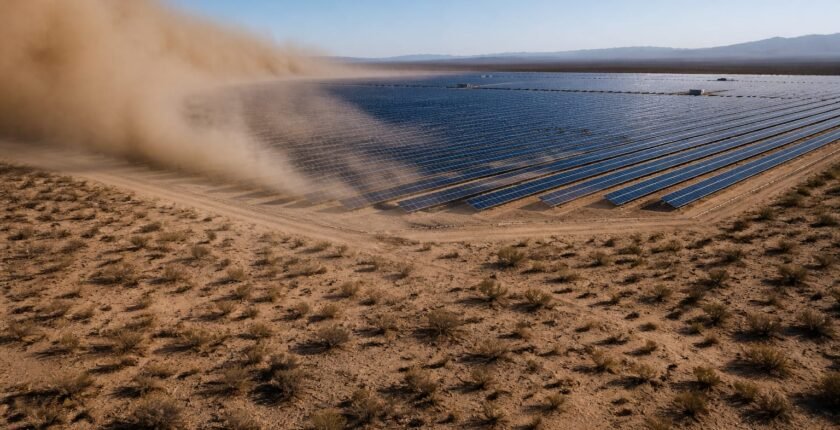
A study in Geophysical Research Letters by Hao Y. et al. finds that existing solar farms in the Gobi Desert already reduce springtime dust emissions by about 352,400 metric tons per month and that the sites also cut transport of dust downwind by roughly 131,400 metric tons monthly. The paper models how solar arrays change wind and surface conditions — increasing terrain roughness, stabilising soils and acting as windbreaks — and quantifies the air-quality gains in northern Chinese cities. The authors estimate much larger benefits if the desert’s solar coverage expands toward the study’s 140,000 square kilometre scenario.
Key takeaways
- Hao Y. et al. calculate existing Gobi Desert solar farms reduce springtime dust emissions by 352,400 metric tons per month.
- The study estimates solar arrays reduce downwind dust transport by about 131,400 metric tons each month through wind changes and local sheltering.
- Forty-two solar farms already cover more than 13,000 square kilometres of the Gobi Desert, per the paper's figures.
- If solar area grew eleven-fold to 140,000 square kilometres, the study finds Gobi dust emissions would fall by 12% and downwind transport by 21% versus no solar.
- Absent additional solar deployment, the authors project climate-change-driven increases of 13% in emissions and 27% in transport during springtime.
Table of contents
- Key takeaways
- How solar farms change winds and surfaces to cut dust
- What the modelling measured and the headline numbers
- City benefits: who gains and by how much
- Policy value and limits of using solar for dust mitigation
- How the case for and against scaling desert solar looks
- What to be careful about
- Frequently asked questions
How solar farms change winds and surfaces to cut dust
The study explains the physical mechanisms by which large photovoltaic arrays alter local meteorology and soil behaviour. Photo-voltaic rows raise the effective roughness of otherwise flat desert surfaces; that roughness reduces near-surface wind speeds so storms lift less material. Arrays also reduce erosion by altering how wind shear is distributed across the ground and by fostering small gains in vegetation and surface stability where panels shade and trap moisture.
Solar installations act like engineered windbreaks across stretches of desert. That sheltering redirects flows and reduces the distance viable dust plumes travel. The authors model these processes together rather than individually, which lets them estimate the combined effect on both local emissions and the long-range transport that delivers dust to cities.
What the modelling measured and the headline numbers
Hao Y. and colleagues combined satellite observations with regional atmosphere modelling to produce their estimates. Using present-day solar coverage in the Gobi, the team attributes a reduction of 352,400 metric tons per month in springtime dust emissions to existing arrays and an additional ~131,400 metric tons per month reduction in the amount of dust transported downwind.
The paper also runs scenarios for a much larger deployment. Under a scenario with 140,000 square kilometres covered by panels — an eleven-fold increase on today’s footprint — the model gives a 12% drop in desert emissions and a 21% fall in downwind transport compared with a world without solar farms in the Gobi. That scenario is presented alongside a simulation of climate-change effects, which, without more solar, raises springtime emissions by 13% and transport by 27%.
City benefits: who gains and by how much
The authors translate desert changes into urban air-quality outcomes and report measurable improvements across northern China. In their future-deployment scenario, average springtime concentrations of larger dust particles fall by about 14% across the region. The study explicitly connects those reductions with improvements in public-air-quality metrics used by the World Health Organization.
Because the panels have their largest relative effect on the worst dust days, the analysis finds that expanding solar capacity could push many northern Chinese cities into a higher tier in the World Health Organization's air-quality ratings. The paper treats these improvements as additional to the gains already achieved by cutting fossil-fuel emissions, making cleaner air a co-benefit of large-scale solar deployment.
Policy value and limits of using solar for dust mitigation
The study presents solar deployment as a climate and public-health intervention, but its benefits depend on scale, geography and local ground conditions. The greatest gains require expanding arrays far beyond current footprints: the paper’s illustrative target is 140,000 square kilometres of solar in the Gobi. That magnitude raises questions about land availability, ecological impacts and transmission build-out that fall outside the modelling but matter for policy.
The authors also flag that their results depend on several model assumptions — for example, how vegetation responds to panel shading and the exact wind regimes across different parts of the desert. They model climate change separately and show that without additional solar the region faces higher dust emissions and transport, which strengthens the case for mitigation but also highlights exposure to future meteorological shifts.
| Metric | Current solar footprint | Modeled large-scale scenario |
|---|---|---|
| Area covered | more than 13,000 square kilometres | 140,000 square kilometres |
| Springtime emissions change | −352,400 metric tons/month | −12% (vs no solar) |
| Downwind transport change | −131,400 metric tons/month | −21% (vs no solar) |
| Urban larger-particle change | noted in study | about −14% average in spring |
How the case for and against scaling desert solar looks
The case for
- Scaling Gobi solar multiplies the observed local effects: the paper’s 140,000 square kilometre scenario delivers markedly larger cuts in emissions and transport than today’s footprint.
- By targeting the worst dust days, expanded arrays could produce outsized gains in public-health indicators even if average improvements appear modest.
The case against
- Real-world gains depend on land-use trade-offs, transmission capacity and how soil and vegetation actually respond at scale; those implementation constraints could slow or limit the benefits modelled.
- Climate change is projected in the study to raise wind-driven dust by double-digit percentages unless offset by additional mitigation, so benefits are contingent on timely deployment.
What to be careful about
- Model sensitivity to assumptions about vegetation response and surface stabilisation could change the magnitude of estimated benefits.
- Large-scale deployment raises potential land-use and ecological trade-offs in the Gobi that the paper does not quantify.
- Need for grid and transmission expansion to realise energy and co-benefits could delay or fragment deployment at the scales modelled.
The bottom line
The Geophysical Research Letters paper by Hao Y. et al. shows that utility-scale solar in the Gobi can deliver an unanticipated co-benefit: measurable reductions in wind-blown dust that reaches Chinese cities. The magnitude of that benefit reflects both current deployments and the scale assumed in the study’s larger scenario; climate-driven increases in dust make those co-benefits more valuable, not less. Policymakers weighing desert solar should therefore include air-quality outcomes and the practical constraints of land, grid and ecology when assessing the net value of large-scale deployment.
What to watch
- Watch for Chinese planning decisions or pilot programs that aim to expand utility-scale solar in the Gobi; no date has been set.
- Watch for peer teams publishing replication studies that test the paper’s wind, vegetation and transport assumptions; no date has been set.
Frequently asked questions
How much dust do current Gobi solar farms remove?
Hao Y. et al. calculate that existing solar farms in the Gobi lower springtime dust emissions by about 352,400 metric tons per month and reduce downwind transport by roughly 131,400 metric tons per month.
How large is the area modelled for bigger benefits?
The paper compares today’s footprint—42 solar farms covering more than 13,000 square kilometres—with an eleven-fold expansion to 140,000 square kilometres, the latter producing much larger emission and transport reductions.
What do cities gain in practice?
Under the large-deployment scenario the authors report average springtime concentrations of larger dust particles falling by about 14%, enough to move most northern Chinese cities up a World Health Organization air-quality rating tier in the study’s analysis.
Related reading