
Blog
Fervo’s modular GeoBlocks aim to scale geothermal power
Estimated reading time: 5 minutes · Last updated:
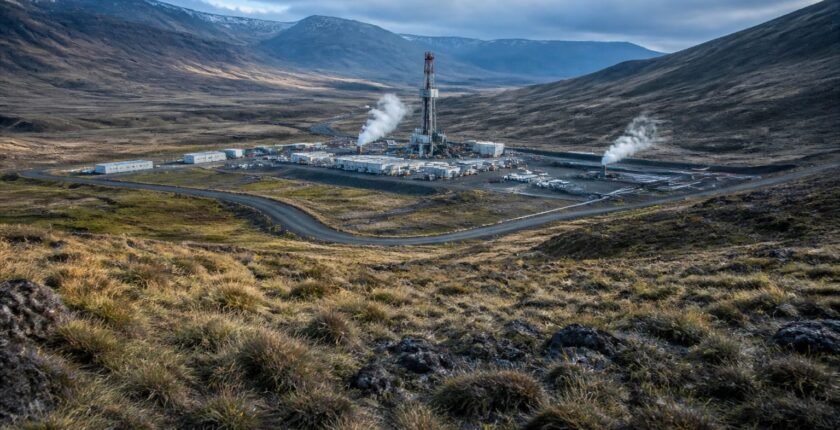
Fervo Energy is trying to make geothermal power viable well beyond the small number of naturally suitable sites by drilling horizontally and opening pathways in rock, then repeating a modular plant design. The company calls each repeatable unit a GeoBlock, about 50 megawatts of capacity, and it measures success by installed cost per kilowatt — targets include roughly $7,000 per kilowatt for the first 100 megawatts at Cape Station, $5,500 for the next 400 megawatts, and a long-term goal of $3,000 per kilowatt. As first reported by MIT Technology Review, Cape Station’s first phase began selling power in late September.
Key takeaways
- Fervo Energy designs modular 50-megawatt GeoBlocks to combine into projects hundreds of megawatts in size.
- The company raised roughly $2.2 billion in a May IPO to accelerate its pipeline.
- Fervo and Google agreed to pursue as much as 3 gigawatts of enhanced geothermal projects through 2033.
- Google agreed to buy at least 396 megawatts from Fervo’s Cape Station project in Utah.
- Fervo targets about $7,000 per kilowatt for Cape Station’s first 100 megawatts and $5,500 per kilowatt for the next 400 megawatts, toward a $3,000 per-kilowatt goal.
Table of contents
How GeoBlocks standardise drilling, fracturing and plant design
Fervo’s technical playbook combines horizontal drilling with hydraulic fracturing to create or enlarge flow paths in hot deep rock where natural permeability is low. Instead of relying on naturally porous formations, the company engineers a reservoir and then pairs it with a modular surface plant. Each module, which Fervo calls a GeoBlock, is designed as a roughly 50-megawatt power plant that can be replicated and assembled into larger projects.
The modular approach shifts the company’s performance metric from single-site output to installed cost per kilowatt of capacity, and that drives the engineering and procurement choices. For Cape Station in southwestern Utah, Fervo is targeting about $7,000 per kilowatt for the first 100 megawatts and $5,500 per kilowatt for the following 400 megawatts; the company says the long-term learning goal is $3,000 per kilowatt. Those numbers determine whether enhanced geothermal can compete with new natural gas plants on a levelised-construction basis without fuel costs.
Why major data-center buyers change the commercial math
Demand from hyperscale computing — the firms that build and run the largest data centers — is the commercial lever Fervo is using to scale. The company expanded a years-long relationship with Google: the two agreed this year to pursue up to 3 gigawatts of enhanced geothermal projects through 2033, and Fervo committed to proposing at least 1 gigawatt of projects within two years for Google to evaluate. As part of that roll-out, Google agreed to purchase at least 396 megawatts of power from Cape Station to fuel a potential data center in Utah.
Large corporate offtakes shorten revenue risk and make repeatable plant designs easier to finance. Building the next 400 megawatts beside the first 100 at Cape Station lets Fervo test cost reductions on contiguous ground, compress supply-chain learning and refine engineering packages that would be reused at other sites if the geology permits. The immediate commercial question is whether those savings hold when plants move beyond the same basin or state.
The replication problem: geology, permitting and proof points
The critical technical and commercial hurdle is geological variability. Shuvajit Bhattacharya, research associate professor at the University of Texas at Austin’s Bureau of Economic Geology, warns that success in Utah and Nevada does not guarantee similar results elsewhere because subsurface conditions vary by depth, permeability and rock chemistry. Cape Station’s next 400 megawatts are being built adjacent to its first 100, which helps learning on that site but does not alone demonstrate nationwide replicability.
Fervo’s nearer-term corporate targets are specific: the company aims to have one gigawatt operating by the end of 2030 and five gigawatts five years after that, which the company says would exceed current US geothermal supply. The timeline for Cape Station also matters as a public test: the plant is expected to reach full commercial operation in 2028, and the first phase already began selling power in late September. These milestones will be the earliest empirical checks on whether the modular approach reduces costs across different settings.
What could move this either way
The case for
- Hyperscale data centers provide large, creditworthy offtake that can underwrite early buildout and compress financing costs for repeatable designs.
- A modular GeoBlock approach allows engineering, procurement and construction teams to refine a common design, which should lower installed cost per kilowatt with learning-by-doing.
The case against
- Geological variability and site-specific drilling depths could blunt learning curves when projects move away from Utah and Nevada, preventing uniform cost reductions.
- Permitting, local opposition to hydraulic fracturing and water availability risks could delay projects or add costs that offset learning gains.
What to be careful about
- Scaling outcomes are concentrated: the next 400 megawatts at Cape Station are adjacent to the first 100 megawatts, so those results may overstate the ease of replication in different basins.
- Cost targets depend on sustained learning rates; if drilling or reservoir stimulation costs do not fall as expected, the $3,000 per-kilowatt goal may remain out of reach.
- Offtake concentration risk if major buyers pause or reduce procurement, since early commercial projects lean on large corporate deals to justify investment.
- Regulatory and public resistance to hydraulic fracturing for geothermal could add delays, mitigation requirements or higher engineering costs.
The bottom line
Fervo’s bet is that engineering a reservoir and pairing it with a repeatable 50-megawatt GeoBlock will let geothermal compete beyond the handful of naturally favourable sites. The company has deep capital after a roughly $2.2 billion IPO and a major commercial partner in Google, which together reduce early revenue risk. Still, the critical test remains geological replication: success beside an existing unit at Cape Station will prove learning on a single basin, but not across the varied subsurface conditions of the United States. The next milestone set — full commercial operation in 2028 and the one-gigawatt goal by 2030 — will show whether modularity and offtake deals translate into national-scale geothermal deployment.
What to watch
- Watch for Cape Station to reach full commercial operation in 2028, which will test Fervo’s cost and reliability claims.
- Watch for Fervo to reach its nearer-term target of one gigawatt operating by the end of 2030.
- Watch for Fervo’s five-gigawatt target in 2035, five years after the 2030 milestone, to see whether national-scale replication has been achieved.
Frequently asked questions
What is a GeoBlock and how big is one?
A GeoBlock is Fervo’s repeatable surface-and-reservoir module designed as a roughly 50-megawatt power plant that can be combined into projects of hundreds of megawatts.
How does Fervo measure progress on cost reduction?
Fervo tracks installed cost per kilowatt: its Cape Station targets are about $7,000 per kilowatt for the first 100 megawatts, $5,500 per kilowatt for the next 400 megawatts, and a long-term goal of $3,000 per kilowatt.
Where has Fervo demonstrated the technology so far?
Fervo demonstrated its approach at Project Red in Nevada in 2023 and is developing Cape Station in southwestern Utah, whose first phase began selling power in late September and is expected to reach full commercial operation in 2028.
Related reading