
Blog
Virginia schools install solar-plus-storage microgrids
Estimated reading time: 5 minutes · Last updated:
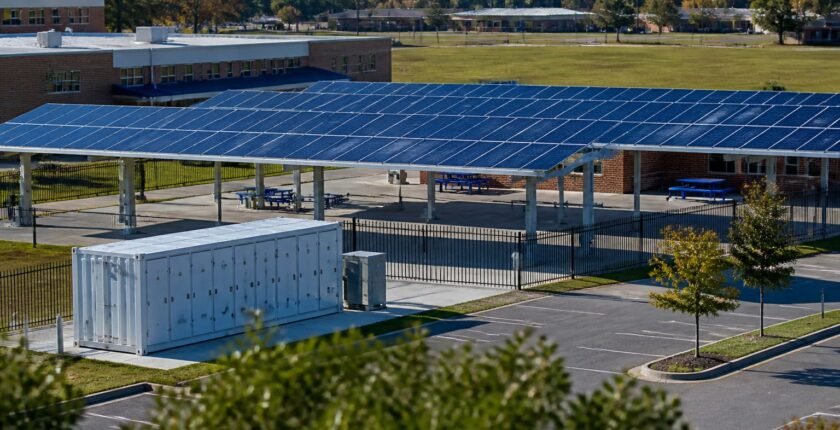
Roanoke City Public Schools is installing solar-plus-storage microgrids at both of its high schools to keep FEMA-designated disaster shelters operating during extreme weather and to reduce costs. The district expects installation of the battery systems to be completed before the end of 2026 and says the project is funded in part by a state Department of Emergency Management grant and a donation from Secure Solar Futures. The district already leads Virginia schools on rooftop solar, with a portfolio totaling about 9.4 megawatts spread over 29 sites.
They’ll run on the battery until such time as it’s discharged.
Jeff Shawver, senior director of school plants for Roanoke City Public Schools
Key takeaways
- First-in-state storage: Roanoke City Public Schools will be the first district in Virginia to install solar-plus-storage microgrids at both of its high schools.
- Existing solar capacity: The district serves about 14,000 students and has nearly 9.4 megawatts of solar planned for or already atop 29 rooftops and sites.
- Energy and budget impact: Solar arrays are expected to cover 44% of the district’s energy needs and to cut more than $22 million from electric bills over 35 years while avoiding roughly $24 million in capital roofing costs.
- Funding source: The microgrids are paid for in part by a state emergency-management grant and a donation from Secure Solar Futures; the state grant program has $2.5 million available for fiscal year ’27.
Table of contents
- Key takeaways
- Why Roanoke picked solar-plus-storage for school shelters
- Scale and savings from the district’s existing solar program
- How the microgrids are being paid for and who is involved
- How this project fits state and national trends
- What could move this either way
- What to be careful about
- Frequently asked questions
Why Roanoke picked solar-plus-storage for school shelters
Roanoke’s decision responds to two problems: increasing extreme weather and schools’ role as community hubs. FEMA data shows that schools make up 60% of designated relief shelters in Virginia and about half nationwide, so keeping them powered is essential for public safety. The district’s microgrids pair rooftop solar with batteries that can run critical shelter loads through outages, reducing how long diesel generators must run and easing fuel logistics during prolonged events.
The district and its facilities director framed the system as a cycling arrangement: the batteries supply shelter loads until discharged, at which point diesel backup starts, then daytime solar recharges the battery. That operational cycle is intended to cut generator runtime, lower emissions during events, and preserve interior conditions for occupants without a continuous dependence on fossil fuel backup.
Scale and savings from the district’s existing solar program
Roanoke already ranks as the state leader among school systems for solar installations, serving about 14,000 students with about 9.4 megawatts of capacity spread across 29 rooftops and other sites. Those arrays are expected to meet roughly 44% of the district’s electricity demand, lowering utility costs and cutting daytime purchases from the grid.
The district projects more than $22 million in avoided electric bills over 35 years and estimates that many panels come with new roofs that together will avoid around $24 million in capital roofing costs. Beyond the dollar figures, school installations create classroom opportunities: Secure Solar Futures will provide hands-on clean energy education and training for students at the district’s technical education center, linking the capital projects to workforce pathways.
How the microgrids are being paid for and who is involved
Funding for the storage portion comes from a mix of public and private support. The project uses a grant from the state Department of Emergency Management plus a donation from commercial installer Secure Solar Futures. The microgrid work is a departure from more common diesel-focused shelter upgrades: a senior program director at Generation180 noted that Roanoke’s grant is an early example of the funds being applied to solar microgrids rather than conventional diesel systems.
The district’s negotiations with Appalachian Power date back to 2018, demonstrating that policy changes allowing schools to buy power from third parties and sell excess back to the grid helped make these projects viable. The state grant program that Roanoke tapped has $2.5 million available for fiscal year ’27, and the microgrid funding package mixes that public support with the installer donation, as first reported by Canary Media.
How this project fits state and national trends
Generation180’s dataset shows K–12 capacity of 83 megawatts on 236 campuses in Virginia, with nearly half of those installations coming online after 2020 when the Virginia Clean Economy Act helped establish supportive policy. By comparison, California leads nationally with almost 900 megawatts on schools, and New Jersey has more than 300 megawatts.
Roanoke’s move to add batteries follows a smaller national set of school deployments and mirrors broader interest in solar-plus-storage at municipal facilities. The district frames batteries as both resilience infrastructure for shelter operations and an energy-cost-management tool tied to its broader rooftop-solar program.
| Item | Quantity/Scope | Role |
|---|---|---|
| Roanoke district solar | nearly 9.4 megawatts; 29 sites | Covers ~44% of district energy; $22M saved over 35 years |
| School microgrids being added | Two high schools | Provide battery-backed shelter power; reduce diesel runtime |
| State grant program | $2.5 million for FY27 | Pays part of storage cost |
What could move this either way
The case for
- Improved shelter resilience: batteries can shorten diesel-generator runtime and keep critical loads on during outages.
- Cost and capital savings: district estimates $22 million in avoided electric bills over 35 years and about $24 million in avoided roof capital costs tied to installations.
The case against
- Upfront funding limits durability of rollout: the state grant pool is finite ($2.5 million for FY27) and may not scale to all districts that want storage.
- Operational and maintenance responsibilities increase: schools will need staff training, warranty management and plans for battery end‑of‑life handling.
What to be careful about
- If battery commissioning is delayed beyond the end of 2026 target, shelters may rely longer on diesel backup during upcoming storm seasons.
- The state grant allocation is limited to $2.5 million for fiscal year ’27, which could leave other districts without sufficient funds to follow Roanoke’s model.
- Warranty and roof-integrity assumptions depend on vendor contracts; any shortfall in roof work tied to array installations could raise near-term capital costs.
The bottom line
Roanoke’s move to add battery-backed microgrids to two high-school shelters ties resilience, cost savings and workforce training into a single project. The district’s existing rooftop program anchors the economics — nearly 9.4 megawatts over 29 sites and projected savings and capital-avoidance figures give the board a multi-decade case for investment — while the new batteries aim to reduce diesel runtime during outages. The rollout will depend on limited state grant funding and on timely commissioning, but it offers a replicable model for other districts weighing shelter resilience and clean-energy goals.
What to watch
- Watch for the storage systems at both high schools to be commissioned by the end of 2026.
- Watch for Virginia’s Department of Emergency Management to award FY27 shelter upgrade grants; no award schedule has been announced.
- Watch for Secure Solar Futures to begin its clean energy education and training programs at the Charles W. Day Technical Education Center; no start date has been announced.
Frequently asked questions
Which schools are getting the microgrids and when will they be installed?
The district is installing solar-plus-storage microgrids at its two high schools, and the storage systems are scheduled to be in place before the end of 2026.
How much solar does the Roanoke district already have?
Roanoke City Public Schools has about 9.4 megawatts of solar capacity across 29 rooftops and other sites, a portfolio the district says will cover about 44% of its energy needs.
How is the storage being funded?
The storage work is financed in part by a grant from the state Department of Emergency Management and a donation from Secure Solar Futures; the state program has $2.5 million available for fiscal year ’27.
Related reading