
Blog
Wave Energy Is Wind’s Final Frontier
Estimated reading time: 5 minutes · Last updated:
Wave energy remains behind wind because device diversity, ocean survivability and system-integration costs keep it commercially small today. CorPower Ocean’s buoy concept is one recent contender: the company describes a unit 19 meters tall and 9 meters wide intended for deployment in >40 meter deep water, rated at 300 kW and claimed to run at a 40–60% capacity factor. That performance would match offshore wind on capacity factor but not on unit scale — top-line wind turbines reach 25 MW while reported wave units sit near 0.3 MW — and the mismatch drives higher per‑MWh system costs once transmission, storage and backup are included.
Key takeaways
- CorPower design and claims: CorPower Ocean's buoy design is described as 19 meters tall, 9 meters wide and intended for installation in >40 meter deep water, rated at 300 kW with a 40-60% capacity factor.
- Unit-size gap with wind: Top-line wind turbines reach 25 MW versus reported wave generators around 0.3 MW, highlighting a large unit-size gap that affects cost and deployment logistics.
- Survivability is a make-or-break issue: A single CorPower prototype survived a year of testing off Portugal, but long-term survival and the prospect of major storm losses about every five years remain the chief commercial risk.
- Grid and system costs: Wave farms add system requirements such as grid-forming converters and reactive-power management; poor integration risks oscillations like those that affected the Iberian peninsula.
Table of contents
- Key takeaways
- Why wave devices lag wind on unit scale and cost
- Engineering and survivability: the ocean is unforgiving
- What CorPower's buoy claims actually mean in practice
- System integration: grid needs amplify cost and complexity
- How wave energy could advance — and what could stop it
- What to be careful about
- Frequently asked questions
Why wave devices lag wind on unit scale and cost
Wind power converged on a single dominant machine architecture — a three‑bladed rotor on a tower with a nacelle — which drove rapid cost reductions through scale. By contrast, wave energy has produced many divergent machines: point absorbers, attenuators, oscillating water columns and surface buoys each suit different sea states. That diversity prevents the industry-wide learning curve that shrank turbine costs and left wave developers buying bespoke parts and marine engineering services.
The difference appears in unit capacity: the authors reference top-line wind machines at 25 MW versus typical wave generators of about 0.3 MW. That gap matters beyond a headline—smaller units require more foundations, more moorings, more inter-array cabling and a longer operations-and-maintenance (O&M) tail per megawatt, all of which increase delivered cost per MWh even when raw capacity factors look similar.
Engineering and survivability: the ocean is unforgiving
The marine environment multiplies damage modes. Structures face salt corrosion, biofouling, impact loads and chaotic wave sets that are far more severe and complex than the gusts turbines confront. A device that must resonate with waves to reach good efficiency also becomes vulnerable when storms break the resonance condition and impose irregular loads on joints and moorings.
The text notes a single prototype survived a year off Portugal, which is encouraging but not decisive. Commercial plans require long run‑rates across dozens or hundreds of units; losing a large share of a farm in a severe storm every few years would wipe out expected returns and end projects. In short, survival through extreme weather and low-cost, frequent access for maintenance are technical and logistical constraints that still limit scale.
What CorPower's buoy claims actually mean in practice
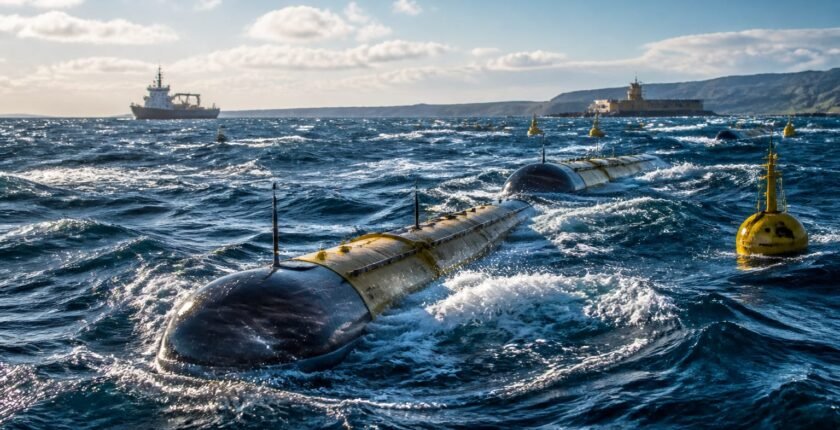
CorPower Ocean's concept in the source is a surface, buoy‑like point absorber tuned to heave with the waves. The cited physical dimensions — 19 meters tall and 9 meters wide — and an installation depth capability of >40 meter indicate a sizeable hull and mooring package. Rated electrical output is given as 300 kW, with a claimed capacity factor in the 40–60% range. If realised, that capacity factor narrows the performance gap with offshore wind on an energy-per-unit basis, but the small nameplate means many more machines are needed to reach gigawatt scale.
Tuning is the core engineering task: extract energy by matching device dynamics to the local wave spectrum. That tuning delivers the efficiency numbers in benign seas, but it can be lost in chaotic seas and storms. The practical questions for CorPower or any builder are how often tuning holds, what repair cadence is required, and whether hull and mooring design keep O&M and replacement rates low enough to yield a competitive lifetime cost.
System integration: grid needs amplify cost and complexity
Wave farms do not sit in isolation: they must connect to shore over long submarine cables, and their aggregated electrical behaviour affects grid stability. The authors highlight transmission, grid-level storage and backup plants as components of the true system cost beyond plant-level LCoE. Operators may need grid‑forming converters to provide inertia-like services and reactive-power control to avoid oscillations.
The source links reactive‑power handling and grid-following converter limitations to events on the Iberian peninsula, illustrating a real risk: poor integration can create network oscillations or worsen blackout conditions. Adding storage, stronger transmission corridors and grid‑forming electronics raises capital expenditure and complicates approvals and permitting. Those system-level charges are a repeat cost that has to be carried alongside device procurement and marine O&M.
| Device | Typical size | Claimed capacity factor | Site depth |
|---|---|---|---|
| Top-line offshore wind turbine | 25 MW | 40-60% | fixed or deepwater foundations |
| Reported wave generator (example) | 0.3 MW | 40-60% (claimed) | >40 meter (CorPower claim) |
How wave energy could advance — and what could stop it
The case for
- Higher energy density in waves means devices that hold tuning can deliver capacity factors of 40–60%, narrowing the energy yield gap with offshore wind.
- Successful long-duration sea trials and modular, low-cost maintenance strategies could push unit costs down and unlock clustered deployments.
The case against
- Repeated storm losses or high O&M frequencies would keep lifetime cost per MWh above competing options despite good capacity factors.
- If grid integration remains expensive — requiring more transmission, storage and grid-forming electronics — system-level costs will keep wave projects uneconomic at scale.
What to be careful about
- Major storm damage that forces frequent replacement or withdraws large shares of a farm, undermining lifetime economics.
- High O&M and inspection costs driven by corrosion, biofouling and remote repairs that scale with the number of small units required.
- System‑level integration failures: insufficient reactive-power control or lack of grid-forming capability provoking network oscillations.
- Deployment logistics and permitting for hundreds of small moored units increasing up-front capex and lead times.
The bottom line
Wave energy remains an active engineering frontier because ocean power promises high energy density but imposes harder durability and system-integration challenges than wind. CorPower Ocean’s buoy illustrates both the upside and the caveats: dimensions of 19 meters by 9 meters and a 300 kW rating with a claimed 40–60% capacity factor show how devices can target useful output, yet the small unit size compared with 25 MW wind machines forces more foundations, cabling and O&M per megawatt. Whether wave energy moves from intriguing prototypes to cost‑competitive farms depends on survivability through storms, a low-cost maintenance model and workable grid connections that keep system costs from eclipsing device performance.
What to watch
- watch for CorPower Ocean announcements on multi-unit deployments and commercial-scale pilots; no date has been set.
- watch for multi-year survivability data from full-scale sea trials that track failure rates and repair intervals; no date has been set.
- watch for transmission or grid-connection studies that specify whether grid-forming converters will be required for wave farms in key markets; no date has been set.
Frequently asked questions
How does wave energy's capacity factor compare with offshore wind?
CorPower claims a 40–60% capacity factor for its buoy, and the authors note a similar 40–60% range is achievable for steady offshore wind; parity on capacity factor does not erase the unit-size and system-cost differences between the technologies.
Why are there so many different wave-device designs?
Wave climates vary by location and depth, so developers have pursued point absorbers, attenuators and other topologies rather than one converged design; that diversity raises bespoke engineering costs and prevents the scale learning that pushed wind prices down.
What grid work do wave farms need before they run reliably?
The source highlights transmission, storage and reactive-power control as necessary system elements, and specifically notes operators may need grid-forming converters to provide stability services and avoid the oscillations seen on the Iberian peninsula.
Related reading