
Blog
Wind turbine recycling turns nacelles into tiny solar homes
Estimated reading time: 4 minutes · Last updated:
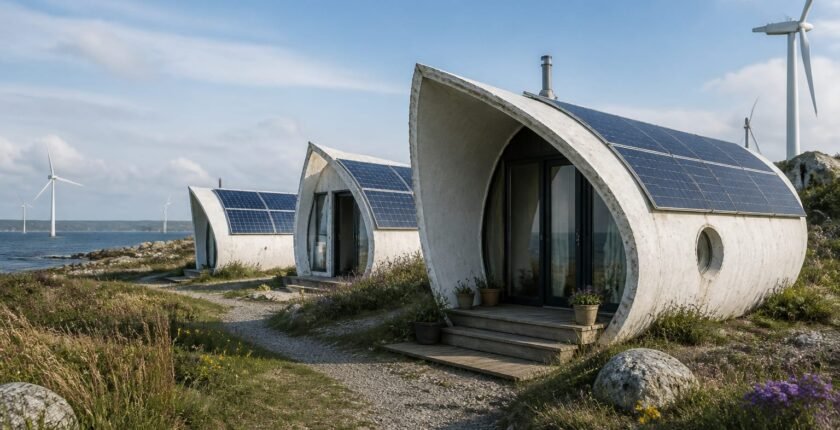
A Swedish energy company and designers are finding new uses for retired wind-turbine parts rather than sending them to landfill. Vattenfall, working with Dutch design studio Superuse, converted a retired nacelle cover into a four-metre-wide by 10-metre-long, three-metre-high tiny house fitted with a heat pump, solar panels and a solar water heater. The shift comes as the wind sector expands: WindEurope reports that 8.8 GW of additional capacity came online in the first half of 2026, a 30% increase compared with the same period a year earlier, while blade retirements will rise as first-generation farms reach the end of their design life.
“Separating the composite materials from the resin requires specialised processes, often involving high temperatures or other energy-intensive treatment methods,”
Eva Julius-Philipp, Director of Environment and Sustainability of Business Area Wind at Vattenfall
Key takeaways
- Scale of new builds: WindEurope says 8.8 GW of new capacity was installed in the first half of 2026, representing a 30% year‑on‑year increase.
- Household equivalence: WindEurope says that 8.8 GW in H1 2026 is enough electricity to power around seven million European households.
- Fuel-import replacement: WindEurope estimates the new capacity could displace imported fossil fuels on a scale comparable to about 25 LNG tankers annually.
- Nacelle reuse pilot: Vattenfall and design studio Superuse converted an Austrian turbine nacelle cover into a tiny solar‑powered living unit showcased at Dutch Design Week in 2024.
- Blade recycling challenge: Blades are typically 50 and 100 metres long and designed for up to 25 years of operation, making large‑scale recycling difficult.
Table of contents
A nacelle repurposed: how a turbine top became a tiny solar house
Vattenfall partnered with Superuse to turn a retired nacelle cover — the box that houses a turbine's mechanical and electrical equipment — into a compact living module. The unit measures four metres wide, 10 metres long and three metres high and was fitted with a kitchen, bathroom, a heat pump, rooftop solar panels and a solar water heater to demonstrate low‑impact reuse.
The project was presented at Dutch Design Week in 2024 as an experiment in keeping processing energy and emissions to a minimum. The reuse focuses on the nacelle's structural box rather than the blades and aims to avoid intensive separation processes that can degrade recovered materials when composites are treated at high temperature.
Why blades are hard to recycle and what that means for volume
Wind turbine blades are large, laminated structures built to endure decades of harsh weather; most measure between 50 and 100 metres. Their longevity depends on composite construction: stacked layers of glass and carbon fibres bonded with epoxy, balsa wood cores, metal fittings and various fillers. That combination of materials is what makes conventional recycling both technically complex and energy‑intensive.
Eva Julius-Philipp, Director of Environment and Sustainability of Business Area Wind at Vattenfall, told Euronews Earth that "Separating the composite materials from the resin requires specialised processes, often involving high temperatures or other energy-intensive treatment methods." She added that those treatments can reduce the quality and value of recovered fibres, which limits how easily blade waste can be reused at scale.
Scale pressure: more retirements meet rising installations
The timing amplifies the problem. WindEurope's figures show the sector is still growing fast: 8.8 GW of capacity began operating in the first half of 2026, 30% higher than in the equivalent period of 2025. WindEurope adds that those H1 2026 additions are sufficient to serve roughly seven million households and could displace imported fossil fuels on a scale similar to 25 LNG tankers a year, but the expanding fleet will require more end‑of‑life planning.
Design pilots that reuse nacelles or turn composite material into lower‑intensity products (the article headline also mentions recycled skis) demonstrate routes away from landfill. Still, scaling those approaches from single showcase projects to the tens of thousands of metres of blade material expected from first‑generation retirements will require recycling processes that preserve material value without large energy inputs.
| Component | Typical size / life | Reuse example | Recycling difficulty |
|---|---|---|---|
| Nacelle cover | box of equipment (project example: 4 m × 10 m × 3 m) | Converted into tiny solar home (Vattenfall & Superuse) | Lower — rigid shape, fewer mixed composites |
| Blade | 50–100 m long; up to 25 years life | Creative uses reported (headline cites skis) | High — layered composites and resins require energy‑intensive separation |
How reuse could scale — the case for and against
The case for
- Showcase projects reuse large, already‑shaped components (nacelles) with limited processing energy, reducing landfill.
- Continued capacity growth (8.8 GW in H1 2026) creates commercial incentives to find cost‑effective end‑of‑life pathways.
- Repurposing can deliver visible circular‑economy wins that support local secondary markets for shelters, community assets or lower‑grade composite products.
The case against
- Blade composites are currently expensive to separate without degrading value, and high‑temperature treatments consume energy and raise emissions, per Vattenfall.
- Showcase conversions address small volumes relative to total blade tonnage; prototypes alone will not absorb the incoming wave of retirements.
- Without standardised, low‑energy recycling processes, recovered material may be low value and uneconomic to collect at scale.
What to be careful about
- Pilots that reuse nacelles do not reduce the large volume of composite blade waste, which remains technically hard to recycle.
- Energy‑intensive recycling methods can negate some of the lifecycle emissions benefits of wind if applied at large scale.
- Lack of commercial markets for downgraded composite outputs risks sending material back to landfill despite early reuse efforts.
The bottom line
Reusing turbine components offers tangible, low‑energy pathways to keep large, serviceable parts out of landfill: the nacelle conversion shows what can be done with minimal reprocessing. But blades remain the harder problem. Their size and composite construction limit easy recycling and will produce substantial waste as turbines reach 25 years of operation. Solving that gap requires low‑energy separation methods, new markets for reclaimed materials and policies that steer both industry investment and collection logistics — otherwise showcase projects will remain ad hoc fixes rather than a systemic solution.
What to watch
- Watch for further pilot announcements from Vattenfall on reuse projects; no date has been set.
- Watch for WindEurope updates on blade‑retirement volumes and end‑of‑life guidance; no date has been set.
Frequently asked questions
What part of a turbine was reused as a tiny house?
Vattenfall worked with Superuse to repurpose a retired nacelle cover — a structural box that houses mechanical and electrical equipment — into a compact unit measuring four metres wide, 10 metres long and three metres high, fitted with solar panels and a heat pump.
How big is the blade‑recycling problem?
Blades are typically between 50 and 100 metres long and designed to last up to 25 years, and their layered composite construction makes large‑scale recycling technically and energetically demanding.
How urgent is end‑of‑life planning for wind?
WindEurope reports strong near‑term growth — 8.8 GW added in the first half of 2026, a 30% year‑on‑year rise — which improves generation but also means more components will reach retirement as first‑generation farms age.
Related reading