
Blog
PacWave South wave energy testing facility opens
Estimated reading time: 4 minutes · Last updated:
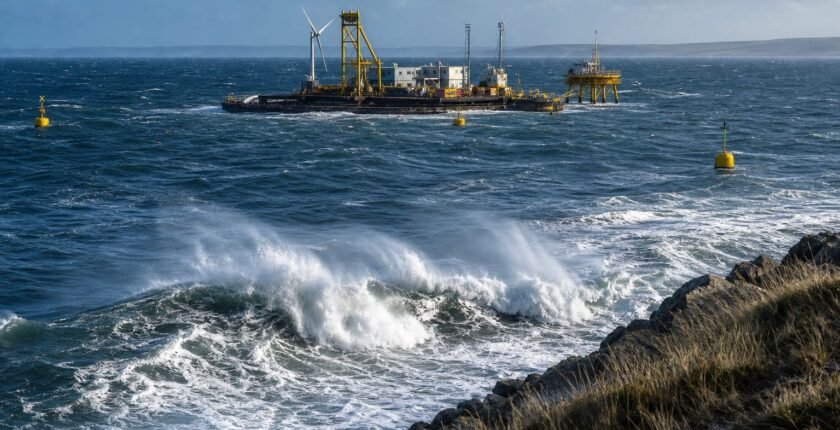
PacWave South, a wave energy testing facility off the Oregon coast developed by Oregon State University, has completed federal review and been tied to the mainland grid after receiving roughly $150 million in U.S. government support since 2016. The site is the first large, grid-connected marine energy test area on the North American continental grid and is pre-permitted for multiple device types. Energy Department sign-off came after a department ‘‘go/no-go’’ review, and PacWave director Dan Hellin says the connection and approval clear the path for open-ocean device trials, even though no commercial converters have yet deployed to the site.
When you’re developing this technology, ultimately you have to get to that stage of full-scale open water testing, connected to the grid. And that’s the real bottleneck for the global industry, the fact that there’s very few facilities like this.
Dan Hellin, PacWave Director
Key takeaways
- Federal funding: The U.S. government has provided about $150 million for PacWave South since 2016.
- Grid connection: PacWave South received Energy Department approval and was connected to the continental U.S. grid after a go/no-go review, PacWave Director Dan Hellin said.
- Industry scale: The site is described as the first large, continental U.S. test platform for grid-connected wave energy technology.
- Resource potential: Federal estimates cited for marine energy put its theoretical potential at about 57% of U.S. electrical demand.
Table of contents
What PacWave South is and how it got built
PacWave South is a deep-water test area off Oregon developed by Oregon State University to host full-scale trials of devices that convert wave motion into electricity. The project has received about $150 million in U.S. government funding since 2016, money that underwrote planning, infrastructure and permitting work to make the site test-ready.
The Energy Department required a ‘‘go/no-go’’ review before the site could open; PacWave Director Dan Hellin said that review cleared the facility last summer and that the site was tied into the continental grid this summer. The combination of federal funding, a formal approval and a grid connection is intended to remove a common barrier for developers seeking to validate devices in open-ocean conditions.
How wave converters tested at PacWave operate
Testers can bring several kinds of wave energy converters to PacWave South without seeking separate permits because the site is pre-permitted for experimental deployments. The main device types named for trials are point absorbers, oscillating water columns and attenuators.
Point absorbers are buoy-like units that move with wave heave and drive generators; oscillating water columns use rising and falling water to force air through a turbine; attenuators are long, articulated floats that convert relative motion into electricity. Devices at sea will tie back to shore via subsea cables to deliver power to the local grid for measurement and validation.
Why the Energy Department backed the site and the security argument
The Energy Department framed wave converters as having applications beyond utility-scale generation. The department says these technologies can supply persistent, low-visibility power for national security uses such as remote sensors, autonomous underwater vehicles and resilient power at forward bases.
That framing helped secure approval even as federal policy has recently constrained other offshore projects. The department’s position positions marine energy both as a climate resource and as an asset with defence-related utility, which PacWave backers cite when arguing for continued federal support.
Current status: ready but waiting for devices
PacWave South's test infrastructure and grid connection are in place, but the site has not yet produced electricity because no commercial devices have arrived; the developer said delays in receiving federal funding are the primary reason for the hold-up.
The U.S. Navy already operates a grid-connected wave test site in Hawaii, but PacWave South is the first of its scale on the continental U.S. network. PacWave’s backers argue that removing permitting and infrastructure obstacles will accelerate the industry once developers can secure device funding and complete sea trials.
| Site | Location | Grid connection | Notes |
|---|---|---|---|
| PacWave South | Oregon coast | Connected to continental U.S. grid (this summer) | Developed by Oregon State University; pre-permitted; $150 million federal support since 2016 |
| Navy test site | Hawaii | Grid-connected | Operated by the U.S. Navy; earlier, smaller-scale deployments |
Near-term prospects and obstacles
The case for
- Grid connection and federal approval reduce the infrastructure barrier to full-scale open-ocean testing.
- Pre-permitted status lowers regulatory friction for trial deployments and shortens developer timelines.
The case against
- No devices have arrived yet; developers have reported delays in receiving federal project funding.
- Shifts in federal policy or defence priorities could change the availability of grants and support for marine energy.
What to be careful about
- Deployment delays: developers facing funding hold-ups may postpone device arrivals and sea trials.
- Funding concentration: the project depends on federal support that could be altered by future policy changes.
- Technical risk: full-scale converters must survive and prove reliable in exposed open-ocean conditions before commercialisation.
The bottom line
PacWave South represents the most significant step to date in continental U.S. wave-energy testing: federal investment since 2016, a formal Energy Department clearance and a grid tie create the conditions for real-world trials. But the site remains idle as measured generation until developers can deploy devices and complete sea trials. The project’s near-term fate therefore hinges on private developers securing funding and moving equipment to Oregon, while continued federal backing will determine whether PacWave catalyses wider commercial progress in marine energy.
What to watch
- Watch for the arrival and deployment of the first commercial wave energy converters to PacWave South; no date has been set.
- Watch for announcements of federal grants or funding awards to developers that would finance sea trials at PacWave South; no date has been set.
- Watch for the first measured export of wave-generated electricity from PacWave South to the continental grid; no date has been set.
Frequently asked questions
Who developed PacWave South and who paid for it?
Oregon State University developed PacWave South, and the U.S. government has provided about $150 million in funding for the facility since 2016.
Has PacWave South generated electricity yet?
No. PacWave South was connected to the continental grid this summer after Energy Department approval, but the site has not produced electricity because no wave energy devices have arrived for testing.
How much of U.S. electricity could marine energy supply?
Federal estimates put marine energy’s theoretical potential at about 57% of U.S. electrical needs.
Related reading