
Blog
PacWave South opens as U.S. grid-connected wave test site
Estimated reading time: 4 minutes · Last updated:
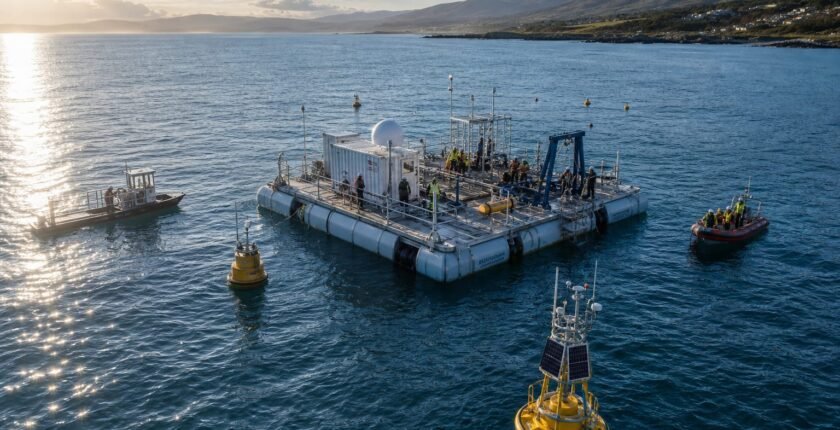
Oregon State University announced that PacWave South, a grid-connected ocean testing site for wave energy, is now operational following more than 15 years of development. A ribbon-cutting on Aug. 27 drew about 150 attendees including Jayathi Murthy, Suzanne Bonamici, Val Hoyle, David Gomberg and Tim Ramsey. The installation can carry power from devices 7 miles offshore back to land through subsea cable into a Utility Connection and Monitoring Facility near Seal Rock. The project has been supported primarily by the U.S. Department of Energy, and the opening was covered, as first reported by OSU Today.
PacWave represents the culmination of more than 15 years of vision, determination and collaboration,
Jayathi Murthy, Oregon State University president
Key takeaways
- PacWave South is now operational after more than 15 years of work.
- The Aug. 27 ribbon-cutting was attended by about 150 people including Jayathi Murthy and U.S. representatives.
- Power from devices 7 miles off Newport is transmitted ashore via nearly 50 miles of subsea cable.
- The site ties into a Utility Connection and Monitoring Facility located near Seal Rock and is backed by the U.S. Department of Energy.
Table of contents
- Key takeaways
- Why PacWave matters for marine energy development
- The hardware onshore and offshore that makes testing possible
- What opens next: testing, partnerships and regulatory learning
- How PacWave could change device development—and what could slow adoption
- What to be careful about
- Frequently asked questions
Why PacWave matters for marine energy development
PacWave South provides a full-scale environment where companies can put ocean energy devices into service and measure performance against real operating conditions. The facility closes a gap in U.S. testing capacity by offering device developers access to a pre-approved, grid-tied location that reduces permitting and interconnection barriers. That combination—open-ocean exposure plus a direct shore connection—lets engineers evaluate power production, reliability and environmental interactions under conditions that smaller or shore-side rigs cannot reproduce.
The site is intended to speed the path from prototypes to commercial machines by giving regulators, researchers and manufacturers the same testbed. Support from the U.S. Department of Energy underwrites both the infrastructure and coordinated research to track marine life interactions, regulatory compliance and grid integration.
The hardware onshore and offshore that makes testing possible
PacWave’s offshore assets connect to shore through a system designed for sustained commercial-style testing. Devices deployed seven miles off the Oregon coast link by subsea transmission to a land-side Utility Connection and Monitoring Facility, where power is routed into the local grid and performance data are recorded. The UCMF near Seal Rock houses metering, control gear and environmental monitoring systems used during each trial.
The installation includes nearly 50 miles of cable configured to carry generated electricity and telemetry back to shore. That infrastructure lets multiple developers run concurrent trials while grid operators observe integration impacts without staging temporary or bespoke hookups for each device.
What opens next: testing, partnerships and regulatory learning
With infrastructure complete, the focus shifts to hosting device demonstrations and collecting data that inform commercialization. Oregon State and PacWave partners plan to use the site to test performance, validate durability and gather environmental observations that can speed permitting for subsequent projects. The facility’s operator has framed the coming months as a phase of active device deployments and monitoring.
PacWave leadership has emphasised collaboration with federal, state and fishing-industry stakeholders to ensure trials answer both engineering and ecosystem questions. The site also becomes a focal point for companies that need a grid-connected proving ground before committing to larger commercial arrays.
| Feature | Detail |
|---|---|
| Location | 7 miles off the coast of Newport; shore facility near Seal Rock |
| Grid connection | Yes; via Utility Connection and Monitoring Facility |
| Cable length | Nearly 50 miles of subsea cable |
| Primary supporter | U.S. Department of Energy |
How PacWave could change device development—and what could slow adoption
The case for
- Having a grid-connected, open-ocean test point reduces the time and cost for developers to run representative trials, accelerating product validation and investor confidence.
- Coordinated environmental monitoring and shared infrastructure can lower duplication of effort and help regulators standardize approval criteria.
The case against
- Commercial deployment depends on device performance and cost reductions; promising tests do not guarantee competitive levelized costs.
- Operational surprises at sea, permitting delays for individual devices, or constraints from local grid capacity could slow scheduled demonstrations.
What to be careful about
- Device tests may reveal durability issues that require design changes and delay commercial timelines.
- Environmental monitoring could identify impacts that necessitate operational limits or additional mitigation measures.
- Local grid constraints or meter/connection issues at the UCMF could limit the number or size of concurrent tests.
The bottom line
PacWave South brings a long-awaited capability to the U.S. marine energy ecosystem: a pre-approved, shore-connected testbed that operates in true open-ocean conditions. With support from the U.S. Department of Energy and a completed cable and onshore connection, the site lets developers run representative, grid-tied trials that should shorten the path to commercialization. The near-term focus will be on device demonstrations, environmental monitoring and refining operational practices; the outcomes of those first tests will determine how quickly wave technologies move from trial to wider deployment.
What to watch
- Watch for announcements of PacWave’s first grid-connected device tests; no date has been set.
- Watch for published environmental monitoring results from initial deployments; no date has been set.
Frequently asked questions
Where is PacWave located and how far offshore are tests?
PacWave’s offshore test area sits about 7 miles off the coast of Newport, Oregon, with onshore connections routed to a Utility Connection and Monitoring Facility near Seal Rock.
Who funded the infrastructure and who operates the site?
The facility is supported primarily by the U.S. Department of Energy and has been developed and is led by Oregon State University staff and PacWave program leadership.
What infrastructure transmits power from devices to the grid?
Power and telemetry are carried by nearly 50 miles of subsea cable that connect the open-ocean test area to the onshore Utility Connection and Monitoring Facility, where electricity is metered into the local grid.
Related reading