
Blog
Nio opens first solar-powered off-grid battery swap station
Estimated reading time: 5 minutes · Last updated:
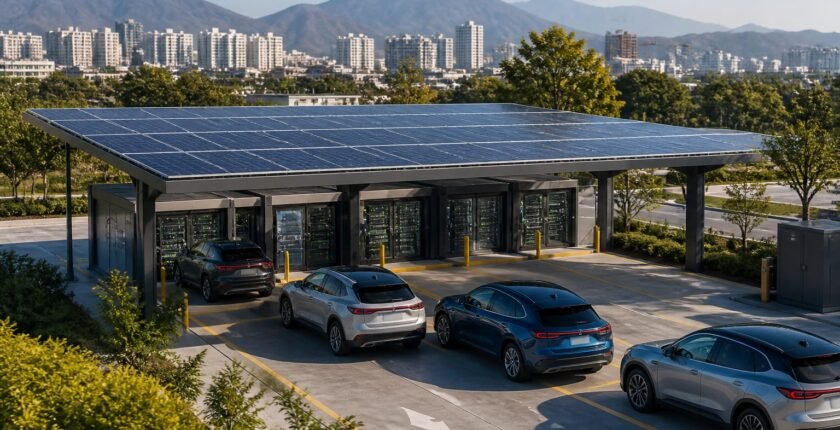
On 23 September 2026 Nio began operating at the Xingxingxia service area in Xinjiang a battery swap station that runs entirely on solar generation and on-site storage, the company said. Nio described the installation as an off-grid facility that operates day and night by automatically switching between solar production and its energy storage system, as first reported by CnEVPost. The site uses Longi equipment, and Nio presents the project as its first validation of battery swapping without reliance on the power grid. The primary aim is to extend swap coverage into remote stretches of the G30 Lianyungang-Horgos Expressway where building transmission lines is costly and slow.
Key takeaways
- Opening date and place: Nio put the Xingxingxia swap station in Xinjiang into service on 23 September 2026.
- Off-grid power system: The station runs entirely on solar generation and energy storage using Longi Block and Longi H2D systems.
- Silk Road route role: The station is a node on Nio's 3,605-kilometre Silk Road battery swap route, which has 33 swap stations and is scheduled to be fully connected on 26 September 2026.
- Network scale: As of 23 September 2026, Nio had 4,109 battery swap stations in China, including 1,060 along highways, and 5,301 charging stations.
Table of contents
How the station supplies power off-grid
The Xingxingxia facility combines photovoltaic generation with on-site energy storage to meet every electrical need without tying into the local transmission network. During daylight the array feeds station loads directly and channels surplus into the Longi H2D storage system; at night the storage discharges to sustain service. The installation also includes an automatic mode that reserves battery energy for critical loads if sunlight is insufficient for prolonged periods.
Nio said the hardware includes Longi's Longi Block mobile energy station paired with the Longi H2D storage product; the systems switch operating modes without on-site staff. Liquid-cooling and other thermal controls are part of the setup to help equipment cope with the Xinjiang site’s extreme temperatures. Key phrase: Longi Block mobile energy station.
Why Xinjiang needed an off-grid swap node
Xingxingxia sits in eastern Xinjiang's Gobi Desert along the G30 expressway, where grid extension would require long transmission runs across sparsely populated terrain. Nio emphasised that building power lines through such stretches would be slow and expensive, making self-contained power an attractive alternative for road-facing infrastructure.
Nio said the site endures harsh conditions: wind gusts exceed force 8 on more than 100 days each year, ground temperatures in summer rise above 70°C, and winter temperatures fall to about −30°C. Those extremes informed the selection of cooled storage and the automated control logic that keep swap operations dependable despite heat, cold and dust.
The Silk Road route and network implications
Nio described the Xingxingxia station as a key node on its Silk Road battery swap route, a corridor that spans 3,605 kilometres and comprises 33 swap stations. The company scheduled the route to be fully connected on 26 September 2026 so that drivers could link provincial-level regions by sequential swaps along the way.
More broadly, the project tests how solar-plus-storage swap nodes could close gaps in highway coverage. Nio’s network statistics in the same notice show 4,109 swap stations nationwide, with 1,060 positioned along highways and 5,301 charging stations, signalling that off-grid nodes are an incremental adaptation rather than a replacement for grid-connected facilities.
Operational limits and engineering trade-offs
Nio acknowledged a fallback emergency mode that conserves stored energy for critical loads during extended cloudy stretches, which implies the system's available autonomy depends on storage sizing and load management. The company did not publish storage capacity or expected autonomy hours for the Xingxingxia installation, but the presence of an emergency mode makes clear there are scenarios when full service cannot be sustained indefinitely off-grid.
Design choices such as liquid cooling were selected to preserve equipment function across extreme temperatures, and automated switching reduces the need for local staffing. The station therefore tests not just hardware but the controls and operational procedures needed to run unattended swap nodes in remote environments.
How the project could play out
The case for
- The off-grid model could unlock swap coverage on long highway stretches where grid buildout is slow or costly, accelerating practical interprovincial EV travel.
- Proving autonomous solar-plus-storage operation in harsh desert conditions would validate a repeatable template that uses existing solar vendors such as Longi and reduces dependence on local grid upgrades.
The case against
- Extreme temperatures, frequent high winds and prolonged cloudy periods create conditions where storage capacity and thermal management may limit continuous service.
- Emergency-mode operation that reserves power for critical loads means passenger convenience and full swapping capacity could be curtailed during extended low-insolation spells.
What to be careful about
- Equipment degradation or failure under extreme heat or cold could force temporary station closures in a remote location.
- Prolonged cloudy weather may push the system into emergency mode and limit swap availability if storage capacity is insufficient.
- Remote, unattended operation increases reliance on automated controls; control software or communications failures could interrupt mode switching or dispatch of maintenance.
The bottom line
Nio’s Xinjiang installation is a technical test and an operational experiment: it demonstrates that battery swapping can be powered solely by solar and storage in locations where extending the grid is impractical. Using Longi’s Block and H2D systems, the station targets continual operation through automated mode switching and thermal controls designed for desert extremes. The immediate impact is local—keeping a section of the Silk Road swap route live—but the broader test is whether off-grid nodes can be scaled as a network strategy without compromising availability during extended low-sun conditions. Published capacity figures and early uptime data will determine if the model is commercially repeatable.
What to watch
- Watch for the Silk Road battery swap route to be fully connected on 26 September 2026, completing the 33-station corridor.
- Watch for Nio to publish operational data or uptime figures from the Xingxingxia off-grid station; no date has been set.
Frequently asked questions
How does the Xingxingxia station run without grid power?
Nio pairs photovoltaic generation with an on-site Longi H2D energy storage system and a Longi Block mobile energy station; daytime solar feeds loads and charges storage, while the storage discharges at night and an automatic emergency mode reserves power during prolonged cloudy periods.
What is the Silk Road battery swap route and when will it be complete?
The Silk Road route covers 3,605 kilometres and comprises 33 swap stations; Nio scheduled it to be fully connected on 26 September 2026.
How large is Nio’s swap and charging network nationally?
As of 23 September 2026, Nio reported 4,109 battery swap stations in China, including 1,060 on highways, and 5,301 charging stations.
Related reading