
Blog
Carnegie advances ACHIEVE CETO deployment at BiMEP
Estimated reading time: 3 minutes · Last updated:
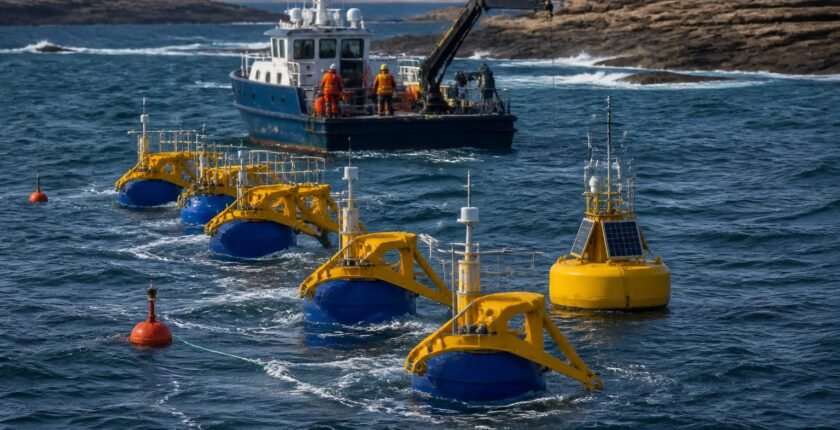
Carnegie Clean Energy Ltd has progressed its ACHIEVE Programme, advancing CETO wave technology toward a grid-connected demonstration at the Biscay Marine Energy Platform in Spain. The company says foundation structures have completed final preparations and that modular fabrication of Buoyant Actuators in the Basque Country is approaching completion ahead of an offshore deployment in October 2026. At the same time, Carnegie reports it is assembling power take-off modules for onshore trials of a rotary electric system intended to demonstrate performance and reduce integration risk for stakeholders.
Key takeaways
- Project: Carnegie’s ACHIEVE Programme targets grid-connected deployment of CETO at the Biscay Marine Energy Platform in Spain.
- Construction milestone: Carnegie completed final preparations of foundation structures and said Buoyant Actuator fabrication in the Basque Country is nearing completion.
- Testing and timing: Assembly of power take-off modules is under way for onshore trials prior to an offshore deployment scheduled for October 2026.
- Market data: Barchart Solutions lists Carnegie’s current market cap as A$81.19M and average trading volume at 894,580.
Table of contents
How ACHIEVE moves CETO from design to sea
Carnegie characterises the ACHIEVE Programme as the route to a commercial-scale demonstration of its CETO converters at BiMEP. The company says project-specific design and construction carried out over three years have supported on-site preparations, including finalising foundation structures on the BiMEP berth and finishing modular fabrication steps onshore. Carnegie presents these activities as the immediate prerequisites to move a unit from factory to the test site and into grid-connected operation.
Onshore assembly and the rotary electric system
Carnegie reports assembly is underway for its power take-off modules, which will be evaluated in onshore trials prior to any offshore integration. Those land-based trials aim to validate a rotary electric system Carnegie describes as converting wave-driven mechanical inputs into electricity. Carnegie frames the onshore validation as a chance to gather technical learnings and lower the engineering risks associated with later offshore installation and grid connection.
Company position and commercial context
Carnegie Clean Energy Ltd is an Australian developer of ocean-energy technologies, including CETO and MoorPower, and it operates subsidiaries in Spain and Ireland. The company says it uses artificial intelligence and advanced electric machines to optimise generation efficiency for grid-connected marine projects. Public market metrics published alongside the announcement show a current market cap of A$81.19M and an average trading volume of 894,580, with market data provided by Barchart Solutions.
Case for and against near-term success
The case for
- Completion of onshore fabrication and foundation work supports the October 2026 deployment schedule.
- Onshore testing of power take-off modules could validate the rotary electric system and lower integration risk for offshore commissioning.
The case against
- Delays in modular fabrication or in securing final offshore integration approvals would push back deployment.
- Onshore tests could reveal performance issues that require redesign or further trials before offshore work proceeds.
What to be careful about
- Offshore deployment depends on the fabrication schedule for modular Buoyant Actuators in the Basque Country.
- The project’s timetable is contingent on successful onshore validation of the rotary electric power take-off modules.
- Permitting or berth availability at the Biscay Marine Energy Platform could affect the planned October 2026 window.
The bottom line
Carnegie’s announcement frames the ACHIEVE Programme as a move from multi-year design work into practical demonstration at BiMEP. With foundation work finished and modular fabrication in the Basque Country nearing completion, the company is targeting an October 2026 offshore deployment and is prioritising onshore validation of power take-off modules to de-risk grid connection. The next milestones to watch are the outcome and timing of onshore tests and confirmation that local approvals and berth arrangements at BiMEP remain aligned with the deployment window.
What to watch
- Watch for the offshore deployment at the Biscay Marine Energy Platform in October 2026.
- Watch for completion and public results of onshore testing of the power take-off modules; no date has been set.
Frequently asked questions
What is the ACHIEVE Programme?
The ACHIEVE Programme represents Carnegie’s approach to delivering a grid-connected demonstration of its CETO wave converters at the Biscay Marine Energy Platform in Spain, following three years of design and construction work specific to the project.
When is the offshore deployment scheduled?
Carnegie states that the offshore deployment is planned for October 2026, pending completion of fabrication and onshore testing.
What will onshore testing evaluate?
Onshore testing will exercise the assembled power take-off modules and validate a novel rotary electric system before any offshore integration.
Related reading
This article is information, not financial advice. Anyone acting on it should do their own checks.