
Blog
AI detects wind turbine blade damage from drone photos
Estimated reading time: 5 minutes · Last updated:
A team at Hangzhou Dianzi University and Hangzhou City University published CHS‑Net, a deep‑learning pipeline that maps wind turbine blade defects from ordinary UAV photos and reports an intersection‑over‑union of 69.94% and an F1‑score of 82.31% on a 2,250‑image test set. The network rebuilds the U‑Net encoder‑decoder flow with four tailored modules — COSM, CIT, TCSE and DAT — to combine multi‑scale texture, CNN/transformer global context and topology‑aware output regularization. Faith Mcneil of Scienmag covered the paper and the public code release; Mcneil first reported the findings.
Key takeaways
- Model and team: CHS‑Net was developed by Feng Tian, Ban Wang, Jun Li, Zhenyu Wang and Juyong Zhang of Hangzhou Dianzi University and Hangzhou City University.
- Dataset and performance: On a publicly released dataset of 2,250 annotated UAV images, CHS‑Net achieved an IoU of 69.94% ±0.11 and an F1‑score of 82.31% ±0.08 across repeated runs.
- Architectural novelties: CHS‑Net adds a Contextual Multi‑Scale Semantic Modeling module (COSM), a CNN‑ViT Interaction (CIT) block, a Twin Channel‑Spatial Squeeze‑and‑Excitation (TCSE) unit and a Dual‑path Attention Topology (DAT) head.
- Reproducibility: The authors released code and data on a public GitHub repository and published the paper in Cluster Computing (2026), DOI 10.1007/s10586-026-06540-9.
Table of contents
- Key takeaways
- How CHS‑Net refocuses U‑Net architecture on blade defects
- Topology and dual attention: keeping cracks continuous
- Dataset, benchmarks and reproducibility
- Operational fit and limits for industry inspection workflows
- How this could and might not scale
- What to be careful about
- Frequently asked questions
How CHS‑Net refocuses U‑Net architecture on blade defects
CHS‑Net starts from the encoder‑decoder pattern of U‑Net but replaces generic blocks with modules tuned to the visual physics of turbine blades. In the encoder the team adds COSM, a depth‑adaptive multi‑scale module that gathers contextual cues at each layer so small hairline cracks and broad erosion patches are both represented. The authors argue that adapting receptive behaviour to encoder depth mirrors how an inspector alternates between fine texture and global shape.
At the network bottleneck CHS‑Net routes features through a CNN‑ViT Interaction block, CIT, that keeps the computational efficiency of convolutions while letting transformer self‑attention link distant image regions. On blade images this helps the model relate a faint discoloration to remote structural patterns rather than treating both as isolated artifacts. The design choices are presented with ablation tests in the paper and the implementation is part of the released codebase.
Topology and dual attention: keeping cracks continuous
Thin, elongated defects such as cracks pose a special challenge because common segmentation losses tend to fragment them into disconnected pixels. CHS‑Net's Dual‑path Attention Topology module, DAT, replaces the conventional output head with parallel attention paths and a boundary‑aware regularization that preserves connectivity. The authors emphasise that for maintenance decisions the continuous length and connectivity of a crack are often more important than raw pixel overlap.
The decoder also uses TCSE, a twin channel‑and‑spatial squeeze‑and‑excitation unit that refines both which feature types matter and where they matter in the image. Together DAT and TCSE sharpen boundary localization and keep thin structures from collapsing under thresholding — a practical gain when an engineer must estimate remaining blade strength from a segmentation map.
Dataset, benchmarks and reproducibility
The evaluation rests on a 2,250‑image UAV dataset with pixel‑level annotations covering cracks, surface erosion and delamination. The paper reports CHS‑Net's mean IoU as 69.94% ±0.11 and mean F1 as 82.31% ±0.08 across repeated runs, and compares performance against families of baselines: original U‑Net, Attention U‑Net and TransUNet variants, efficient real‑time models such as ICNet, SegFormer encoders and several prior blade‑defect systems from recent literature.
Crucially, the authors made code and data available on GitHub and list funding from the National Natural Science Foundation of China, from the Scientific Research Fund that belongs to Hangzhou Dianzi University Information Engineering College, and from the Open Research Project of the State Key Laboratory of Industrial Control Technology. The public release allows independent teams to reproduce the reported IoU and F1 numbers and to run the model on new image collections.
Operational fit and limits for industry inspection workflows
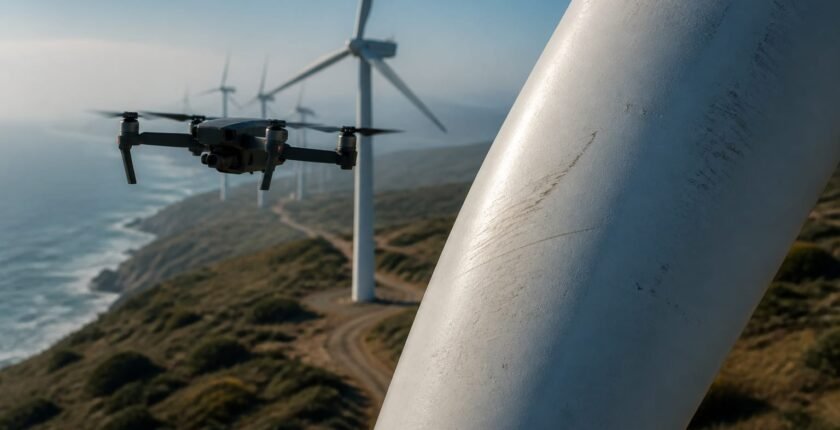
CHS‑Net addresses a genuine industry bottleneck: drones can capture thousands of images per turbine campaign, but interpreting them at pixel accuracy is the slow step. A segmentation map that preserves crack continuity lets asset owners estimate remaining life and prioritise repairs more precisely than bounding boxes do. Hybrid CNN‑transformer designs like CHS‑Net also map cleanly onto modern edge‑plus‑cloud inspection stacks where some processing runs on the drone or a nearby gateway.
That said, the paper does not report deployment latency, parameter counts or inference cost on representative edge hardware, and its dataset composition (for example, the share of offshore vs onshore images) is not detailed in the metrics section. These operational gaps are the main barriers to immediate roll‑out at scale and are the areas where follow‑up field trials will be decisive.
| Method family | Role in comparison |
|---|---|
| U‑Net | Baseline encoder‑decoder family |
| Attention U‑Net / TransUNet | Attention‑augmented segmentation baselines |
| ICNet | Efficient real‑time model |
| SegFormer lineage | Transformer encoder baselines |
| Specialized blade‑defect systems | Prior literature on blade inspection |
How this could and might not scale
The case for
- Public code and data make independent replication possible and lower the barrier for OEMs and service providers to trial CHS‑Net on their fleets.
- Hybrid CNN‑ViT interaction can bring global context without full transformer costs, improving detection of subtle defects across large images.
The case against
- Lack of reported inference latency and hardware benchmarks leaves uncertainty about real‑time edge deployment on drones or gateways.
- Domain shift — different lighting, moisture, paint schemes or offshore spray — could reduce performance unless the training set closely matches operational conditions.
What to be careful about
- Performance reported on a 2,250‑image dataset may not transfer to offshore turbines or novel blade materials without further annotation and retraining.
- Topology‑aware regularization that preserves connectivity can still produce false positives in textured or shadowed regions unless thresholds and post‑processing are validated in field trials.
- Computational cost and the absence of published edge latency figures may delay adoption in inspection pipelines that require on‑site or near‑real‑time inference.
The bottom line
CHS‑Net is a focused reengineering of U‑Net for the peculiar visual challenges of wind turbine blade defects: multi‑scale texture, long thin crack topology and the need for global context across a large image. The reported IoU (69.94% ±0.11) and F1 (82.31% ±0.08) on 2,250 images indicate stable, repeatable gains over a range of baselines, and the public code release enables verification. The critical next steps are field trials, domain expansion of the dataset and published latency figures to prove CHS‑Net can run inside real inspection pipelines.
What to watch
- watch for updates to the authors' GitHub repository; no date has been set for new model weights or expanded dataset releases.
- watch for field trials or pilot deployments by turbine OEMs or service contractors; no date has been set for such trials in the paper.
- watch for follow‑up benchmarks at major vision or wind‑industry conferences; no date has been set for a public replication study.
Frequently asked questions
What is CHS‑Net and who built it?
CHS‑Net (Collaborative Hybrid Segmentation Network) is a segmentation architecture developed by Feng Tian, Ban Wang, Jun Li, Zhenyu Wang and Juyong Zhang of Hangzhou Dianzi University and Hangzhou City University; the work appears in Cluster Computing (2026), DOI 10.1007/s10586-026-06540-9.
How well does the model perform on blade images?
On a 2,250‑image UAV dataset the authors report a mean intersection‑over‑union of 69.94% ±0.11 and a mean F1‑score of 82.31% ±0.08 across repeated runs.
Can operators use CHS‑Net directly in drone inspections?
The authors released code and data on GitHub, but the paper does not publish inference latency or edge hardware benchmarks; operators should verify model size and runtime before deploying on drone or gateway hardware.
Related reading