
Blog
Extended EGS circulation test starts at FORGE site in Utah
Estimated reading time: 5 minutes · Last updated:
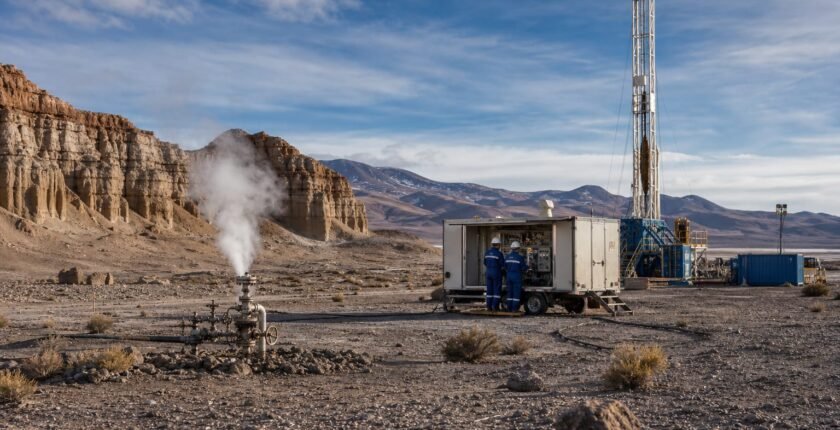
An extended enhanced geothermal system (EGS) circulation test began in August at the Frontier Observatory for Research in Geothermal Energy (FORGE) site in Utah to probe reservoir behaviour over months rather than hours. The run is planned for 90 days and could be extended to 120 days, FORGE said in an Aug. 12 release; the exercise aims to measure thermal decline and water loss under continuous flow. FORGE is managed by the University of Utah and funded by the U.S. Department of Energy, and the test is described by DOE as a milestone for EGS development.
heretofore unknown variables required to ensure long term EGS production remains commercially viable,
Kristie McLin, FORGE principal investigator
Key takeaways
- FORGE began a four-month extended circulation EGS test in August to evaluate reservoir performance under continuous flow.
- The planned run length is 90 days and could be extended to 120 days, FORGE said in an Aug. 12 release.
- FORGE is managed by the University of Utah and funded by the U.S. Department of Energy.
- Fervo Energy’s Cape Station is a 500-MW commercial-scale EGS project in Beaver County, Utah, and is expected to begin delivering power later in 2026.
Table of contents
- Key takeaways
- Why an extended circulation run matters for EGS
- What this test will measure and how it is run
- Where the test sits in the industry and who’s involved
- What a clear test result could unlock — and what would remain uncertain
- What could move this either way
- What to be careful about
- Frequently asked questions
Why an extended circulation run matters for EGS
FORGE designed the extended circulation test to move beyond short-duration experiments and observe reservoir behaviour under continuous operation. The site team will monitor how heat and fluid move through created fractures when wells are kept flowing for months rather than hours; that behaviour determines how reliably a field can sustain power output over years.
The U.S. Department of Energy framed the August test as a milestone, saying only a handful of EGS projects worldwide have reached this stage and that the experiment could “hold the key to some of the most important steps to advance EGS.” Because commercial power plants require stable thermal output and predictable water management, a multi-month run is the most direct way to see whether engineered reservoirs meet those requirements.
What this test will measure and how it is run
An “extended circulation” means continuous injection and production over an extended period to reveal slow processes that short tests cannot show. FORGE said the planned duration is 90 days, with a possible extension to 120 days, allowing technicians to track trends in temperature, pressure, fluid loss and signs of thermal breakthrough over time.
Enhanced geothermal systems (EGS) are engineered reservoirs where water is circulated through fractures heated by the Earth and returned to surface heat exchangers to generate electricity; unlike conventional hydrothermal plants, EGS does not rely on naturally porous, water-bearing rock. The test will log temperature decline at production wells, cumulative water loss from the system, and any changes in injectivity that indicate how the reservoir evolves under sustained use.
Where the test sits in the industry and who’s involved
FORGE, the Frontier Observatory for Research in Geothermal Energy, is managed by the University of Utah and funded by the U.S. Department of Energy. FORGE made the Aug. 12 release announcing the extended run; Kristie McLin, FORGE’s principal investigator, framed the experiment as a way to address “heretofore unknown variables required to ensure long term EGS production remains commercially viable.”
Separately, commercial deployment is advancing: Fervo Energy’s Cape Station, cited in material about the sector, is a 500-MW commercial-scale EGS project under construction in Beaver County, Utah. Fervo went public in a May IPO; the company’s stock has declined 56% from its initial peak, and a Jefferies research note from Julien Dumoulin-Smith cited a lowered FY27 revenue estimate of $63 million from $79 million. Fervo CFO David Ulrey told investors the company is focused on drilling performance as a mitigant to development risk.
What a clear test result could unlock — and what would remain uncertain
If extended circulation shows limited thermal decline and manageable water loss, developers could have hard field-level evidence to underwrite long-duration output projections and to design long-lived EGS wells and surface plants. DOE and FORGE say the data set from months-long operation is the missing link between experimental wells and grid-scale projects.
But even a successful run will leave open questions that the test cannot answer alone: how representative the FORGE reservoir is of other geologies, how costs scale when developers replicate stimulation and drilling at utility scale, and how permitting and transmission siting interact with deployment. FORGE’s data will reduce technical uncertainty but not eliminate the commercial and logistical work that follows.
What could move this either way
The case for
- A successful extended-circulation result would provide field-scale evidence on thermal decline and water loss, lowering technical risk for EGS developers.
- Multimonth performance data could shorten the timeline from demonstration to commercial deployment by clarifying reservoir-management practices and well spacing.
The case against
- If the test records rapid thermal decline or significant, irreversible water loss, it would raise costs and complexity for projects that depend on sustained heat extraction.
- Technical success at FORGE may not translate to other basins; geological variability could keep project-level uncertainty high even after the test.
What to be careful about
- Thermal breakthrough or faster-than-expected temperature decline during extended flow, which would reduce long-term power output.
- Sustained water loss from the engineered reservoir that raises operational water needs and cost.
- Transmission constraints and external development risks illustrated by Fervo’s lowered FY27 revenue outlook and announced curtailments.
The bottom line
The FORGE extended circulation test is a technical step that addresses the slow processes — thermal decline, water loss and injectivity change — that determine whether engineered reservoirs can sustain commercial power output. FORGE’s 90-to-120-day run will not by itself prove broad deployability, but it will supply the empirical, months-long performance data developers and policymakers have been missing. The industry will follow the dataset closely, and project economics and permitting discussions will shift depending on what the field measurements show.
What to watch
- Watch for FORGE to publish the extended circulation dataset; no date has been set for public release.
- Watch for updates from Fervo Energy on Cape Station’s commercial commissioning schedule and any transmission solutions; no date has been set.
Frequently asked questions
How long will the extended EGS test run?
FORGE said the run is planned for 90 days and could be extended to 120 days, allowing engineers to observe reservoir behaviour over months rather than only hours.
Who manages FORGE and who pays for it?
FORGE is managed by the University of Utah and funded by the U.S. Department of Energy, which described the test as a significant milestone for EGS.
What is the connection between this test and Fervo Energy’s project?
The FORGE test aims to reduce technical uncertainty that underpins commercial projects; Fervo Energy’s Cape Station is a 500-MW commercial-scale EGS project in Utah and its developers will benefit from FORGE’s field-scale findings.
Related reading
This article is information, not financial advice. Anyone acting on it should do their own checks.