
Blog
Floating data center Kraaken to power 32,000 homes
Estimated reading time: 6 minutes · Last updated:
Optimal Transit and InMar Technologies propose the Blue Economy VITAL 100 MW Kraaken, a 100 MW floating platform that combines OTEC-derived power, vacuum-flash desalination and an AI-grade data center. The company says the design delivers up to 40 MW of continuous electricity ashore — enough to power roughly 32,000 homes 24/7 — while producing 30 million litres (7.9 million gal) of fresh water per day for an estimated 150,000 people and retaining 60 MW for AI compute. These specifications and company estimates come from Optimal Transit’s presentation of the VITAL configuration, as first reported by New Atlas.
Key takeaways
- Platform capacity: Optimal Transit’s VITAL Kraaken is presented as a 100 MW floating platform split into 40 MW exported power, 60 MW for AI compute, and desalination capacity.
- Homes powered: Optimal Transit estimates that exporting 40 MW ashore would power roughly 32,000 homes 24/7.
- Fresh water output: Kraaken is claimed to produce 30 million litres (7.9 million gal) of fresh water per day, enough for about 150,000 people.
- Estimated cost and pace: Optimal Transit estimates an all-in VITAL vessel at about US$587 million and deployment in around three years versus six to 10 years for separate on‑land builds.
Table of contents
- Key takeaways
- How Kraaken’s DOT engine, waste heat and desalination are supposed to fit together
- Vessel design, mobility and how utilities reach shore
- Cost, timeline and the technical validation still needed
- Case for and against Kraaken’s near‑term delivery
- What to be careful about
- Frequently asked questions
How Kraaken’s DOT engine, waste heat and desalination are supposed to fit together
Optimal Transit calls its power core the Digital Ocean Thermal (DOT) engine — an extensively modified ocean thermal energy conversion (OTEC) architecture that pairs warm surface water and deep cold water using ammonia as the working fluid. Optimal Transit's diagram shows warm seawater entering at about 25 °C (77 °F), liquid-cooled servers adding waste heat at roughly 45 °C (113 °F) into an integrated thermal bus, and 5 °C (41 °F) deep seawater used to condense the ammonia back to liquid.
DOT is presented as a closed-cycle, multi-stage Rankine arrangement with enthalpy recovery and an AHEB unit that "supercharges" ammonia vapour from the server waste heat before it reaches the turbine. Optimal Transit claims this architecture can reduce turbine, condenser and cold-water-pumping equipment by roughly 70% in several places and cut warm-water pumping and evaporator costs by about 40% — claims the company makes for DOT but has not yet demonstrated in public tests.
The desalination function is vacuum-flash desalination grafted onto the same hot-and-cold thermal streams: warm seawater at reduced pressure boils at low temperature, the vapour leaves salts behind and is condensed using the cold-water flow. Optimal Transit’s intent is to squeeze electricity, cooling and fresh water from the same thermal infrastructure rather than treating them as separate plants.
Vessel design, mobility and how utilities reach shore
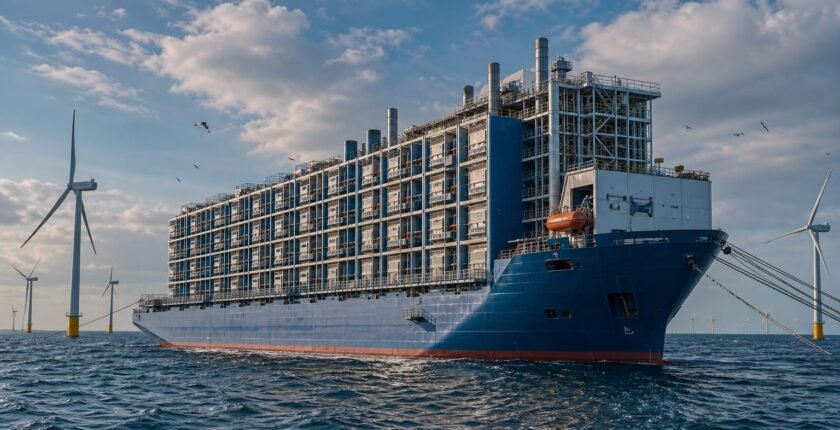
Kraaken is a ship rather than a fixed platform. The 100 MW configuration is shown as a roughly 300 ft (91 m), 50,000-long-ton vessel using a Small Waterplane Area Twin Hull (SWATH) design; the smaller 10/20 MW variants are around 250 ft (76 m). A SWATH places buoyancy low in two submerged hulls and links them to the topside via narrow struts, which reduces motion at the surface and stabilises onboard equipment.
Connectivity to land would be via a quick-disconnect umbilical that carries power, fibre and water conveyance to shore. Optimal Transit highlights mobility as a safety and commercial feature: it says the ship could detach within hours to evade storms or relocate if contracts change, and earlier design material cited speeds approaching 16 knots (18 mph/30 km/h). The company proposes clustering five VITAL vessels within a 2-mile (3-km) area as a "Sovereign Power Park" to yield around 200 MW of power to shore, 40 million gallons (151 million litres) of fresh water per day and 300 MW of data-center capacity.
Cost, timeline and the technical validation still needed
Optimal Transit lists an all-in cost of about US$587 million for a single VITAL vessel. It contrasts that with its $750 million to $1.33 billion estimate for constructing, on land, a 40 MW power station, a desalination plant sized for 7.9 million gallons per day, and a 60 MW AI data-center shell. Using those numbers, Optimal Transit presents Kraaken as costing roughly 44% to 78% of the separate-build total and says a vessel could be deployed in about three years rather than six to ten.
In its July announcement, Optimal Transit said a Series A raise would fund ABS-ready engineering drawings and comprehensive digital-twin validation of DOT; production plans depend on a proposed Series B raise in 2027. A 2026 modelling study cited in Optimal Transit's public materials obtained a peak thermal efficiency of about 3.75% for a 100 MW net OTEC plant at 700 m cold-water depth, and NOAA estimates that a conventional 100 MW OTEC plant could move 10 to 20 billion gallons (38–76 billion litres) of seawater per day through a cold-water pipe roughly 33 ft (10 m) across to around 3,300 ft (1,000 m) depth.
Optimal Transit specifically claims DOT can reduce cold-water pipe size by about 70%, which would materially ease those deployment challenges if validated, but public material has not yet explained how a deep-water intake would connect, disconnect and survive repeated relocations and storms while delivering the claimed net outputs and accounting for parasitic loads such as pumps and desalination.
| Item | Net power (MW) | Power ashore (MW) | Fresh water/day | AI/data capacity (MW) | Length |
|---|---|---|---|---|---|
| Single VITAL Kraaken (100 MW) | 100 | 40 | 30 million L (7.9 million gal) | 60 | 300 ft (91 m); 50,000 long‑ton |
| Smaller 10/20 MW design | 10/20 | — (modular racks) | 250 ft (76 m) | ||
| Sovereign Power Park (5 VITALs) | ≈500 (installed) | ≈200 (claimed export) | 40 million gal (151 million L) | 300 | clustered within 2-mile (3-km) area |
Case for and against Kraaken’s near‑term delivery
The case for
- If DOT’s equipment reductions are validated, the integrated approach could lower capex and speed deployment relative to building power, water and compute separately; Optimal Transit estimates a $587 million vessel versus $750 million–$1.33 billion for separate builds.
- Mobility and modular liquid-cooled racks let newer GPU generations be swapped into a long-life hull, which supports commercial flexibility and clustered scaling in a Sovereign Power Park.
The case against
- OTEC’s low thermal efficiency and the enormous seawater flows NOAA associates with 100 MW plants make deep-water intake engineering and environmental interaction major practical risks; a 2026 study modeled just 3.75% thermal efficiency at 700 m depth.
- Key validation steps remain unpublished: a detailed power balance that accounts for desalination, seawater pumps and ship auxiliaries is not yet available, and the proposed Series B raise in 2027 is required to move to production planning.
What to be careful about
- Deep-water intake engineering and disconnect survivability: how a cold-water pipe that reaches hundreds to ~1,000 m detaches and survives relocations and storms is unresolved.
- Unproven DOT performance at scale: the company’s claims of ~70% equipment-size reductions are not yet demonstrated and would materially affect feasibility.
- Funding and certification risk: production plans hinge on a Series B raise in 2027 and on ABS-ready engineering drawings before fabrication.
- Energy accounting gap: publicly available material does not provide a detailed net power balance that includes desalination and pumping parasitics.
The bottom line
Kraaken bundles established components — Rankine-cycle generation, ammonia working fluids, vacuum desalination, SWATH hulls and liquid‑cooled racks — into an unusual, movable merge of power, water and compute. The company’s figures are specific: 100 MW installed, 40 MW ashore, 60 MW for compute, 30 million litres of freshwater per day and a US$587 million price tag. The concept’s viability now rests on engineering validation of DOT at scale, a credible disconnectable deep‑water intake, an auditable power balance that includes parasitic loads, and the finance and certification steps that Optimal Transit has tied to its Series A and the proposed Series B raise in 2027.
What to watch
- Watch for Optimal Transit’s proposed Series B raise in 2027 and any published term sheet or investor update tied to production plans.
- Watch for completion and publication of ABS‑ready engineering drawings and the comprehensive digital‑twin validation of DOT; no date has been set.
Frequently asked questions
How much power does Kraaken claim to deliver to shore?
Optimal Transit presents the VITAL Kraaken as a 100 MW platform and says it would export up to 40 MW of continuous electricity ashore, a figure the company equates to powering roughly 32,000 homes 24/7.
How does the DOT engine make electricity and fresh water?
DOT is described as a modified OTEC closed‑cycle system that uses warm surface seawater at about 25 °C and deep cold seawater at about 5 °C with ammonia as a working fluid; onboard server waste heat at roughly 45 °C is blended into the thermal chain, and vacuum‑flash desalination produces fresh water from the same hot-and-cold streams.
What are the main technical hurdles the company still needs to prove?
Public material flags several gaps: demonstrating DOT’s claimed equipment reductions at scale, explaining how a deep-water intake can connect and disconnect while preserving performance, and providing a detailed net power balance; external modelling cited for a 100 MW OTEC plant shows thermal efficiency around 3.75% at 700 m depth and NOAA estimates conventional 100 MW OTEC could move 10–20 billion gallons (38–76 billion litres) of seawater per day.
Related reading