
Blog
Floating Solar Moorings Face Storm Tests at Alto Rabagão
Estimated reading time: 6 minutes · Last updated:
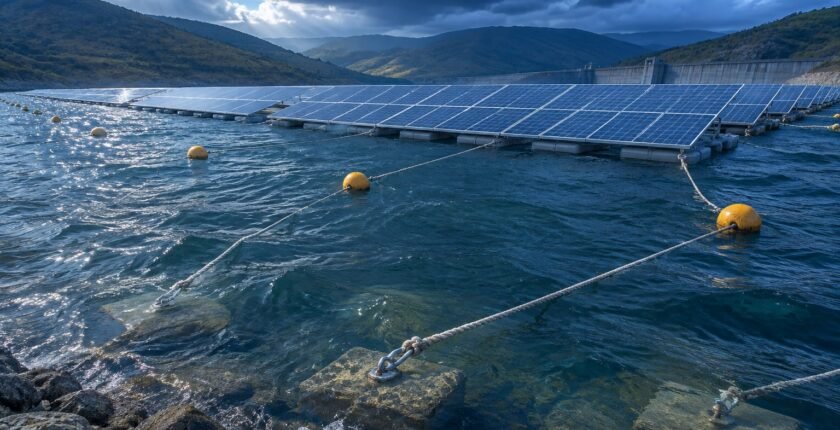
EDP has opened its Floating PV Lab at the Alto Rabagão reservoir in Portugal to outside developers. Its first two trials target the hardware that keeps a floating solar plant in place. Fred. Olsen 1848, a Norwegian company, is testing a buoy that automatically holds mooring tension as the water rises and falls. Sperra, based in California, is trialling gravity anchors made from 3D-printed concrete. Both pilots are set to run for a year. The reservoir was chosen because it is difficult: it faces strong winds, waves, snow, ice and wide swings in temperature. EDP says it wants the lab to help at least five new technologies reach commercial use by the end of 2027.
Key takeaways
- The test site: EDP's Floating PV Lab sits on the Alto Rabagão reservoir in Portugal, where the utility has run a floating photovoltaic pilot since 2016.
- The buoy trial: Norwegian company Fred. Olsen 1848 is testing an automatic tension buoy meant to keep mooring lines correctly loaded as reservoir levels shift.
- The anchor trial: California-based Sperra is trialling gravity anchors of 3D-printed concrete whose shape can be tailored to each site's loads, mooring layout and ground.
- The timeline: Each pilot runs for one year, EDP plans to operate the lab for three more years, and its target is at least five commercialised technologies by the end of 2027.
Table of contents
- Key takeaways
- Why Alto Rabagão Makes Floating Panels Work Hard
- How a Self-Adjusting Buoy Keeps Moorings Under Control
- Why Sperra Is Printing Its Anchors in Concrete
- What EDP Wants From an Open-Access Lab
- Will these designs reach commercial floating solar?
- What to be careful about
- Frequently asked questions
Why Alto Rabagão Makes Floating Panels Work Hard
EDP's presence at the reservoir predates the lab by a decade. In 2016 the Portuguese utility launched a floating photovoltaic pilot there, built around the idea that solar generation and a hydropower plant could share infrastructure. The new lab reuses that working setting, so developers test equipment beside an operating hydropower and solar installation rather than in a tank or a sheltered pond.
Floating photovoltaics are solar panels mounted on buoyant platforms that sit on a body of water instead of on land. The panels are rarely the weak point. The harder problem is holding the platform steady while the water underneath moves up and down and the wind pushes across it.
Alto Rabagão gives that problem every chance to show itself. The site sees strong winds, waves, snow, ice and changing temperatures. For a mooring or anchor designer, that combination is the attraction: a component that copes with all of it on one site has been tested against more than a calm-day demonstration would reveal. Field trials of this kind are how designers find weak points, refine a product and cut the risk of a failure at full commercial scale.
How a Self-Adjusting Buoy Keeps Moorings Under Control
A mooring is the set of lines connecting a floating platform to anchors below it. On a reservoir whose level keeps changing, the distance between the platform and the anchors keeps changing too. If the line length stays fixed, the tension in it shifts with the water, which is exactly what a designer wants to avoid.
Fred. Olsen 1848 is testing an automatic tension buoy built for floating photovoltaic systems. Its purpose is to keep the mooring arrangement at the right tension whatever the water is doing, adjusting on its own rather than needing crews to retension lines by hand.
The varying water levels at Alto Rabagão are what make the site useful for this trial. A buoy that holds tension through a full year of rises and falls there would have shown how a mooring system has to adapt in practice. No performance results have been published yet, and the trial's start and end dates have not been given.
Why Sperra Is Printing Its Anchors in Concrete
A gravity anchor holds a structure in place through its own weight resting on the bed, rather than by being driven or screwed into the ground. Concrete blocks have long filled that role because they are heavy and cheap. Sperra, based in California, is trialling a version of the same idea made from 3D-printed concrete.
Printing changes what the anchor can look like. Sperra's geometry can be tailored to the loads a particular site imposes, to its mooring configuration and to its ground conditions, instead of using one standard block shape everywhere.
The case for the approach is that a shape fitted to the job could hold better, cost less and be simpler to install than a generic block. Those are the outcomes the year-long trial is meant to test, and none of them has yet been demonstrated at Alto Rabagão. If the results hold up, the design could appear in future floating solar projects; if they do not, the trial will have done its job by showing where the idea falls short.
What EDP Wants From an Open-Access Lab
The more significant change may be who gets to use the site. EDP has opened the lab to businesses and research partners, so lessons that were once kept inside one utility can now feed into products from other companies. Fred. Olsen 1848 and Sperra are the first two named participants.
EDP intends to keep the lab running for three more years. By the end of 2027, the company wants at least five new technologies to have reached commercialisation with its backing. That target arrives well before the lab's planned operating period ends, and with two pilots named so far, at least three further technologies would need to come through within roughly the same window.
Commercialisation is also the hard step. A one-year trial can validate a buoy or an anchor; it cannot guarantee that developers will buy it. EDP has not said how it will judge whether a technology has been commercialised, which is the measure its 2027 goal depends on.
| Technology | Company | Company base | Problem addressed | Trial length |
|---|---|---|---|---|
| Automatic tension buoy | Fred. Olsen 1848 | Norway (Norwegian company) | Mooring tension as water levels change | One year |
| 3D-printed concrete gravity anchors | Sperra | California | Anchoring to site-specific loads and ground | One year |
Will these designs reach commercial floating solar?
The case for
- Alto Rabagão combines wind, waves, snow, ice, temperature swings and varying water levels, so a component that survives a year there has faced a wide range of loads.
- An operating hydropower and solar site lets developers gather data from a real installation rather than a lab tank.
- Opening the lab to outside companies widens the pool of mooring and anchoring ideas that can be tested on one site.
- Site-specific anchor shapes could reduce cost and installation complexity if Sperra's trial confirms the benefit.
The case against
- Neither pilot has published results, and validation after one year is not assured.
- A design proven on one Portuguese reservoir may not transfer directly to sites with different ground or water conditions.
- EDP's target of five commercialised technologies by the end of 2027 leaves a short window with only two pilots named so far.
- EDP has not defined what counts as commercialisation, making the 2027 goal hard to assess from outside.
What to be careful about
- Either pilot could fail validation after its one-year run, leaving the mooring and anchoring problems unsolved for now.
- Results from a single reservoir may say little about performance on larger or differently shaped water bodies.
- Without a stated definition of commercialisation, EDP's 2027 target could be met on paper without wide industry uptake.
The bottom line
The two trials at Alto Rabagão are aimed at the unglamorous part of floating solar: keeping a platform in place on water that moves. Fred. Olsen 1848 is testing whether a buoy can hold mooring tension on its own as levels rise and fall. Sperra is testing whether anchors printed to fit each site can outperform standard concrete blocks on cost and installation. Neither has results yet, and each has a year to produce them. EDP's bigger bet is the open-access model, letting outside companies use a working hydropower and solar site. Whether that yields five commercial technologies by the end of 2027 is the measure to hold it to.
What to watch
- Watch for results from the Fred. Olsen 1848 tension buoy and Sperra anchor trials at the end of their one-year runs; EDP has not given a completion date.
- Watch whether EDP names further technologies at the lab before the end of 2027, the deadline for its goal of at least five commercialised technologies.
- Watch for either design being specified in a commercial floating solar project; no date has been set.
Frequently asked questions
Can other companies test equipment at EDP's Alto Rabagão lab?
Yes. EDP has opened the Floating PV Lab to businesses and research partners, not only its own teams. Fred. Olsen 1848 and Sperra are the first two named participants.
Why test floating solar at Alto Rabagão rather than a calmer reservoir?
The reservoir sees strong winds, waves, snow, ice and temperature swings, along with changing water levels. EDP has also operated a floating photovoltaic pilot there since 2016, so the site already pairs solar with hydropower.
How long will EDP run the Floating PV Lab?
EDP plans to operate the lab for three more years. Over that period it aims to support at least five new technologies toward commercial use by the end of 2027.
Related reading