
Blog
IMO Net‑Zero Negotiations Restart, Carbon Pricing Central
Estimated reading time: 6 minutes · Last updated:
Governments return to London on 1-4 September 2026 for the International Maritime Organization’s Intersessional Working Group on Greenhouse Gas Emissions from Ships to resume negotiations over the IMO Net-Zero Framework. The core dispute is the framework’s economic mechanism — a carbon-pricing and compliance system tied to GHG Fuel Intensity (GFI) rules — and how high the price signal should be. The mechanism is expected to generate roughly $10 billion to $15 billion annually, as first reported by gCaptain. Delegations will test whether the MEPC 83 compromise still commands enough support or whether a new, materially different package will emerge before MEPC 85 on 30 November through 3 December 2026.
“Laying the regulatory foundation now is critical to ensuring that these investments take shipping into the right direction,”
Andreas Enger, Höegh Autoliners CEO
Key takeaways
- The IMO Intersessional Working Group meets 1-4 September 2026 to continue negotiation of the Net-Zero Framework.
- The framework’s economic mechanism is expected to generate roughly $10 billion to $15 billion annually.
- Brazil proposes GFI cuts of 3% in 2029 and 4% in 2030 and keeps remedial-unit prices at $100 and $380 per tonne of CO2e.
- Tuvalu would set Tier 1 units at $300 per tonne and Tier 2 units at $380 per tonne, with a GFI pathway intended to deliver a 30% reduction in direct-compliance obligations and a 65% reduction in base targets by 2035.
- Liberia would replace much of the Fund with transferable Surplus Units that ships could trade, bank or borrow.
Table of contents
Where the negotiations stand in London
Delegations will meet in London from 1 to 4 September 2026 to press on with changes to the Net-Zero Framework first negotiated at MEPC 83. The agenda covers implementation guidance, lifecycle greenhouse gas rules and the design of the mechanism that attaches a price to emissions while rewarding ships that use zero and near-zero fuels. The working group reports back to MEPC 85, scheduled for 30 November through 3 December 2026, where the larger membership will again face the question of whether to convert the package into binding global regulation.
Positions are now clearer and more entrenched than when the framework was first tabled. Intercargo’s pre-brief catalogued competing submissions from Liberia, Brazil, Tuvalu and a group including Australia, Canada, South Africa and the United Kingdom. China seeks more technology-neutral wording to recognise shore power, wind propulsion and solar power in GFI calculations, while several states press to keep the two-tier GFI system and incentives for zero and near-zero fuels.
The carbon-price divide driving the impasse
Much of the dispute is over how the economic mechanism should work in practice and how steep the carbon price should be. Norway, Pacific Island states and several European countries argue a strong price is essential to drive investment in alternative fuels and meet the IMO’s GHG strategy. By contrast, Liberia, Saudi Arabia and the United Arab Emirates warn that a uniform carbon price would raise costs for long-distance exports, remote trade-dependent economies and developing states and question the legality and administrative burden of a Fund-based approach.
Two clear price proposals are on the table. Brazil retains a two-tier remedial-unit approach with prices at $100 and $380 per tonne of CO2 equivalent. Tuvalu’s submission sets Tier 1 at $300 per tonne and Tier 2 at $380 per tonne, coupled with much steeper GFI reductions by 2035. Liberia’s alternative shifts emphasis away from a centralised Fund toward tradable Surplus Units, a design that Norway has said would reduce regulatory certainty and ambition.
What the main proposals would change
Liberia’s submission is the most structural: it links GFI targets to the availability, affordability and scalability of commercially viable fuels and would convert much of the fund-based approach into transferable Surplus Units that vessels could trade, bank or borrow. Liberia and Panama would also grant Surplus Units for verified operational or technological efficiency gains, while providing support for developing countries on a voluntary basis.
Brazil seeks to ease the initial years by proposing GFI cuts of 3% in 2029 and 4% in 2030, followed by a steeper path later, and it would keep remedial-unit prices at $100 and $380 per tonne. Tuvalu advocates a far more ambitious route, aiming for a 30% cut in direct-compliance obligations and a 65% lowering of base targets by 2035, paired with higher unit prices to strengthen incentives for near-zero fuels. A group that includes Australia, Canada, South Africa and the United Kingdom would largely preserve the MEPC 83 package while adding specifics on governance and how Net‑Zero Fund revenues are distributed.
Why the outcome matters for onboard renewables and wind propulsion
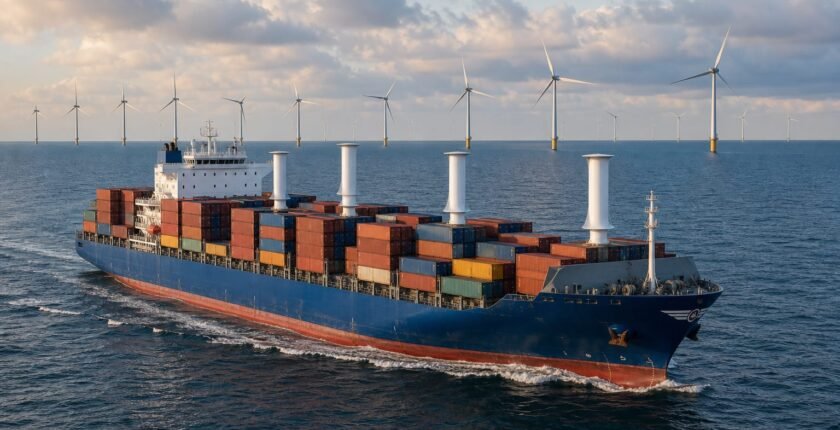
The framework’s final text will set which technologies count toward GFI performance and therefore which investments shipowners make. China’s push for technology-neutral wording explicitly seeks recognition of shore power, wind propulsion and solar power in GFI calculations; if accepted, that would give owners clearer credit for retrofit options such as rotor sails or rotor-assisted designs that reduce fuel intensity.
A weaker price or an opt-in approach for developing states would reduce the near-term commercial incentive to install on-board wind systems or add shore-power capability. By contrast, a firm two-tier price structure and robust rewards for zero and near-zero fuels would raise the relative value of technologies that lower lifecycle emissions, including renewable electricity supply at ports and wind-assist systems on vessels.
| Country/Group | Price ($/t) | GFI trajectory | Mechanism |
|---|---|---|---|
| Liberia | not specified | linked to fuel availability and scalability | transferable Surplus Units; bank/trade/borrow |
| Brazil | $100 and $380 | 3% in 2029; 4% in 2030 then steeper | two-tier remedial units; retains Fund elements |
| Tuvalu | $300 and $380 | 30% direct and 65% base-target by 2035 | higher-tier prices to drive stringent compliance |
| Australia/Canada/South Africa/UK | retain existing two-tier approach | follows MEPC 83 trajectory with added governance | Net-Zero Fund with clearer revenue distribution |
| China | flexible | technology-neutral GFI accounting | recognise shore power, wind propulsion, solar |
How this could play out before MEPC 85
The case for
- A compromise that keeps a two-tier price and adds governance detail could secure enough support to adopt a Fund-based framework at MEPC 85 on 30 November through 3 December 2026.
- Recognition of shore power and wind propulsion in GFI accounting would unlock investment in retrofit technologies and port infrastructure by making those options creditable under compliance rules.
The case against
- If Liberia’s availability-linked approach or a lighter Facility replaces the Fund, Norway and several European states may withhold support, weakening the price signal and reducing incentives for zero-fuel investment.
- Continued disagreement over revenue distribution and legal or administrative complexity could push a final decision beyond MEPC 85, leaving shipping exposed to an inconsistent patchwork of regional rules.
What to be careful about
- A diluted pricing mechanism that lowers the carbon price would slow investment in alternative marine fuels and onboard renewables.
- Unresolved governance and revenue-disbursement rules could leave developing countries without the promised infrastructure support for a just transition.
- A split outcome at MEPC 85 could prompt regional regulators to impose overlapping rules, increasing compliance costs for international shipping.
The bottom line
Next week’s London meeting is unlikely to settle the Net-Zero Framework but will clarify whether a majority still supports the MEPC 83 compromise or prefers a materially different path. The choice over price levels, the Fund versus tradable Surplus Units, and which technologies count in GFI accounting will determine whether shipping’s transition favours rapid roll-out of alternative fuels and onboard renewables or a slower, more regionally uneven shift. With MEPC 85 on the calendar for 30 November through 3 December 2026, negotiators have a limited window to bridge the carbon-price divide and agree governance rules that protect developing-country trade while delivering clear investment signals.
What to watch
- Watch the IMO Intersessional Working Group on Greenhouse Gas Emissions from Ships meeting, set for 1-4 September 2026, for whether delegations narrow the carbon-price gap.
- Watch MEPC 85, scheduled for 30 November through 3 December 2026, for any decision to adopt or further postpone the Net-Zero Framework.
Frequently asked questions
What is the core mechanism at the center of the talks?
The core mechanism combines progressively tighter greenhouse-gas fuel-intensity (GFI) rules with an economic instrument that prices emissions and rewards zero and near-zero fuels; negotiators expect the mechanism to generate roughly $10 billion to $15 billion annually.
How would Liberia’s proposal change compliance?
Liberia would largely replace a Fund-based approach with transferable Surplus Units that ships could trade, bank or borrow and tie GFI requirements to commercially viable fuel availability, reducing the central role of a pooled Fund.
Which submissions specify explicit carbon prices?
Brazil retains remedial-unit prices of $100 and $380 per tonne of CO2e; Tuvalu proposes Tier 1 at $300 per tonne and Tier 2 at $380 per tonne; other delegations propose different or unspecified price approaches.
Related reading