
Blog
Enercon takes delivery of 1,000t Liebherr LR 11000
Estimated reading time: 4 minutes · Last updated:
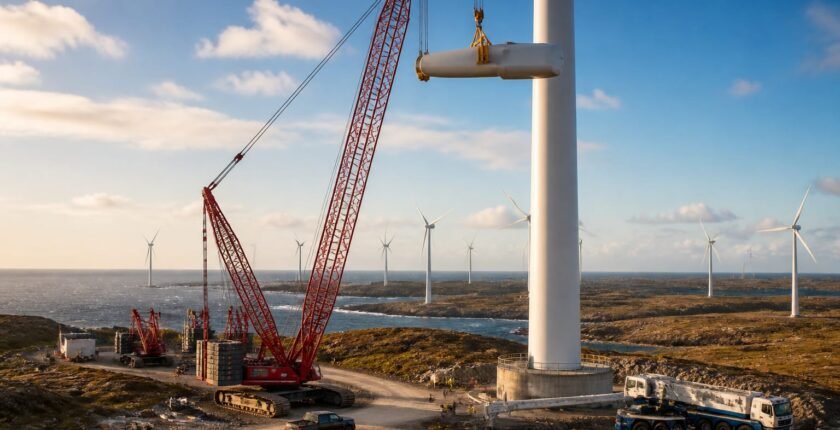
Enercon has taken delivery of a 1,000 tonne Liebherr LR 11000 lattice crawler crane, ordered with Liebherr’s SL12 wind power boom system and configured for tall onshore turbine work. The crane provides hook heights up to 192 metres and a rated capacity of 110 tonnes, with a main boom that can reach 168 metres and a fixed offset jib of up to 24 metres. Enercon has put the machine into operation at the Kakerbeck wind farm in eastern Germany, where it is installing multiple E-160 EP5 turbines with rotor diameters of 160 metres. The LR 11000 also carries Liebherr’s VarioTray and V-Frame ballast systems.
By investing in modern installation equipment, we are increasing our independence from external crane availability and enhancing our flexibility as a provider of solutions for the renewable energy ecosystem.
Hendrik Peterburs, Enercon vice president
Key takeaways
- Enercon has taken delivery of a 1,000 tonne Liebherr LR 11000 lattice crawler crane.
- The LR 11000 was ordered with Liebherr’s SL12 boom, giving a main boom up to 168 metres and a fixed offset jib up to 24 metres.
- The crane provides hook heights up to 192 metres, a capacity of 110 tonnes, and transport dimensions of 3.5 metres wide by 3.2 metres high.
- The machine is in operation at the Kakerbeck wind farm installing E-160 EP5 turbines with rotor diameters of 160 metres.
Table of contents
What the LR 11000 adds to onshore turbine lifts
The Liebherr LR 11000 is a 1,000 tonne-class lattice crawler designed for the heaviest onshore lifts. Specified here with the SL12 wind power boom system, the configuration gives a main boom length up to 168 metres and a fixed offset jib of up to 24 metres, allowing very tall picks while retaining capacity. In Enercon’s configuration the crane’s published hook heights reach 192 metres and its maximum single-hook capacity is 110 tonnes, figures that suit the assembly of modern multi-megawatt nacelles and long blades.
Transportability for large lattice crawlers matters: the LR 11000 as supplied includes Liebherr’s VarioTray and V-Frame ballast systems and ships with a transport width of 3.5 metres and a transport height of 3.2 metres. Those dimensions reduce the complexity and cost of road moves compared with wider or taller ballast arrangements, but route planning and permits remain necessary for each project.
Key phrase: hook heights up to 192 metres
Why Enercon chose an in-house heavy crane
Enercon’s vice president Hendrik Peterburs framed the acquisition around operational control. He said the investment increases the company’s flexibility on project timetables and reduces dependency on hired cranes, a practical advantage when multiple large-turbine installations compete for scarce heavy lifts in the same region.
Owning a dedicated LR 11000 lets Enercon plan sequential turbine installs at sites such as Kakerbeck without waiting on external crane availability, which can be constrained during peak seasons. That control shortens critical-path windows on erection schedules and can reduce mobilisation gaps between blade, nacelle and tower lifts.
Key phrase: increasing our independence from external crane availability
How the crane matches current turbine scale and Enercon’s fleet
Enercon is installing E-160 EP5 machines at Kakerbeck; those turbines carry rotor diameters of 160 metres and require long-reach lifts for blades and hubs. The LR 11000’s boom and jib lengths and its 110-tonne capacity at tall hook heights are a technical fit for that class of machine, making it suitable for present onshore platforms that are trending toward larger rotors.
The LR 11000 also reflects a broader logistics trade-off: fewer crane hires but higher ownership and mobilisation commitments. Enercon’s machine can be redeployed between regional projects, but each move will still need route surveys and local approvals because of the crane’s ballast and transport modules.
Key phrase: rotor diameters of 160 metres
| Item | Spec / Note |
|---|---|
| Model | Liebherr LR 11000 |
| Rated class | 1,000 tonne |
| SL12 boom | Main boom up to 168 m; fixed offset jib up to 24 m |
| Hook height / capacity | Up to 192 m; capacity 110 tonnes |
| Transport dims | Width 3.5 m; height 3.2 m |
| Current site | Kakerbeck wind farm — installing E-160 EP5 turbines (rotor 160 m) |
Near-term case for and against the purchase
The case for
- Greater scheduling control should cut delays tied to external crane queues, speeding project delivery at Enercon sites such as Kakerbeck.
- The LR 11000’s reach and capacity align with large-rotor turbines like the E-160 EP5, enabling Enercon to erect blades and nacelles without reliance on the tallest external rigs.
The case against
- High-capacity crawler ownership concentrates financial and operational risk: the crane must be kept busy to justify purchase and mobilisations between sites add cost.
- Local route, permit and site-preparation constraints remain, so the machine’s transport dimensions and ballast systems will not remove all logistical barriers.
What to be careful about
- Underutilisation risk if local project pipelines slow, leaving a high-value asset idle between campaigns.
- Route and permitting constraints despite compact transport dimensions could delay redeployments and raise costs.
- Future turbine designs exceeding the LR 11000’s tall-hook capacity would require different lift equipment or dual-crane procedures.
The bottom line
Enercon’s acquisition of a 1,000 tonne Liebherr LR 11000 configured with the SL12 boom is a direct, operational response to rising turbine scale and the market pressure on heavy-lift availability. The machine’s reach and capacity suit the E-160 EP5 class now being erected at Kakerbeck, and ownership should give Enercon more control over erection windows. That said, ownership shifts cost and scheduling risk onto the OEM: utilisation, inter-site mobilisations and local permitting will determine whether the crane proves a durable advantage or an underused asset.
What to watch
- Watch for Enercon to publish a deployment schedule that details where else the LR 11000 will be used; no date has been set.
- Watch for the completion date for the E-160 EP5 installations at Kakerbeck; no date has been set.
Frequently asked questions
What capacity and hook height does the LR 11000 provide?
The supplied LR 11000 has a rated capacity of 110 tonnes and provides hook heights up to 192 metres, enabled by the SL12 boom with a main boom length up to 168 metres.
Where is Enercon using the crane first and what turbines are being installed?
Enercon has deployed the crane at the Kakerbeck wind farm in eastern Germany to install E-160 EP5 turbines, which have rotor diameters of 160 metres.
Does the LR 11000 simplify transport and logistics?
Liebherr supplied the crane with VarioTray and V-Frame ballast systems and transport dimensions of 3.5 metres wide by 3.2 metres high, which reduce but do not eliminate route and permit requirements for moves.
Related reading