
Blog
Maryland Opens Up to $200M Solar and Storage Grant Auction
Estimated reading time: 4 minutes · Last updated:
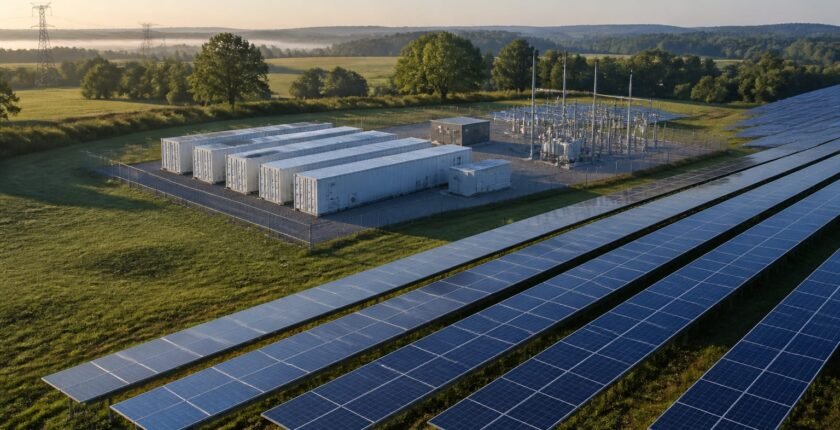
Maryland has opened a competitive grant auction for solar and battery projects. The Maryland Energy Administration (MEA) program, Megawatts for Maryland, offers up to $100 million for Fiscal Year 2027 and expects a further $100 million for FY 2028, all drawn from the state's Strategic Energy Investment Fund. Developers bid the lowest price per megawatt-hour they will accept, and the cheapest eligible bids win. The Maryland solar and storage grant targets grid-scale projects as MEA tries to meet rising electricity demand and ease regional transmission costs. Preliminary applications are due 30 November 2026, final bids on 22 January 2027, and awards are expected in spring 2027.
Key takeaways
- Funding: Megawatts for Maryland is backed by up to $100 million for FY 2027, with another $100 million anticipated for FY 2028 from the Strategic Energy Investment Fund.
- Deadlines: MEA wants preliminary applications by 30 November 2026 and final per-megawatt-hour bids by 22 January 2027, with grant decisions expected in spring 2027.
- How winners are picked: MEA will fund the eligible developers asking for the lowest price per megawatt-hour in a closed-bid auction, not a fixed incentive.
- The storage gap: Maryland has 3,440 MWdc of installed solar but only 35 MWh of battery storage, the imbalance this auction is meant to address.
Table of contents
How the Two-Stage Auction Screens Out Speculative Bids
MEA has split the process in two so that only projects with a credible route to operation reach the pricing round. The first stage is a preliminary application due 30 November 2026. MEA will use it to check basic project parameters, whether the developer controls the land, and where the project sits in the interconnection queue.
Developers who clear that screen then submit a sealed bid by 22 January 2027. The bid sets a price per megawatt-hour and must arrive with full financial models and supporting documents. In a closed-bid auction, no bidder sees rival offers, so each must price from its own costs.
Grant decisions are expected in spring 2027. Winning projects then have seven years from the funding allocation to reach commercial operation.
Which Solar and Battery Projects Can Compete
Eligibility is broad. Tier 1 renewable generation can bid if it sits outside net energy metering, the arrangement that credits customers for power they export to the grid. Battery systems qualify whether they stand alone or are paired with Tier 1 renewables, net-metered or not. Hybrid assets that combine generation and storage are also eligible.
MEA has chosen price competition over fixed incentives. It will fund the eligible developers who ask for the least money per megawatt-hour. That should stretch the fund, though it favours the cheapest site over the one the grid most needs.
MEA Director Kelly Speakes-Backman has described renewables and storage as the quickest, cleanest and lowest-cost way to build local supply. The Funding Opportunity Announcement and financial model templates are on the My MEA online portal.
Why Storage Is the Gap Maryland Must Close
Maryland's solar base is already sizeable. The state has 3,440 MWdc of solar spread across 119,137 installations, representing $7.7 billion of investment. That fleet supplies 8.77% of Maryland's electricity and powers over 408,000 homes.
Battery storage lags far behind, at 35 MWh statewide. Beside the solar fleet that figure is tiny, which makes near-term grid-scale storage the clearest case for this money. Batteries let daytime solar output be shifted into later hours.
Some 200 solar firms operate in the state, 17 of them manufacturers and 100 of them installers or developers, and together they account for nearly 5,000 jobs. A five-year projection, whose author is not named, has Maryland adding 2,637 MW of solar. If that arrives without matching storage, the imbalance widens.
| Stage | Date | What MEA requires or does |
|---|---|---|
| Preliminary application | 30 November 2026 | Project parameters, site control, interconnection standing |
| Final bid | 22 January 2027 | Price per MWh, financial models, documentation |
| Grant decisions | Spring 2027 | Awards to lowest eligible bids |
| Commercial operation | Within seven years of funding | Project must be operating |
What could help or hold back the auction
The case for
- Lowest-price bidding should buy more capacity per dollar than a fixed incentive would.
- The preliminary screen on site control and interconnection standing should weed out projects unlikely to be built.
- Standalone, co-located and hybrid storage can all compete, widening the pool of bidders.
The case against
- Only the FY 2027 tranche of up to $100 million is in place; the FY 2028 $100 million is described as anticipated.
- A seven-year window to reach commercial operation means awarded capacity may take years to appear on the grid.
- Price-only selection may favour cheap sites over the locations where storage would relieve the grid most.
What to be careful about
- If the anticipated FY 2028 funding does not materialise, the program shrinks to up to $100 million.
- Interconnection delays could push winning projects toward the seven-year commercial operation limit.
- With 35 MWh of storage today, too few experienced local storage developers may bid to make the auction competitive.
The bottom line
Megawatts for Maryland tests whether a reverse auction can buy storage cheaply in a state that has built solar far faster than batteries. The design is disciplined: a screening round, sealed bids and a seven-year deadline to operate. Its scale is less settled. Only the FY 2027 tranche of up to $100 million is backed; the FY 2028 money is described as anticipated. MEA has not said how much will go to storage rather than generation. Answers begin with the preliminary applications due 30 November 2026, and the awards expected in spring 2027 will show who won and how much capacity the fund bought.
What to watch
- Watch for the volume of preliminary applications MEA receives by the 30 November 2026 deadline.
- Final sealed bids with per-megawatt-hour prices and financial models are due 22 January 2027.
- MEA expects to announce grant decisions in spring 2027, which will show how much storage the auction actually bought.
Frequently asked questions
When is the deadline for Megawatts for Maryland applications?
Preliminary applications are due 30 November 2026. Developers who pass that stage must file final bids, with per-megawatt-hour pricing and financial models, by 22 January 2027.
Can a standalone battery project apply for the Maryland grant?
Yes. MEA lists standalone battery energy storage systems as eligible, alongside batteries paired with Tier 1 renewables and hybrid generation-plus-storage assets.
Is the full $200 million guaranteed?
No. Up to $100 million is backed for Fiscal Year 2027, while the second $100 million for FY 2028 is anticipated. Both tranches come from the Strategic Energy Investment Fund.
Related reading