
Blog
Michigan approves first PA 233 solar farm
Estimated reading time: 6 minutes · Last updated:
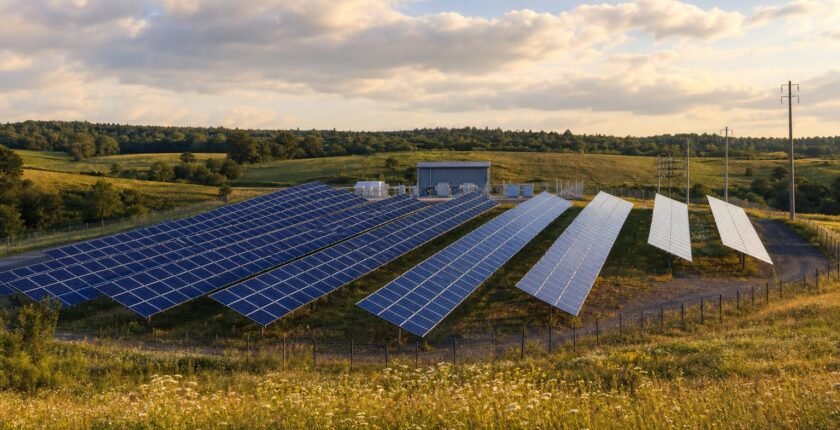
The Michigan Public Service Commission has approved a settlement that clears the way for a 90-megawatt Acceleration Solar project covering 870 acres in southern Ingham County, after state authority under Public Act 233 superseded local zoning. As first reported by News 10, the deal was negotiated between developer Ranger Power and the townships of Leslie, Onondaga and Vevay and includes screening, tighter noise limits and a shift in decommissioning responsibility to the state. The approval is the first real-world test of the 2023 law that gives Lansing final say over large renewable projects and arrives while 79 townships and counties press a legal challenge to the statute.
They just said, we’re going to jam it down your throat whether you like it or not. So here we are.
Dallas Henney, Leslie Township Supervisor
Key takeaways
- Project cleared: The Michigan Public Service Commission approved a settlement that allows the 90-megawatt Acceleration Solar project on 870 acres in Leslie, Onondaga and Vevay townships.
- Developer and concessions: Ranger Power negotiated screening, stricter noise limits and a state responsibility for decommissioning in exchange for township concessions.
- Local payments secured: Commission chairman Dan Scripps said the settlement included "hundreds of thousands of dollars in direct payments" to the three townships.
- Legal challenge pending: Seventy-nine townships and counties have filed with the Michigan Supreme Court after a split Court of Appeals ruling in May over Public Act 233.
Table of contents
How the Acceleration Solar approval worked
The project known as Acceleration Solar is a 90-megawatt installation sited across 870 acres in three adjacent townships: Leslie, Onondaga and Vevay. Under Michigan law passed in 2023 — Public Act 233 — the state can authorize large renewable projects where local ordinances conflict with statutory limits. Rather than leaving the project to a unilateral state finding, the townships and Ranger Power negotiated a settlement that the Michigan Public Service Commission then approved. The settlement adds local concessions: extra visual screening to reduce view impacts, stricter noise limits compared with the townships’ prior rules, and an explicit allocation of responsibility that places decommissioning oversight with the state when the facility reaches end of life.
Ingham County declined to join the three-township settlement but reached a separate direct-payment agreement with Ranger Power, the commission said. Dan Scripps, chair of the Michigan Public Service Commission, described the package as including funding for township legal fees, drain maintenance and first responder training, and he told the commission it secured "hundreds of thousands of dollars in direct payments" for the communities affected.
Public Act 233, the courts and the political backdrop
Public Act 233, enacted in 2023, transfers siting authority for certain large renewable energy facilities from local governments to state regulators when local ordinances are more restrictive than the statute. The law is designed to streamline approvals and meet the state's statutory target of 100% clean energy by 2040. The Acceleration Solar approval in Ingham County is the first practical application of that authority; it shows how the commission and developers can negotiate community-level concessions while the state holds final approval.
The legal fight over the statute is active. Seventy-nine townships and counties filed a challenge with the Michigan Supreme Court after a split decision from the Michigan Court of Appeals in May that narrowed the definition of what counts as a "compatible renewable energy ordinance." Lawmakers have also pursued repeal efforts. Erik Nordman, director of the MSU Institute of Public Utilities, said researchers at Michigan State University are exploring agrivoltaics and other approaches to reduce friction between farming communities and solar deployment — an indication that technical options are being sought even as courts and legislatures consider policy changes.
Local reaction and the trade-offs negotiated
Local officials voiced clear reservations even as they accepted concessions. Leslie Township Supervisor Dallas Henney framed the outcome as a loss of local control and argued the townships were compelled by state authority to accept the project. Henney’s view encapsulates the political tension: residents and local leaders who oversee zoning see land-use decisions differently than state regulators charged with meeting statewide clean-energy mandates. The settlement was a route to win mitigation measures and cash for local services while acknowledging the limits the law imposes on township authority.
The settlement’s package included funds earmarked for local priorities and practical measures such as additional screening and emergency services training. Ingham County, which did not join the three-township settlement, negotiated a separate payment arrangement with Ranger Power. Those negotiated payments and mitigations show how developers and regulators can craft site-level terms even when statutory authority rests with the state, but the arrangements do not end the broader disagreement over who should set land-use rules for large renewable projects.
What this decision means for future renewable projects in Michigan
As the first test case of Public Act 233 in practice, the Acceleration Solar approval will inform how developers, local governments and the commission handle future large-scale projects. If settlements like this become routine, they could set negotiating templates for screening, noise and payments that other communities replicate. The state’s 100% clean-energy target for 2040 provides a policy driver for faster build-out, but it does not eliminate contests over siting, local impacts and long-term liabilities.
At the same time, the pending legal challenge keeps uncertainty high. A reversal by the Michigan Supreme Court or legislative changes could alter the balance of authority and reopen local zoning power. Meanwhile, technical approaches such as agrivoltaics and negotiated mitigation funding may reduce opposition on some sites. Developers and local governments will watch closely whether the Acceleration Solar settlement becomes a model or an outlier once the courts rule and political momentum shifts.
How this could play out
The case for
- Public Act 233 creates a clear path for large projects, reducing uncertainty for developers and helping the state meet its 100% clean-energy by 2040 requirement.
- Settlements that include screening, noise limits and direct payments could become standard, giving localities concrete mitigation in exchange for ceding siting control.
The case against
- The Michigan Supreme Court review of the 79 filings or a future legislative repeal could restore broader local zoning authority, delaying or blocking projects approved under PA 233.
- Continued local opposition may increase project costs through negotiated payments, stricter site requirements or litigation, making some sites uneconomic.
What to be careful about
- A Michigan Supreme Court decision against the current interpretation of "compatible renewable energy ordinance" could invalidate approvals granted under Public Act 233.
- Ongoing local opposition and separate county agreements, such as Ingham County’s separate payment deal, may fragment mitigation standards and complicate future siting.
- Shifts in state policy or a successful repeal effort could change the permitting regime and retroactively affect projects approved under PA 233.
The bottom line
The Acceleration Solar settlement shows how Michigan’s 2023 siting law operates in practice: the state can approve a large facility, but settlements can secure local mitigations and payments. That balance may speed some projects toward construction while leaving legal and political questions unresolved — most notably the 79 filings before the Michigan Supreme Court and continuing repeal efforts in the legislature. How the courts rule and whether the state standardizes settlement measures will determine if this project is a template or a one-off in Michigan’s push to reach 100% clean energy by 2040.
What to watch
- Watch for a Michigan Supreme Court decision on the petitions filed by 79 townships and counties; no date has been set.
- Watch for any legislative action to amend or repeal Public Act 233; no date has been set.
- Watch for the Michigan Public Service Commission or Ranger Power to release a project construction timeline; no date has been set.
Frequently asked questions
What is Public Act 233 and why does it matter here?
Public Act 233 is a 2023 Michigan law that lets state regulators approve large renewable projects when local ordinances conflict with the statute; it is the legal basis the commission used to clear the 90-megawatt Acceleration Solar project in Ingham County.
Who negotiated the settlement terms and what do they include?
Ranger Power negotiated the settlement directly with Leslie, Onondaga and Vevay townships; the approved terms include extra screening, stricter noise limits and funding for local services along with payments described by the commission chair as "hundreds of thousands of dollars in direct payments."
Could this approval be reversed or blocked?
Yes. Seventy-nine townships and counties have filed with the Michigan Supreme Court after a split Court of Appeals ruling in May, and the outcome of that appeal or any legislative repeal effort could change how PA 233 is applied to projects like Acceleration Solar.
Related reading