
Blog
Seasonal heat storage for data center waste heat
Estimated reading time: 6 minutes · Last updated:
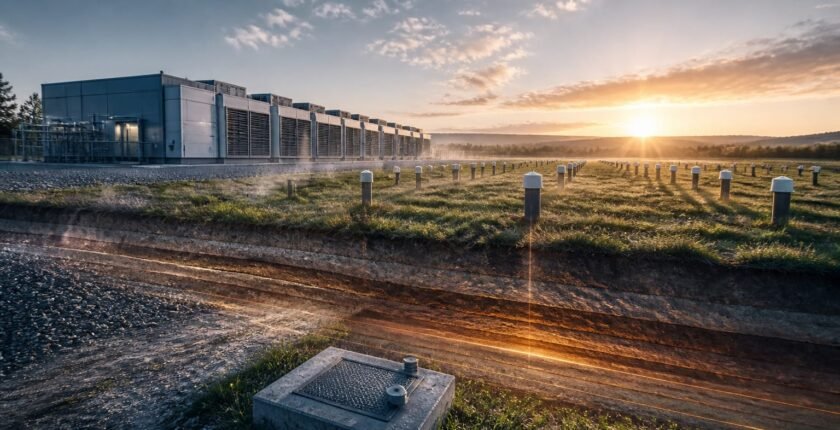
Seasonal heat storage can hold data center waste heat produced year-round in summer and return it as usable warmth in winter by warming rock or groundwater in boreholes. Epic Systems in Verona, Wisconsin, has drilled roughly 6,100 wells 300 to 800 feet (90 to 240 meters) deep around its campus and uses waste heat from a 3.5-megawatt data center to heat about 40 buildings months later. The method relies on the fact that a few hundred feet down the ground stays close to the local yearly average (about 50°F / 10°C), so warmed rock loses heat only slowly and serves as seasonal thermal storage.
Key takeaways
- Epic Systems has drilled roughly 6,100 wells 300 to 800 feet (90 to 240 meters) deep and uses waste heat from a 3.5-megawatt data center to heat about 40 buildings on its Verona, Wisconsin campus.
- Research-grade systems heat packed material in wells to as much as 284°F (140°C) to drive generators, but data-center-scale waste heat is around 140°F (60°C) and is better suited to space heating with heat pumps.
- The U.S. had more than 141,000 documented orphaned oil and gas wells that modelers have proposed converting for thermal storage without replacing steel casings.
- Data centers used about 4.7% of the country's electricity in 2024 and Lawrence Berkeley National Lab projects that share could reach nearly 12% by 2030; about 30% to 40% of that usage is for cooling.
Table of contents
How the ground holds heat for months
Seasonal heat storage turns the ground into a slow, low-loss container. In summer, warm water from a data center is pumped through pipes in boreholes where it transfers heat to surrounding rock or to an aquifer. Rock is a poor conductor of heat, so the warmed volume loses heat only at its edges; pushed into a large enough volume, most of the input remains months later.
There is no buried tank or battery: the rock or groundwater is the storage medium. That principle explains why a pile of snow melts slower than a thin sheet of snow — shape and surface area matter. Systems in colder climates have delivered water back to the surface at temperatures commonly reported around 59°F (15°C) when recovering summer-stored heat for winter use.
Working examples: borefields and aquifers
On-site projects show the concept at building scale. Epic Systems has drilled roughly 6,100 wells 300 to 800 feet (90 to 240 meters) deep around its Verona, Wisconsin campus and channels waste heat from a 3.5-megawatt data center into that borefield to heat about 40 buildings months later. The Department of Energy reports Epic’s campus buildings use about 25% less energy than comparable buildings in the same climate.
A different approach stores heat in underground water. A complex in Bonn, Germany, has used aquifer thermal energy storage since 2009 to supply between 60% and 80% of its winter heat demand for offices, a hotel, a medical center and a data center. Those examples show two technical routes—borehole thermal energy storage and aquifer storage—each suited to different geology and project scale.
Limits: thermal saturation, distance and regulatory gaps
Borefields face a concrete physical limit: if more heat is injected in summer than recovered in winter, the warmed rock slowly grows hotter year after year and the field can no longer accept heat at the design temperature. That thermal saturation of borefields forces either more use of stored heat—preheating boiler feedwater or melting snow—or more drilling to spread the heat through greater rock volume, which raises land, equipment and capital costs.
There are additional practical limits. Stored heat sits under or beside the facility that supplied it, so users must be close by. And while modelers have shown idle or orphaned oil and gas wells could be repurposed for thermal storage, most states currently regulate wells only as oil-and-gas installations or as plugged wells; a dedicated regulatory category for heat storage does not yet exist, which complicates permitting even where the geology is usable.
Scale and the policy opportunity
Whether seasonal storage becomes widespread depends on both data-center growth and policy. Data centers used about 4.7% of the country's electricity in 2024 and Lawrence Berkeley National Lab projects that share could reach nearly 12% by 2030; in some states the data center share of electricity is already much larger, at 15.4% in North Dakota and 25.6% in Virginia. About 30% to 40% of data-center electricity use goes to cooling, which is the heat stream that could be captured and stored.
The contrast between on-campus borefields and deep geothermal plants is instructive. Google has secured 115 megawatts of geothermal power in Nevada and Meta contracted 150 megawatts from New Mexico—projects that drill for heat the Earth supplies. Storing data-center heat underground is the mirror image: the drilling and wells are similar, but the heat source is the building. No one has yet stored a data center’s heat underground at the 100- to 1,000-megawatt scales now associated with large AI campuses.
| Site | Storage type | Scale / figures | Notes |
|---|---|---|---|
| Epic Systems (Verona, Wisconsin) | Borehole thermal storage | Roughly 6,100 wells, 300–800 ft (90–240 m); heat from 3.5‑MW data center; heats about 40 buildings | Campus system that injects summer waste heat for winter heating; DOE reports ~25% lower building energy use |
| Bonn, Germany | Aquifer thermal energy storage | Supplies 60%–80% of winter heat demand | In operation since 2009 for offices, hotel, medical center and a data center |
| Deep geothermal power projects | Geothermal electricity generation | Google: 115 MW (Nevada); Meta: 150 MW (New Mexico) | Drills for Earth’s heat to make power rather than store building waste heat |
The case for and against wider adoption
The case for
- Captured heat is a persistent, local energy stream: storing summer waste heat can cut building energy for months and reduce water use tied to evaporative cooling.
- Existing infrastructure could lower costs: modelers show more than 141,000 documented orphaned oil and gas wells in the U.S. could be repurposed for thermal storage without replacing steel casings in some cases.
- Policy moves to create a regulatory category and streamlined permitting for converting idle wells would unlock many retrofit opportunities without new drilling in some locations.
The case against
- Thermal saturation means borefields must be oversized, drained by greater use, or periodically expanded by drilling, which raises land, equipment and capital costs.
- Distance limits the beneficiaries: stored heat serves buildings on or beside the warmed ground, so larger data centers or AI campuses (100–1,000 MW) may outgrow local reuse opportunities.
- Regulatory frameworks in most states currently lack a clear category for wells used as thermal storage, which slows deployment and increases permitting uncertainty.
What to be careful about
- A borefield that receives more heat than it returns will gradually overheat and lose capacity to accept additional summer heat.
- Drilling more boreholes to spread heat increases land needs, upfront capital costs and project complexity.
- Regulatory gaps leave orphaned-well repurposing unclear; current law often treats wells only as oil-and-gas installations or as plugged wells.
- Stored heat is inherently local: projects that assume regional heat sharing face transmission and distance constraints.
The bottom line
Seasonal heat storage turns a perennial nuisance—data center waste heat—into a time-shifted resource by warming rock or groundwater and recovering that warmth months later. Campus-scale examples such as Epic Systems’ borefield and Bonn’s aquifer system show the method can reduce building energy demand and supply a large fraction of winter heat. Physical limits, notably thermal saturation, distance constraints and existing regulatory categories for wells, mean the approach suits campus and local clusters more readily than dispersed, very large facilities. Where geology and policy align, repurposing idle wells or adding borefields offers a low-carbon way to keep heat local and reduce both power and water pressures from expanding data centers.
What to watch
- 2030: check whether Lawrence Berkeley National Lab’s projection of data centers reaching nearly 12% of U.S. electricity is realised.
- Watch for state action on a streamlined permit process to allow conversion of idle oil and gas wells to thermal storage; no date has been set.
- Watch for firm proposals or pilots to reuse documented orphaned wells for seasonal heat storage; no date has been set.
Frequently asked questions
How does seasonal heat storage actually keep summer warmth until winter?
Heat from servers is pumped as warm water through pipes in boreholes where it warms surrounding rock or groundwater; rock’s low thermal conductivity means the warmed volume loses heat slowly, so much of the input remains for months. Systems commonly use pipe depths of 300 to 800 feet (90 to 240 meters) so the ground stays near the yearly average temperature (about 50°F / 10°C) below the diurnal and seasonal swings.
Can data center waste heat be turned into electricity?
Not at typical waste-heat temperatures: recovered water from data-center-grade systems is often around 140°F (60°C), which is useful for space heating but not hot enough to drive turbines. Research systems that pack material into wells can reach about 284°F (140°C) and use that heat for generation, but reaching those temperatures requires additional heat pumping and electricity input.
How large is the opportunity compared with current energy use?
Data centers used about 4.7% of the country's electricity in 2024 and Lawrence Berkeley National Lab projects that could grow to nearly 12% by 2030; roughly 30% to 40% of data-center electricity is for cooling, which is the stream that could be captured and stored seasonally.
Related reading