
Blog
Taiwan Allows Solar Over Fishponds If Catch Stays 70%
Estimated reading time: 5 minutes · Last updated:
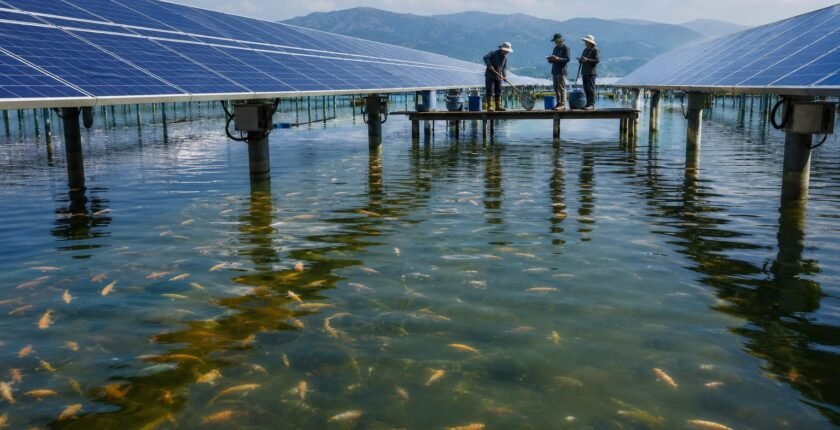
Taiwan has authorised solar installations on aquaculture berms provided farms continue to operate as farms: operators must land at least 70 percent of their pre-cover catch, and officials inspect harvests to verify compliance, as first reported by Energies Media. The rule ties panel coverage to production value rather than a developer revenue target, so arrays must be planned to preserve a commercial fishery. Pilot sites show the approach can deliver power without ending production: one developer converted 142 acres in Qigu, Tainan into an array approaching nearly 43 megawatts while the site still landed more than 220,000 pounds of seafood in a year.
Key takeaways
- Threshold: The regulation requires farms to land at least 70 percent of the three‑year average production value to keep panels in place.
- Project example: A Taipei developer converted 142 acres in Qigu into an array of nearly 43 megawatts while keeping 18 ponds stocked and six reservoir ponds in operation.
- Harvest retained: That Qigu site reported more than 220,000 pounds of seafood and 27,000 pieces of sun‑dried mullet roe in a full year.
- National scale: Taiwan has 154 square miles of fishponds; the programme has earmarked something over 80 square miles toward a 4.4 gigawatts fishery power goal, while the aquaculture sector produces roughly 920 million dollars a year.
Table of contents
Why ponds are unusually good ground for panels and fish
Two technical effects favour placing panels over shallow coastal ponds. Photovoltaic cell voltage falls as temperature rises, and the source notes a benchmark of 158 degrees for rooftop heating that cuts rated output; panels run several degrees cooler over water, which returns incremental kilowatt hours. The same partial cover reduces evaporation, moderates peak summer temperatures and can suppress algae blooms that strip oxygen from the water column.
These climatic shifts benefit the stock: shade that cuts sunlight can stabilise conditions for species such as milkfish, mullet and shrimp. The frames for these Taiwanese projects sit on earthen berms rather than pontoons, keeping build costs near those of a typical ground array while still delivering cooling and shading effects for the aquaculture.
The 70 percent rule and how it is enforced
The programme uses a single numeric floor to prevent a pond being converted into scenery: harvests must remain at or above 70 percent of the operation’s three‑year production value. Inspectors visit sites to confirm that fish are genuinely raised and genuinely harvested, and the rule is explicitly measured by production value rather than by area covered.
The programme’s measurement changes how developers size solar shading: rather than fixing a shade percentage to maximise revenue, coverage is determined by working backward from a minimum acceptable yield so the farm stays commercially viable. The fisheries programme enforces that threshold through on-site inspections and by requiring value accounting, giving the limit practical force rather than leaving it as a guideline.
What one site and the national numbers show about scale and limits
A clear example is in Qigu, Tainan: a Taipei developer converted 142 acres into about two dozen ponds, constructing berms and six reservoir ponds for water treatment. Eighteen ponds remained stocked with mullet and shrimp, and the whole complex has an installed capacity approaching 43 megawatts. In a full year the operation landed more than 220,000 pounds of seafood and produced 27,000 pieces of sun-dried mullet roe; nine percent of the site is set aside for habitat, where observers have recorded black-faced spoonbills, egrets and oriental storks.
At the national level, Taiwan’s pond area totals 154 square miles, and the programme has set aside just over 80 square miles for combined aquaculture and solar use. The programme’s national target for aquaculture-linked generation is 4.4 gigawatts, compared with an aquaculture sector that brings in about $920 million a year. Trials by the national fisheries institute found that nets reducing incoming sunlight by roughly 40 percent kept growth of several cultured species above 70 percent of the unshaded controls; those species included tilapia and milkfish, as well as black tiger shrimp, golden pomfret and grouper. Clams were an exception because their growth depends on available sunlight.
| Item | Figure | Context |
|---|---|---|
| Qigu site area | 142 acres | Developer conversion into two dozen ponds |
| Qigu array capacity | nearly 43 megawatts | Array built over berms and reservoir ponds |
| Qigu annual harvest | more than 220,000 pounds | Seafood landed in a full year |
| National pond area | 154 square miles | Total pond area on the island |
| Earmarked for programme | something over 80 square miles | Area identified for fishery solar |
| National goal | 4.4 gigawatts | Fishery power target |
How the rule could succeed — and where it may not
The case for
- Tying coverage to production value incentivises designs that preserve commercial harvests and keeps frames on berms to limit extra cost.
- Field trials and the Qigu example show multiple species can retain above 70 percent of unshaded yields under moderate shading, supporting the programme’s technical case.
The case against
- Land tenure and owner acceptance are unresolved; the best ponds are family‑owned and uptake is not guaranteed across 80 square miles.
- Cumulative impacts at scale remain untested: one well‑managed site does not prove outcomes for the full 154 square miles of ponds, and clams and other filter feeders may lose economic viability under shading.
What to be careful about
- Local opposition where families hold tenure could stall installations despite technical feasibility.
- Programs that aim to maximise capacity risk pushing coverage beyond what the 70 percent threshold can sustain without clearer enforcement protocols.
- Ecosystem effects for filter feeders (clams) could create livelihood losses in specific fisheries even if finfish and shrimp tolerate shading.
- Competition from rising semiconductor demand may limit the grid capacity available to absorb fishery solar’s 4.4 gigawatts target.
The bottom line
Taiwan’s approach makes a pragmatic trade: it unlocks grid‑connected capacity by sitting panels over ponds while using a clear numeric floor to keep aquaculture viable. The 70 percent rule, enforced by on‑site inspection and measured by production value, changes design incentives and lets the Qigu example show how power and harvest can coexist. The policy’s success will depend less on physics than on land tenure, clear enforcement rules and species‑specific limits—clams aside, trials suggest several key species can tolerate moderate shading, but scaling from a handful of pilot sites to the programme’s planned area remains the open test.
What to watch
- Watch for publication of the programme’s enforcement guidance on inspector procedures and production‑value accounting; no date has been set.
- Watch for the National Fisheries Institute’s full report on shading trials and species‑by‑species yields; no date has been set.
Frequently asked questions
What does the 70 percent rule require in practice?
Farms must retain at least 70 percent of the production value averaged over the previous three years; inspectors visit sites to confirm that harvests meet that threshold rather than relying on coverage permits alone.
How large was the Qigu pilot and what did it produce?
The Qigu conversion covered 142 acres and the array reaches nearly 43 megawatts; in a full year that site landed more than 220,000 pounds of seafood and produced 27,000 pieces of sun‑dried mullet roe.
How big is the national programme relative to Taiwan’s ponds?
Taiwan’s total pond area is 154 square miles, the programme has earmarked something over 80 square miles, and the national target for fishery power is 4.4 gigawatts against an aquaculture sector producing roughly 920 million dollars a year.
Related reading