
Blog
Curbside EV Charging Lags in San Francisco
Estimated reading time: 6 minutes · Last updated:
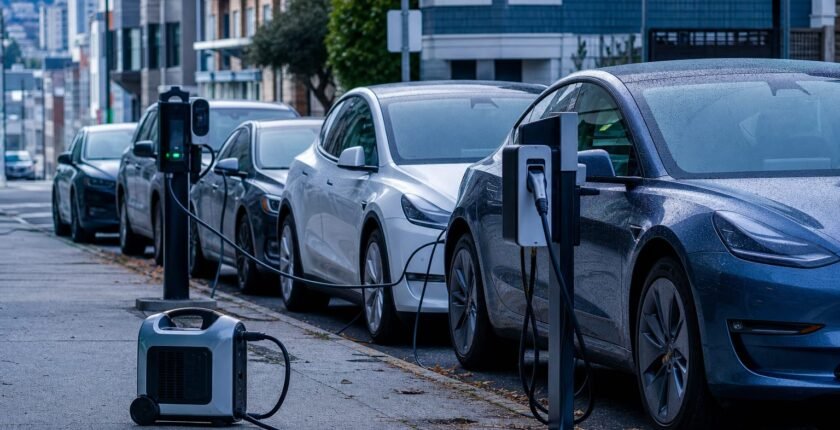
San Francisco opened its first curbside EV chargers in April 2025 and today has two public curb chargers while pledging to reach 100 chargers by 2030. The city centralized permitting under the San Francisco Municipal Transportation Agency but left many approvals, from fire to utilities, in separate agencies and set no internal deadlines for reviews. This account, as first reported by San Francisco Public Press, draws on city rules, a feasibility study and interviews with local officials and charging vendors to explain why other U.S. cities have moved faster and what policy choices could close the gap.
We’ve really let the perfect become the enemy of the good, I think,
Shannon Dulaney, who directs public affairs for It’s Electric
Key takeaways
- Current supply: San Francisco has two public curb chargers and has set a goal of 100 curb chargers by 2030.
- State need: The California Energy Commission says the state needs 1.01 million public and shared chargers by 2030, up from 216,445 it counted last month.
- Peer progress: Los Angeles has mounted 936 chargers on lampposts using its Bureau of Street Lighting and existing street conduit and wiring.
- Big-city pilots: New York plans to boost its curbside network from 88 chargers to almost 700 across the five boroughs over the next three years.
Table of contents
Why San Francisco’s rollout has been slow
San Francisco consolidated application intake with the San Francisco Municipal Transportation Agency, but the approval pathway still requires sign-offs from roughly half a dozen departments, and the new rules reserve broad discretion for the director of transportation. That web of permissions makes an installation need sequential approvals from fire, police, public works, the Department of Building Inspection, the Public Utilities Commission or Pacific Gas & Electric, and sometimes the port authority or Recreation and Park Department.
The city’s published siting checklist is detailed about what vendors must submit, yet the documents set no binding review times for city staff. At a City Hall briefing staff warned that the earliest full approvals were unlikely until spring or summer of 2027. This mix — a strict vendor checklist paired with undefined internal timelines and discretionary vetoes — has discouraged companies that must schedule crews, pay utility engineering fees and wait on multiple departments.
How other cities removed bottlenecks
Cities that moved faster typically paired clear authority with municipal ownership of the supporting infrastructure. Los Angeles used its Bureau of Street Lighting, which owns poles and power lines, to mount 936 chargers on lampposts and tapped roughly 9,000 miles of conduit and 27,000 miles of copper wire beneath streets. That ownership let Los Angeles exempt some public chargers from routine right-of-way permits and let transportation staff designate stalls without a council vote.
New York, meanwhile, is expanding its pilot from 88 chargers to nearly 700 within three years and will set pricing and siting centrally in partnership with Consolidated Edison. Cities in Europe commonly use lampposts and curbside plugs as ordinary street infrastructure; London, for example, has more than 20,000 slow or low-power public points along streets and curbs.
State policy, funding fights and technical hurdles
California has tools it could use but legislators narrowed or shelved proposals that would have forced faster permitting on the curb. Assemblymember Kevin McCarty proposed measures that would have created by-right approvals and statewide siting maps; those provisions were pared back or dropped amid cost and local-control objections. The result: the state set no mandatory deadlines for curb approvals and provided no dedicated curbside funding.
Federal and state financing have also been unstable. A 2021 federal law allocated $7.5 billion for a national charging network; most of the $5 billion earmarked for states was frozen, a court later ordered California’s $379 million share released, and Congress redirected $500 million of the national pool to other priorities. At the state level, the California Energy Commission plans to commit $95 million to a range of charging programs and awarded It's Electric a $1.1 million innovation grant to develop a street-side charger designed to send electricity back into the grid.
What renters and vendors face on the ground
The shortage most affects renters: the Energy Commission’s survey says only about one in six apartment dwellers can currently charge at home. Vendors report strong demand; It’s Electric’s co-founder Tiya Gordon said the two pilot posts were in use about 70% of the time and 325 drivers remain on the pilot’s wait list, demonstrating latent local need.
For companies, the combination of costs and compressed timelines raises the stakes. PG&E requires a $3,500 engineering assessment for each project, and those documents expire after 90 days. Permit records indicate lengthy delays for utility clearances and repeated reviews by multiple city departments. When cities offer no subsidies and retain final siting authority, proposals tend to cluster in higher-EV neighborhoods, creating potential gaps where charging access is most needed.
| City | Model | Key lever | Curb chargers (reported) |
|---|---|---|---|
| San Francisco | Vendor-led pilot with SFMTA as single entry | Interagency approvals; no internal review deadlines | 2 (pilot posts); goal of 100 by 2030 |
| Los Angeles | Municipal poles and power managed by Bureau of Street Lighting | City-owned infrastructure; permit exemptions | 936 mounted on lampposts |
| New York | Centralized planning with utility partnership | DOT sets pricing and locations | 88 (pilot) expanding to nearly 700 within three years |
How the program could speed up — and what might hold it back
The case for
- Using existing streetlight conduit and municipal ownership can cut installation time, as Los Angeles shows with 936 lamppost chargers and reuse of 9,000 miles of conduit.
- State-level guidance and modest grants — the Energy Commission’s planned $95 million and existing innovation awards — can underwrite pilot expansion and technical research, for example bi-directional curb chargers.
The case against
- Local veto points and a requirement for broad neighborhood support mean projects can stall; the city’s map excludes many dense, rental-heavy blocks, creating a mismatch between needs and allowed sites.
- Unstable federal funding and the repurposing of $500 million from the national program make large-scale, coordinated deployment harder and push the burden onto cash-strapped cities and private vendors.
What to be careful about
- Equity gap: siting rules and the green/yellow/red tool concentrate feasible curb space in lower-density neighborhoods, leaving high-apartment neighborhoods undersupplied.
- Revenue and political risk: using metered commercial curb space for chargers can encounter resistance because the transportation agency collects about $52 million a year from metered spots.
- Utility friction: interconnection steps and fees (PG&E’s $3,500 engineering assessment and 90-day paperwork window) can delay projects and raise vendor costs.
- Community opposition: the rules require extensive neighborhood outreach with no set threshold or deadline, allowing opposition to indefinitely hold up applications.
The bottom line
San Francisco’s curbside program demonstrates how design choices matter: strict vendor requirements plus undefined city review timelines and multiple veto points have produced two public curb posts today and a cautious goal of 100 by 2030. Other cities paired municipal ownership or explicit authority with clear timelines and moved more quickly, while state and federal funding shortfalls have left cities to rely on vendor-led builds. If San Francisco wants an equitable network for renters it must decide which trade-offs to make — limit discretionary review, allocate subsidy or preapprove curb locations — and match those choices with staff and utility commitments.
What to watch
- Watch for the Governor’s Office of Business and Economic Development to publish its updated permitting guidebook in fall 2026.
- Watch for cities of 250,000 or more to publish lists of complete curbside charging application requirements by the start of 2027.
Frequently asked questions
How many curbside chargers does San Francisco have now?
San Francisco has two public curb chargers installed from a pilot that opened in April 2025 and has set a target of 100 curb chargers by 2030.
Why can’t vendors just install chargers where they want?
Vendors must clear a chain of city approvals — fire, police, public works, building inspection, utility sign-off and sometimes port or park authorities — and the city reserves discretionary veto power, which can delay or block sites.
Do other big cities face the same problems?
Some do, but cities that own poles and street power have moved faster: Los Angeles has mounted 936 lamppost chargers and New York plans to grow from 88 to nearly 700 within three years by centralizing siting and partnering with the utility.
Related reading