
Blog
Data Centres Are Reshaping Power Sourcing with BESS
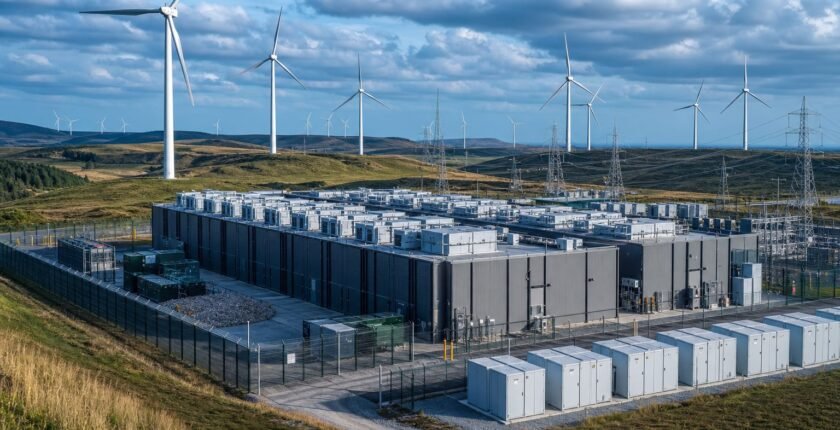
Estimated reading time: 5 minutes · Last updated: 2026-08-19
Cummins has been selected to deliver a 5MWh lithium iron phosphate (LFP) battery energy storage system (BESS) for a forthcoming US data centre, a deployment the company says is its largest BESS project to date. The system is engineered to absorb AI-driven load swings, charge and discharge rapidly to protect the utility interconnection point and meet utility load-management criteria. The move highlights how data centre BESS is reshaping power sourcing: operators are no longer buying only energy, they are buying capacity to stabilise, optimise and bridge grid connections. This report draws on company specifications and executive comments, as first reported by Procurement Magazine.
“This project is an important achievement for Cummins and reflects the confidence customers place in our ability to deliver innovative energy solutions at scale. ”
Jenny Bush, President of Cummins’ Power Systems Business
Key takeaways
- Project scope: Cummins will supply a 5MWh nominal-capacity LFP battery energy storage system to a US data centre, described by the company as its largest BESS deployment to date.
- Why it matters: Cummins says the system is designed to manage AI-driven load fluctuations, mitigate load oscillations and support ride-through performance at the grid interconnection point.
- Market context: A 2024 Barclays Research report projects US data centre annual energy demand could expand by 14% to 21% each year through 2030.
- Standards and integration: Cummins lists compliance with UL 9540A, UL 9540, UL 1973, NFPA 855, NFPA 68, IEEE 1547 and UL 1741 SA/SB and says the system is bridge-to-grid ready with generator integration.
Table of contents
Why AI workloads change how operators buy power
AI-driven compute shifts data-centre demand from a steady baseline to sharp, unpredictable spikes. Those spikes raise both instantaneous power draw and the risk of rapid oscillations that can trip protection or breach utility contracts. The result is that procuring an energy commodity alone is no longer sufficient: operators must secure short-duration capacity, power quality controls and fast response at the interconnection point.
Grid-side responses historically used diesel or gas generators and demand-response programmes. Data-centre operators now add battery systems to smooth peaks, reduce reliance on fuelled gensets and avoid costly utility penalties tied to peak demand. The Barclays Research projection that US data-centre energy demand could grow 14%–21% annually through 2030 frames why operators prioritise on-site flexibility.
This change in procurement — buying storage and control capability as well as kWh — is what the industry means when it says data centre BESS is reshaping power sourcing. The pattern shifts capital from long-run supply contracts toward on-site systems that deliver rapid, repeatable power modulation.
What Cummins is delivering: the 5MWh LFP system and integration
Cummins describes the deployment as a nominal 5MWh system built on lithium iron phosphate (LFP) cells with liquid thermal management. The company highlights a DC block architecture intended for compatibility with a range of power conversion systems (PCS) and energy management systems (EMS), and says the design supports rapid charge/discharge cycles to stabilise the utility interconnection point.
The vendor lists generator integration as a core capability, calling the product bridge-to-grid ready and noting integration with both natural gas and diesel generators. It also cites certification to UL 9540A, UL 9540 and UL 1973 plus compliance with NFPA 855, NFPA 68, IEEE 1547 and UL 1741 SA/SB, signalling the system is engineered to meet common US interconnection and safety standards.
Those specifications matter because hyperscale and AI campus workloads demand both power quality and operational continuity. In practice the BESS will be used to mitigate demand spikes, control ramp rates and provide ride-through performance; Cummins frames these features as the reasons operators can optimise existing grid capacity rather than immediately upgrading transmission or investing in larger utility contracts.
Grid, operations and procurement implications for operators
For operators, on-site BESS shifts procurement decisions toward modular capacity, integration and standards compliance. A 5MWh LFP unit is a discrete asset that can be sized against expected AI load shapes; the system's fast response can reduce peak demand charges and defer some grid reinforcement costs, provided the utility interconnection and tariff structures allow it.
For utilities and planners, a proliferation of BESS behind the meter requires clearer interconnection studies and operational rules. Cummins emphasises compliance with IEEE 1547 and UL 1741 series standards, which are central to inverter behaviour at the point of interconnection, but actual grid impact depends on site-specific studies and the cumulative number of fast-response loads on a feeder.
Procurement teams will therefore weigh three mechanical drivers: the storage system's verified charge/discharge rates and duration, the interconnection study outcome from the local utility, and whether generator integration reduces reliance on fuel-based backup. These technical details, rather than marketing claims alone, will determine whether a BESS deployment lowers total cost of ownership or merely shifts costs between capital and operational budgets.
What could move this either way
The case for
- Faster site-level response: BESS can smooth AI-related spikes and reduce peak charges if dispatch and tariff rules allow.
- Operational resilience: integrated BESS plus generator control can improve ride-through performance during short disturbances, reducing compute interruptions.
- Grid deferral potential: widespread BESS adoption could defer some distribution upgrades when storage is deployed strategically on constrained feeders.
The case against
- Interconnection limits: utilities may impose export or ramp-rate constraints that reduce the value BESS delivers at the point of common coupling.
- Standards and testing friction: achieving full compliance and passing UL 9540A thermal-runaway testing can delay commissioning and add cost.
- Value erosion under tariffs: if rate structures or demand-charge formulas change, the economic case for on-site BESS may weaken.
What to be careful about
- The system’s practical benefit depends on utility interconnection study results and any imposed operational limits at the point of common coupling.
- Thermal management and UL 9540A testing outcomes could reveal additional mitigation requirements that increase implementation cost or extend lead times.
- Generator integration increases system complexity; improper coordination between BESS and gensets can reduce reliability unless controls are carefully engineered.
- The stated claim that the project is Cummins’ largest BESS deployment to date requires external verification against the company’s previous projects.
The bottom line
Cummins’ announced 5MWh LFP deployment illustrates a wider procurement shift: data-centre operators now buy fast-response capacity and integration capability as much as they buy kilowatt-hours. That shift is driven by AI workloads and by tariff and interconnection realities that make short-duration flexibility commercially valuable. The technical checklist—charge/discharge rates, thermal systems, standards compliance and generator integration—will decide whether a BESS delivers cost and resilience gains for a specific site. Confirming commissioning dates, the system’s megawatt ratings and local interconnection constraints will be essential next steps for operators considering the same path.
What to watch
- Watch for Cummins to publish a commissioning date or project timeline for the US data-centre BESS; no public date has been set.
- Watch for the local utility’s interconnection study or any grid-impact filings related to this project; none have been published in the statement.
Frequently asked questions
Why are data centres adding on-site batteries instead of only buying more grid power?
Data centres face rapid AI-driven spikes that can breach peak-demand limits and trigger penalties; a 5MWh on-site BESS can absorb short-duration peaks and stabilise the interconnection point, reducing the need for immediate grid upgrades.
What does 5MWh nominal capacity mean for operations?
A 5MWh nominal-capacity battery stores five megawatt-hours of energy; its operational value depends on the system’s nominal and peak megawatt discharge rate, which determines how long it can sustain a given load.
Which standards must a data-centre BESS meet in the US?
Cummins lists compliance with UL 9540A, UL 9540 and UL 1973 plus NFPA 855, NFPA 68, IEEE 1547 and UL 1741 SA/SB—standards that cover safety testing, thermal-runaway assessment and inverter behaviour at interconnection.
How big a problem is future energy demand for data centres?
A 2024 Barclays Research report projects US data-centre annual energy demand could expand by 14% to 21% each year through 2030, which increases pressure on both grid capacity and site-level power management.
Related reading