
Blog
States with the Most EV Chargers in Q2 2026
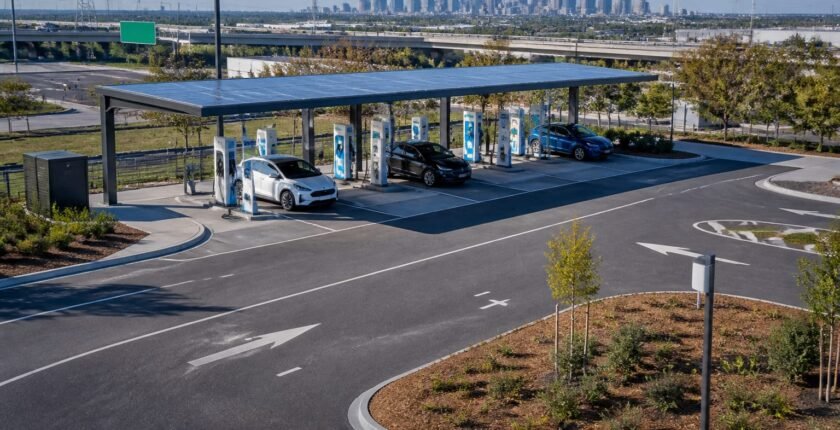
Estimated reading time: 6 minutes · Last updated:
Public EV chargers continued to grow in the U.S. in the second quarter of 2026, led by California, New York and Florida, according to data released 23 September 2026 by the Alliance for Automotive Innovation. The Alliance's quarterly Get Connected report shows public Level 2 ports rose 3.2% over Q1 2026, DC fast ports increased 9% since the end of 2025, and total public ports were up 6% from year-end 2025. EVs made up 7.9% of U.S. auto sales in Q2 2026, a 1.6 percentage-point gain from Q1 2026, a measure that helps explain why charging installations are accelerating.
Public charging infrastructure continued to expand during the first half of 2026,
Alliance for Automotive Innovation
Key takeaways
- Top states by chargers: California had 10,278 unique public charging locations in Q2 2026, followed by New York with 4,151 and Florida with 3,338.
- Charger-type growth: Level 2 public ports increased 3.2% over Q1 2026 and DC fast ports rose 9% since the end of 2025, bringing DC fast chargers to 29% of public ports in Q2 2026.
- Driver concerns: A January 2026 poll of 600 potential buyers by EVs for All America found 20% named unreliable charger networks as their top concern.
- Federal funding status: The 2021 infrastructure law included $5 billion for state charging programs and $2.5 billion for competitive grants; NEVI grant actions were suspended in February 2025 and restarted in August 2025 after a June 2025 court ruling.
Table of contents
- Key takeaways
- How U.S. charging counts moved in Q2 2026
- Which states lead — and how big the gaps are
- Driver sentiment: range anxiety and network reliability
- Federal funding and policy shifts shaping charger deployment
- How the next 12–24 months could play out
- What to be careful about
- Frequently asked questions
How U.S. charging counts moved in Q2 2026
The Alliance for Automotive Innovation published quarterly data on September 23 showing growth across the public charging network in Q2 2026. Its Get Connected report recorded a 3.2% increase in public Level 2 ports from Q1 2026 and a 9% increase in DC fast ports since the end of 2025; overall public charging ports rose 6% compared with the end of 2025.
Those shifts have tilted the public network toward faster charging: DC fast ports made up 29 percent of public ports in Q2 2026, up from 22 percent in 2021, the Alliance reported. The growing share of higher‑power stations shortens public charging sessions for drivers who rely on fast chargers, while the Level 2 base still supports longer, parked charging at workplaces and commercial locations.
EV market share helps explain the demand: in Q2 2026 electric vehicle sales accounted for 7.9% of U.S. auto purchases, up 1.6 percentage points from Q1 2026, according to the same dataset from the Alliance for Automotive Innovation.
Which states lead — and how big the gaps are
An analysis of the Alliance data lists the ten states with the most unique public charging locations in Q2 2026. California led with 10,278 locations; New York had 4,151 and Florida 3,338. The next seven were Texas (2,856), Massachusetts (2,420), Colorado (1,925), Washington (1,869), Georgia (1,615), Michigan (1,525) and North Carolina (1,484).
That ranking shows a steep concentration: California alone holds more than twice the chargers of the next three states combined. For drivers and planners, the absolute counts matter because they reflect both urban density and state-level deployment priorities, while statewide totals can mask rural gaps within each state.
State counts are a practical measure of access in Q2 2026 but say little about charger condition, uptime or port-level power. The Alliance's figures track unique public charging locations rather than total ports per site; cities and highway corridors can still be underserved even where state totals are high.
Driver sentiment: range anxiety and network reliability
Range anxiety remains part of consumer calculus. A January 2026 poll by EVs for All America of 600 respondents aimed at potential buyers found 20% said unreliable charger networks were their top concern. The poll also reported that 65% of respondents preferred charging at home over a seven- to eight-hour period for a full charge, while 29% preferred a 30-minute public charge to reach roughly 80% battery capacity.
Those preferences underline why Level 2 growth matters for overnight and workplace charging, while the faster DC chargers — now 29% of public ports — serve trip‑time charging needs. But the poll's figures show many potential buyers still prioritize predictable, at-home charging over public fast charging, even as fast ports become a larger share of the network.
For automakers and charging operators, addressing perceived reliability — uptime, payment interoperability and clear signage — will be as important as adding new ports. The Alliance and industry stakeholders now point to both hardware rollout and user experience as determinants of whether sales gains persist.
Federal funding and policy shifts shaping charger deployment
The 2021 bipartisan infrastructure law allocated $5 billion for states to expand charging infrastructure and set aside $2.5 billion for competitive grants aimed at alternative fuel corridors and disadvantaged areas. Those funding lines were set to wind down in 2026 and became a focal point of federal policy disputes.
In February 2025 the Federal Highway Administration suspended the NEVI charger program as part of a broader rollback; a federal court in June 2025 blocked that suspension, finding the Transportation Department had overstepped its authority. The DOT restarted the charger grant program in August 2025 with new provisions addressing diversity and labor concerns. Separately, the $7,500 EV tax credit was eliminated in September 2025, a change that USA TODAY linked to a sharp decline in U.S. EV sales after that date.
These federal moves matter because NEVI and the competitive grants are primary levers for building out corridors and equity-focused installations. Political shifts and litigation have already reshaped timing and contractor requirements, so state and local planners are adjusting schedules and procurement to match the restarted grant framework.
| Rank | State | Unique public charging locations |
|---|---|---|
| 1 | California | 10,278 |
| 2 | New York | 4,151 |
| 3 | Florida | 3,338 |
| 4 | Texas | 2,856 |
| 5 | Massachusetts | 2,420 |
| 6 | Colorado | 1,925 |
| 7 | Washington | 1,869 |
| 8 | Georgia | 1,615 |
| 9 | Michigan | 1,525 |
| 10 | North Carolina | 1,484 |
How the next 12–24 months could play out
The case for
- Faster public charging continued to expand: DC fast ports rose 9% since the end of 2025, improving long‑distance usability and reducing a key barrier for some buyers.
- Restarted NEVI and competitive grant activity after the June 2025 court ruling and the DOT's August 2025 changes should unlock federal dollars for corridors and equity projects, sustaining installations where state programs are ready.
The case against
- Federal policy volatility — suspension in February 2025 and legal wrangling through June 2025 — raises timing and contractor‑selection uncertainty for projects that depend on NEVI or competitive grants.
- Persistent driver concerns about charger reliability (20% in the January 2026 poll) could slow adoption even as raw charger counts increase, if uptime and user experience do not improve.
What to be careful about
- State totals mask local gaps: high statewide charger counts do not guarantee access in rural or low‑income neighborhoods.
- Political and legal shifts around NEVI and federal grants can delay projects that rely on those funds.
- Poll responses show reliability concerns that adding ports alone may not fix without investments in maintenance, interoperability and uptime reporting.
The bottom line
The Alliance for Automotive Innovation’s Q2 2026 figures show measurable expansion of public EV charging, led by California and with a faster share of DC fast ports. Those hardware gains coincide with a modest rise in EV market share—7.9% of U.S. auto sales in Q2 2026—and with continued consumer worries about reliability. Federal funding lines from the 2021 infrastructure law and the restarted NEVI program remain decisive for where and how quickly chargers appear, but political and legal turns have already affected rollout timing. For drivers, the immediate picture is more chargers overall, but access, uptime and local distribution will determine how much that growth eases range anxiety.
What to watch
- Watch for the Alliance for Automotive Innovation’s next Get Connected quarterly release; no date has been set.
- Watch for further Federal Highway Administration or DOT guidance on NEVI grant implementation and any new competitive grant timelines; no date has been set.
Frequently asked questions
Which state had the most public EV charging locations in Q2 2026?
California led with 10,278 unique public charging locations in Q2 2026, followed by New York with 4,151 and Florida with 3,338, per the Alliance for Automotive Innovation data.
Are fast chargers becoming a larger share of the network?
Yes. DC fast charging ports rose 9% since the end of 2025 and accounted for 29% of public charging ports in Q2 2026, up from 22% in 2021, according to the Alliance's Get Connected report.
How much federal funding was set aside for charging under the 2021 law?
The 2021 bipartisan infrastructure law included $5 billion for state charging programs and $2.5 billion for competitive grants targeted to corridors and underserved areas.
Related reading